Antiques: Americana sales story is mixed
Every January, Americana Week in New York gauges the market for American antique furniture and decorative arts. Major auctions are a key measurement, featuring in some recent "champagne" years thick catalogs and seven-figure estimates.
Every January, Americana Week in New York gauges the market for American antique furniture and decorative arts. Major auctions are a key measurement, featuring in some recent "champagne" years thick catalogs and seven-figure estimates.
Even as financial crises began playing out nationwide, bubbles were still in the air in September, when a petite Philadelphia Queen Anne stool, circa 1750, soared past its estimate to bring more than $5.2 million at Sotheby's. Quite a price for four pretty legs.
But last week's round of Americana sales was the first chance to assess changes in the market since the financial downturn - to ascertain, using Philadelphia formal and Pennsylvania folk as standards, which pieces held their value and what opportunities presented themselves for prudent collectors to purchase great antiques at reasonable prices.
(Local collectors will have between now and the April shows and sales in Philadelphia to judge for themselves.)
Both Sotheby's and Christie's held strategy sessions while urging consignors to consider the economic context. Catalogs this January were thinner and estimates broader, although some reserves - the lowest prices at which merchandise could be sold - were negotiated last year, when things seemed rosier.
John Hays, deputy chairman and department head at Christie's, says he's trying to be practical.
"I grew up in a sailing family," Hays says. "My dad used to tell me, 'In heavy breezes, anybody can sail. Light air conditions separate great sailors from average sailors. You have to be able to pull the sheets just so to make it move.'
"The analogy has lots of ramifications here, because when we went into the sale, our strategy was quality - and to try our very best to get consignors to be realistic."
Although 68 percent of Christie's lots sold, Hays is disappointed that the front-cover masterpiece did not - the Quincy family Boston bombe chest failed to reach its $2 million to $4 million estimate.
"There was bidding in the room, but it just didn't go up high enough," Hays says. He has hopes for a post-auction negotiated sale, never the ideal situation but always an option.
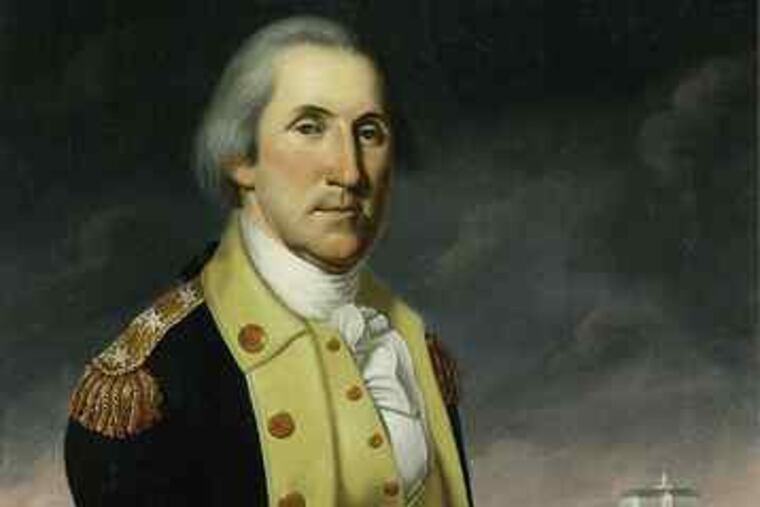
On the other hand, he is delighted that the Founding Fathers came through for the auction house. The back cover portrait, George Washington at Princeton, painted during the president's lifetime by Charles Peale Polk, brought $662,500 - three times what it sold for in 1999 at the height of the dot.com boom, Hays says.
"George Washington is blue-chip. If you have a work painted in his lifetime by an important artist - and it's reasonably estimated - you're going to do well," he says. "It was unbelievable timing with the inauguration."
Other sales supported the power of patriotism. A panoramic 1854 painting, Washington at Valley Forge by T.H. Matteson, sold for $314,500, an auction record for the artist. A Chippendale walnut armchair, made to conceal a commode, brought $40,000 because it was owned by Benjamin Franklin.
Though selective buyers passed on a number of 18th- century Philadelphia case pieces and most of the Shaker furniture Christie's offered, there were some strong prices for Pennsylvania objects: $50,000 for a collection of 125 silhouettes from the Wistar and Pennock families; $20,000 for a Windsor comb-back armchair; $35,000 for a hanging box with folk-art paint.
Over at Sotheby's, senior vice president Leslie Keno realized a higher total, more than $7.7 million, but also saw many lots go unsold, in spite of large crowds on the floor.
"We had double, triple rows of standing people all the way back to the entrance," he says.
The lone seven-figure price of the January sales was for Sotheby's cover item, a Massachusetts bombe chest-on-chest that brought $1.7 million.
The firm also had a separate catalog for the collection of Dr. and Mrs. Henry C. Landon 3d, which included a rococo walnut high chest of drawers from Philadelphia, circa 1755-60, that brought $482,500.
Immediately afterward, Keno said, "The success of the Landon sale, which was 95 percent sold by lot, is a wonderful tribute to Hank and Barbara's eye for collecting. . . ."
"We saw bidders who used to be buying at lower levels really step up their buying. I don't have all the answers, but I will say some buyers see this as an opportunity," Keno said, adding that the firm is making efforts to encourage people who once felt priced out of the Americana market.
Sotheby's offered a number of Philadelphia tall case clocks from which bidders could pick and choose. The best was a highly carved cherrywood example with works by Christian Eby of Manheim, sold for $146,500, just below the low estimate.
Another formal Philadelphia case from about 1770 went for $25,000, and a more rustic Doylestown clock, dated 1837, brought only $6,250.
Everyone knows there are stock-market bargains for savvy investors with cash to buy now. For those willing to step up in antiques, lots of magical categories have suddenly become affordable, with bargains in furniture, weathervanes, folk-art paintings, and figural carvings. You can view complete catalogs and auction results online at www.christies.com and www.sothebys.com.
A lovely cigar store Indian princess by Samuel Robb, circa 1880, brought $53,125 at Sotheby's; at Christie's, an Indian chief tobacconist's figure, more than 6 feet tall, sold for $17,500. A great applique-and-trapunto 19th-century "Floral Urns" quilt sold for $5,625 at Sotheby's, with a pair of patriotic quilts thrown in.
"In times of financial problems, tangibles become more desirable as a part of diversification," Keno says. "I never recommend buying antiques for investment, but I will say someone can own a great piece of 18th-century furniture for a certain price and enjoy it for its beauty. You can wake up every morning and then have it hold its value over the years - and that's not always true of a mutual fund."