Antiques: Brandywine River Museum offers a plethora of pewter
For 38 years, the Brandywine River Museum in Chadds Ford has provided decorative-arts collectors with a double treat in May. A loan exhibition focused on a single specialty - American pewter is the star this year - opens with a weekend antiques show that offers tempting additions for personal collections.
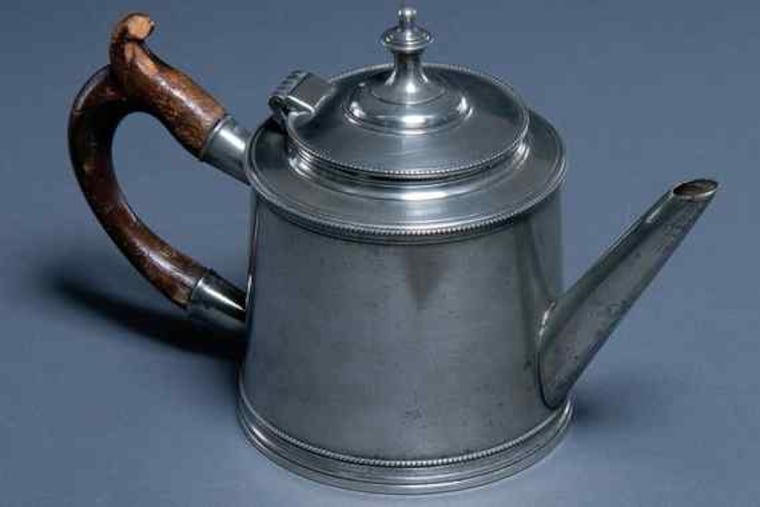
For 38 years, the Brandywine River Museum in Chadds Ford has provided decorative-arts collectors with a double treat in May. A loan exhibition focused on a single specialty - American pewter is the star this year - opens with a weekend antiques show that offers tempting additions for personal collections.
The Brandywine River Museum Antiques Show opens tonight with a benefit preview and reception from 6 to 9; tickets ($125, $100 for young collectors) are available at the door. Take a first look at the displays of 31 exhibitors while enjoying cocktails, hors d'oeuvres, and jazz.
The show is open to the public tomorrow, Sunday, and Monday, from 10 a.m. to 5 p.m.; admission is $12. Dealers set up on three floors of the museum and in the courtyard outside. Eight exhibitors will offer half-hour booth talks on subjects ranging from Windsor chairs to folk art - check the museum Web site for schedule.
Visitors also will be the first to view the new exhibition, "Everyman's Metal: 17th-, 18th-, and 19th-Century Pewter in America," which runs through July 19. Pewter was a durable and less expensive substitute for silver in previous centuries. Today, we might use stainless steel or plastics, but in the past, pewter was shaped into items ranging from home tableware to church plates to bar mugs.
Brandywine curator Lee Wierenga worked directly with a major collectors' group to put the exhibition together. Wierenga said this year is the 75th anniversary of the Pewter Collectors' Club of America.
"Every year, we try to do something different for our decorative-arts show," Wierenga said. "We'd never featured pewter, so we decided that we could work with them."
Club members from around the country have loaned objects from their personal collections - dishes, ink wells, tankards, and lamps - for display in the galleries. On June 5 and 6, the Pewter Collectors' Club of America will hold its 2009 national meeting near the museum at the Concordville Inn. The group's Web site, pewtercollectorsclub.org, has informative articles, meeting information, and opportunities to network with fellow enthusiasts.
The catalog for the Antiques Show has an excellent essay by Wierenga on pewter composition and forms. There, she points out that the "best pewter, referred to as hard metal, was an alloy that contained approximately 90 to 95 percent tin tempered by adding small amounts of other elements, such as copper, antimony, or bismuth."
"The resulting alloy - which contained little or no lead - was used to make the finest wares, including tea-pots, coffee services, and table settings. Workmanship was superb and, when highly polished, pewter resembled silver."
One great advantage of pewter - before the invention of those plastics mentioned above - was its durability. Unlike glass and china, pewter would not shatter if dropped on a hard stone floor.
Lower grades of pewter contained a percentage of lead that made the metal cheaper, softer, and easier to work. The less-expensive pewter alloys could be used for common objects - mugs, toys, wine measures, and buttons. Although lead is shunned for daily use around humans now, it was a common ingredient in alloys and glazes during past centuries.
Before the colonies achieved independence, the raw materials used to make pewter were hard to obtain. The British had a strong guild system for craftsmen and carefully guarded their monopolies on manufactured goods.
"We also show some English export pewter because, before the American Revolution, it was illegal to send the materials for pewter to the colonies," Wierenga said in a recent interview. "So American pewter was made by recycling English export pewter.
"Makers here used a lot of the same stylistic features in their pewter that they observed in the imports from England - shapes of bodies and handles. We have a work by Samuel Ellis - a tulip-shaped mug with an acanthus-leaf handle - and that form was also made by William Will in Philadelphia."
The curator also pointed out other pieces in the exhibition, including a beautiful Philadelphia teapot by Will and a Johann Christoph Heyne flagon from Lancaster.
Collectors have a variety of pewter tableware forms to choose from - stately coffee pots and teapots, handled mugs, tankards with lids, and different sizes of plates and basins. Churches often had high-quality pewter collection plates and chalices. The metal also was useful for early lighting, both candlesticks and oil lamps.
Collectors received an update on current antique pewter market prices in April when Freeman's Auctions in Philadelphia began to sell the large collection of Stanley and Rose Rich. Many wonderful pieces could be had for $500 or less.
However, certain masterpieces inspired bidding wars that sent prices into the six-figure range. The top pewter lot was a dated 1728 sweetmeat dish with floral decoration and scalloped rim, attributed to maker Francis Bassett I of New York City - final price $85,000.
A tulip-shaped tankard with lid by Will (active 1764-1798) reached $25,000, a pair of church chalices by Peter Young of New York (1772-1800) brought $12,188, and an early-19th-century barrel-form pint mug by Robert Palethorp Jr. of Philadelphia sold for $13,750.
Complete results are available online at www.freemansauction.com. More pewter from the Rich collection will be offered by Freeman's in November.
Antiques: If You Go
The 38th annual Brandywine River Museum Antiques Show, May 23-25. Admission $12 (includes museum galleries and exhibition). "Everyman's Metal: 17th-, 18th-, and 19th-Century Pewter in America," on display at the Brandywine River Museum May 23-July 19. Museum open daily, 9:30 a.m.-4:30 p.m. Information: www. brandywinemuseum.org or 610-388-2700.
EndText