Kevin Riordan: Determined to save icon of local history
Haddonfield citizens rally for 1799 Boxwood Hall.
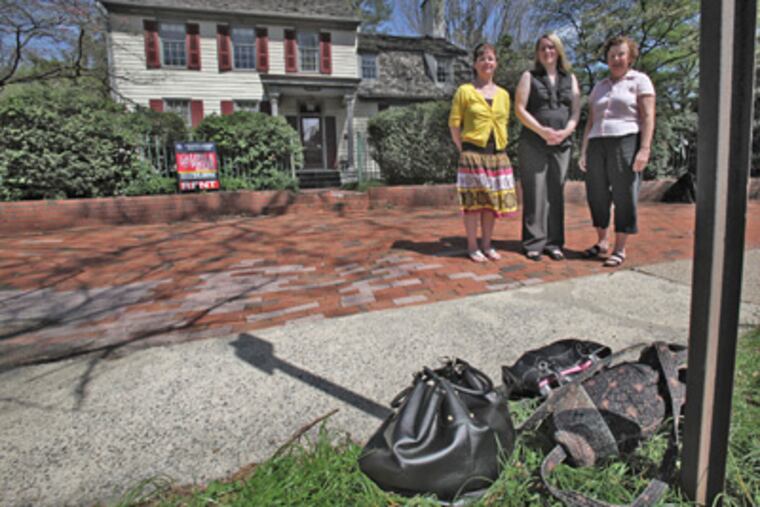
A renowned ornithologist is helping rally support to preserve a historic house and garden in the heart of Haddonfield.
So what if Samuel Nicholson Rhoads, whose bird specimens still draw researchers to the Academy of Natural Sciences in Philadelphia, died in 1952?
After all, the history of Boxwood Hall, the Haddon Avenue property where Rhoads' relatives lived and where he did research, could determine its future.
"He was an amazing man," Kim Custer says, noting that Rhoads also cofounded the Haddonfield Historical Society and helped protect Hopkins Pond from development.
I'm chatting with Custer and four other supporters of Preservation Haddonfield, a grassroots group seeking to stop construction of senior apartments adjacent to Boxwood Hall. That handsome house at 65 Haddon Ave., used for professional offices in recent decades, is across from the borough library, where we've gathered.
The development proposal "would establish a dangerous precedent, and we have to draw the line somewhere," says Dave Gottardi, chairman of the Haddonfield Historic Preservation Commission. "We have to protect our historic district and green spaces. Whatever we have left, we need to protect."
The 211-year-old house is among the most intact and significant residential structures in the historic district, which encompasses the borough's core.
"What's at stake," Maureen Sapnar says, "is Haddonfield."
This talk about preserving the borough's character takes me back - as if via Hot Tub Time Machine (without water or John Cusack). Suddenly I'm in Haddonfield in the 1980s and '90s, when preservation diva Joan L. Aiken reigned and spats raged over a hot dog vendor and a violet house on Kings Highway.
Back to 2010: There's much more at stake with Boxwood Hall, and the fight's just getting started. The owner, Health Resources of New Jersey L.L.C., plans to appeal last month's unanimous thumbs-down from the borough zoning board.
"Boxwood Hall is a historic building. No one denies that," says Richard Hluchan, attorney for Health Resources. The house would be incorporated into a 35-unit assisted-living complex and preserved, as would a "dense buffer of trees," he notes.
"The bottom line is, things change," says Hluchan, a Haddonfield resident. "Are we going to preserve everything because dinosaurs used to graze here? Give me a break."
The man has a point. Worth noting as well is the real market for this sort of complex, particularly in a walkable, transit-rich town center like Haddonfield.
"We all agree we need housing of this type," says Kathy Tassini, the librarian of the Haddonfield Historical Society. "We'd like to have more people who need and want to live here, and have been priced out, be able to be here. But this is just the absolute wrong property.
"It was built by John Estaugh Hopkins, the grandnephew of Elizabeth Estaugh Haddon, the founder of the town. He built this house in 1799 for himself, his wife, and their two daughters. He died in 1806 . . . and the house passed through female relatives until 1965."
Privately owned since then, Boxwood Hall and its 1.5-acre grounds have been incorporated into, or cited as significant by, the borough's historic district, its master plan, and its downtown development and green-space programs.
This vision wasn't decreed by an elite panel of experts, or by some blue-haired clique of snobs infatuated with ye olde quaintness. It was developed by residents who have worked hard for decades so that their community will remain the special and, yes, beautiful place it has been for nearly 300 years.
Preservation Haddonfield acknowledges that the borough "has to evolve, and has evolved," Tassini says. "Every quarter-inch is not sacred by any means, but [the developer] has certainly picked the acre and a half that is sacred."
Which brings us back to Rhoads. The 4,500 specimens he collected worldwide "helped to establish the [Academy of Natural Sciences] as the preeminent institution of South American bird research," ornithology collection manager Nate Price wrote recently to Preservation Haddonfield.
More than 200 of those 4,500 birds were collected between 1875 and 1925 on what had been the 15-acre Boxwood Hall property, Price wrote, adding, "I certainly hope this spectacular old collecting locality can be preserved for posterity."
I hope so, too - and if a long-dead ornithologist, historian, and preservationist helps the cause, all the better.
As Sapnar says, Rhoads is an inspiration for "the kind of citizens we should be."