Michael Smerconish: Led Zeppelin communication breakdown
It was just a simple question about touring. The response shattered visions of old idols.
David Petraeus, Lance Armstrong, Led Zeppelin: All my heroes are falling.
The first two have gotten enough attention, so let me tell you a story about the third.
Led Zeppelin will be recognized with a lifetime achievement award from the Kennedy Center for the Performing Arts next weekend, which comes on the heels of the band's new concert movie, Celebration Day. The film was recorded in 2007, when the band reunited for its first headline show, a tribute to Atlantic Records founder Ahmet Ertegun. Eighteen thousand lucky fans saw the performance at London's O2 Arena; 20 million other requests for tickets were denied.
Zeppelin was one of those bands whose liner notes I studied in my suburban bedroom in the '70s. But I never got to see them perform before their career was cut short by the death of drummer John Bonham in 1980. That's why I was elated when they reunited five years ago, with Bonham's son Jason playing in his stead, amid talk that a tour would ensue. But the tour never happened.
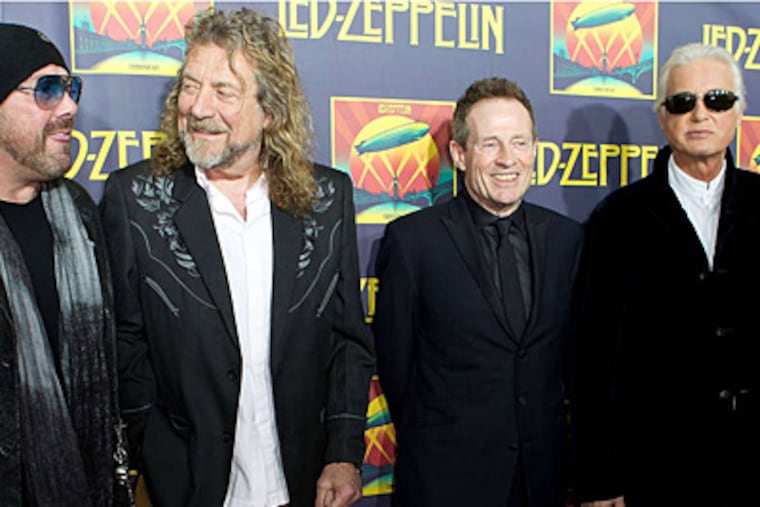
So the closest I've ever gotten to the band was last month, when I attended the premiere of Celebration Day at the Museum of Modern Art in Manhattan. The screening was followed by a news conference with the band: Robert Plant, Jimmy Page, John Paul Jones, and Jason Bonham.
A journalist a few rows in front of me asked the band about rehearsing for six weeks to play just one concert. It struck me as a circuitous way of asking about the possible tour that was on everyone's mind, and there were a few murmurs in the audience suggesting that the reporter had identified the elephant in the room. But the band reacted as if he had told the emperor he had no clothes. The only answer came from lead singer Plant, who called the reporter a "schmuck." It didn't sound as if he were kidding.
A question or two later, I tried to introduce a little levity by saying I wanted to follow up on the question asked by the "schmuck." (No one laughed.) I then congratulated the band on the release of the movie, which I said was terrific. I was very reverent. "But," I said, I doubted it would "quench the thirst" of fans who want to see Led Zeppelin "in the flesh."
In response, one of my heroes started making a snoring noise. The rest sat in stony silence. Plant glared at me. Finally, after a few pregnant moments, John Paul Jones said softly, "Sorry." They hadn't refused to answer the question so much as they'd been completely dismissive of it.
I sat down a bit chagrined, though I was heartened when a reporter from CNN followed up on my question, as did the legendary classic rock DJ Carol Miller. (Neither got more of an answer.) And there was further proof that this was the most important question in the room when both Rolling Stone and the New York Times focused on it in writing about the movie launch.
Leaving the news conference, I asked my field producer, Paul Lauricella, what had just happened. "Wow," he said. "Their contempt for that question was palpable. Shouldn't they be grateful we still care about them? Shouldn't they be dragging their 60-year-old butts on stage before Jason Bonham has grandchildren?"
Former Philadelphia DJ Denny Somach, the author of Get the Led Out: How Led Zeppelin Became the Biggest Band in the World, was also in the room. I later asked him whether he thought the band had played its last live show.
"I don't think they have," he said. "I think they are looking at what the Rolling Stones are doing - playing multiple dates in a few cities. I know for a fact that Jimmy [Page] is sitting at home playing his guitar and waiting for Robert to call."
If Somach is right, the band might indeed give the public what it wants. Just don't ask them about it unless you want to be treated like a schmuck.
Nobody withstands scrutiny anymore - generals, athletes, rock stars. Maybe they never could. Maybe it's time to stop scrutinizing them and just appreciate their talents.