Monica Yant Kinney: Philadelphia balances its budget on the backs of its little guys
Big cities often think small. When times are tough, nickel-and-diming the little guy is an easy fallback. What's he gonna do? Move?
Big cities often think small. When times are tough, nickel-and-diming the little guy is an easy fallback. What's he gonna do? Move?
So it's hardly surprising that Philadelphia's $3.7 billion budget got balanced with a bruising 9.9 percent property-tax hike and a new $300 yearly commercial trash fee.
"No one wants to be doing this," said mayoral spokeswoman Maura Kennedy, "but we all need to chip in to make the city run. We need new creative revenue sources."
By creative, does she mean charging people for services they don't receive and imposing new fees that make little or no sense?
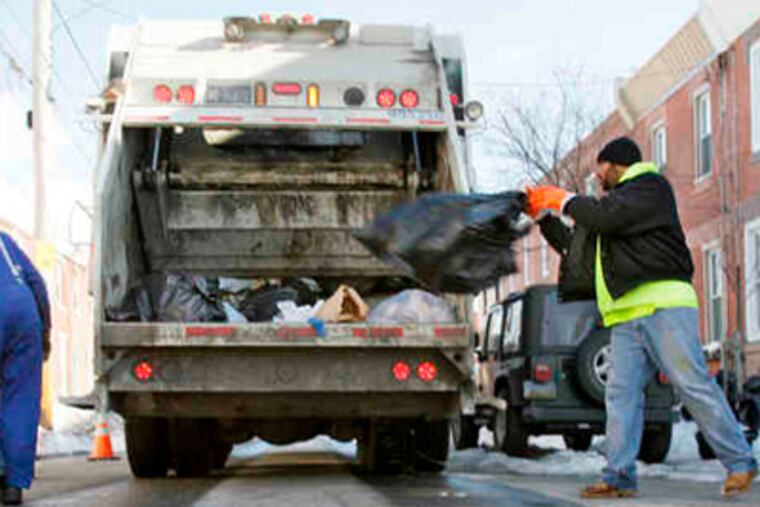
Last month, 55,000 businesses and apartment buildings received a $150 city trash bill, even though many - like those in South Philadelphia's famed Italian Market - don't get city trash service and must pay thousands for private pickup.
Merchants along South Ninth Street also were charged new $40 to $150 fees for curbside trash cans that city workers never touch. A bookkeeper at Esposito's still doesn't understand why the cardboard compactor her boss has long owned and operated in his garage is now considered by Licenses and Inspections a Dumpster subject to a $150 license.
For surreal moneymaking mania, there's Sonny D'Angelo, third-generation butcher, caught in a zoning grinder after someone in City Hall deemed him a manufacturer because he sells sausage.
"The inconsistencies of doing business here are absurd," grumbled former City Council candidate Vern Anastasio, saddened by the thought of a city so strapped it searches for coins under the couch. "It's Bizarro World."
Casting a wide net
Anastasio grew up in the market working at the family produce business. His parents still live above Anthony's Italian Coffee House and received three trash bills.
Anastasio, a lawyer, knew enough to prove his folks were exempt, but he and I predict many business owners will pay out of habit (or fear), not reading the fine print.
This year, that's a $150 error in the city's favor. Next year, $300.
"We're not trying to take anything from anyone," countered Streets Commissioner Clarena Tolson. "If you don't have city trash service, you don't pay."
The city expects to net $7 million from the trash fee this year, so does that mean only 46,000 of the 55,000 billed should pay? Tolson said she wasn't sure how many had been wrongly charged.
Why not? Sanitation drivers must know where they stop. Instead of firing up a database, it was easier to cast a wide net and make thousands of citizens do the hard part.
Chew on this
Patricia "Cookie" Ciliberti, of Betty Ann's Italian Market Florist, serves on the business association board and met with L&I officials over the new fees.
"We know they've got a budget crisis, but c'mon, already," she said. "We're the second-biggest tourist attraction in the city. Everyone makes money off us but us."
L&I Commissioner Fran Burns confirmed that inspectors had descended on the Italian Market in the fall, issuing violations (more $$) where necessary. As a new courtesy, L&I warned the locals in advance.
D'Angelo Bros. was cited for not having a food-prep license. Sonny D'Angelo puzzled over the penalty because he doesn't "prep" anything; eating his meat raw could cause trichinosis.
"He cuts chicken and grinds sausage like 10 other butchers in the market," said lawyer Tom Williams.
D'Angelo didn't care what type of license he got as long as he could stay open. So he took a required food-safety class (still more $$) and submitted to a health inspection.
"But when he went to apply for the new license, they said he needs to be rezoned," a befuddled Williams said. "Then he got a citation for not having the license while we were in the appeals process."
Deputy L&I Commissioner Michael Fink acknowledged "mistakes happened when he got to our zoning unit," where a city worker somehow thought D'Angelo was a big-time sausage manufacturer.
"He still owes us money," Fink said, "but we're not looking to collect interest and penalties on this."
I would expect nothing less. In Bizarro World, every penny counts.