Cheerier week for orchestra, headlining at Carnegie
NEW YORK - On March 11, the Philadelphia Orchestra slashed 20 percent of its staff. The next day, Leonore Annenberg, the most generous donor in the orchestra's history, died.
NEW YORK - On March 11, the Philadelphia Orchestra slashed 20 percent of its staff. The next day, Leonore Annenberg, the most generous donor in the orchestra's history, died.
That was last week, and - as tends to happen with the orchestra - this week the tone has brightened considerably. On Tuesday, the orchestra announced that the William Penn Foundation had offered a challenge, pledging $250,000 if the orchestra could raise $500,000 more by July 31, the sum of which would help offset a threatening deficit.
And Tuesday night the orchestra was back making musical news as the orchestral centerpiece of Carnegie Hall's Honor! festival. Jessye Norman, Carnegie's curator for the three weeks of concerts, interviews, and discussions on African American culture, stepped out on stage to connect the Philadelphia dots.
In praising Annenberg, Norman committed an act of generosity herself, endowing the philanthropist's first name with double its usual number of syllables: "Lay-oh-nor-uh Annenberg," she practically trilled. "We are all the better for her having walked among us."
The concert was dedicated to Marian Anderson, and Norman recalled in a program note how just after her 16th birthday she took the train from Augusta, Ga., to Philadelphia for the Marian Anderson Competition (and did not win a prize).
Wisely, no one decided to commemorate Anderson's appearances in Carnegie by presenting a contralto. Instead, Philadelphia bass-baritone Eric Owens performed Mahler's Lieder eines fahrenden Gesellen (first heard in Carnegie in 1937 with Eugene Ormandy and the Philadelphians), and tenor Russell Thomas took on Lilacs by George Walker, songs that elicited the first Pulitzer Prize awarded to an African American composer.
Walker, who trained at the Curtis Institute of Music, bounded up to the stage at the conclusion of Thomas' performance to accept figurative bouquets from the audience, his thin frame moving at a pace belying his 86 years.
Thomas had a light, nimble sound that fell nicely on a score that goes about as far with dissonance as Barber or Britten. These pieces from 1995, set to a portion of Whitman's "When lilacs last in the door-yard bloom'd," are wonderfully ghostly beings, sometimes lashing out with a snarl from the brass or a cloud of string dissonance, but more often content to lie quietly, glowing and bleak.
Owens in the Mahler reduced his sound at times to mere whisper, a feat all the more impressive in contrast to his capacity for great power.
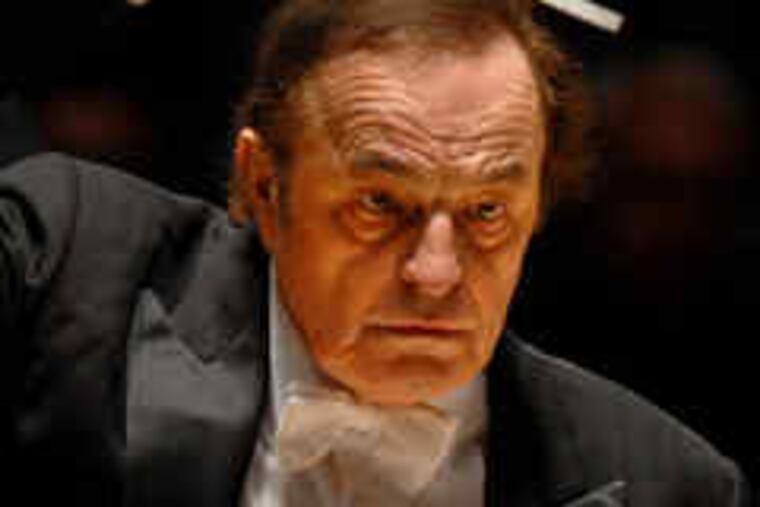
Charles Dutoit and a small subset of the orchestra extended the African American theme with Darius Milhaud's 1923 jazz-informed La création du monde, and filled the second half with a high-impact Dvorák Symphony No. 9, "From the New World." Dutoit is a broad-brush worker, not a detail man. But he has three important assets no one should take for granted: He shapes an elegant phrase, gets a powerful but velvety sound, and gets the orchestra to play well for him.
The Philadelphia Orchestra as avatar of African American culture would have had greater credibility if its ranks contained more than the three African American members hired three and four decades ago.
"Hold fast to dreams," Langston Hughes urged.
We're holding. But for how long?