A new way of looking at things
Two years into his retirement from the U.S. Forest Service, Jim Lockyer is still too busy painting and doing volunteer work to spend the kind of time he'd like on another favorite pastime: recording outdoor sights and sounds in his nature journal.
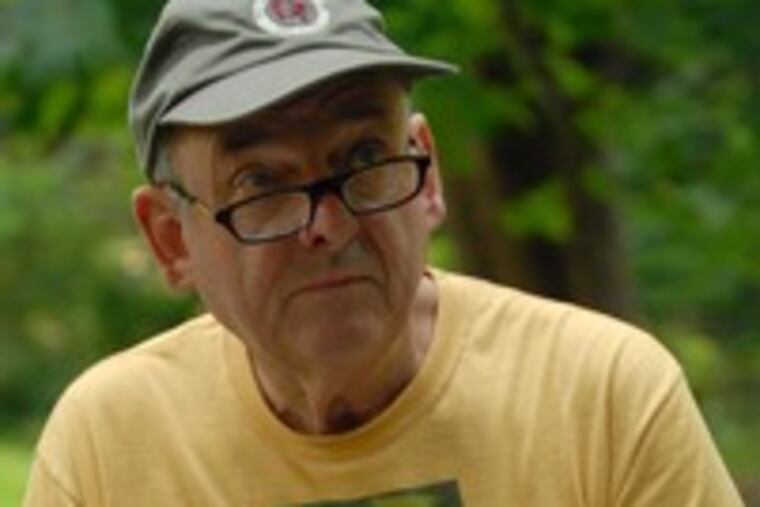
Two years into his retirement from the U.S. Forest Service, Jim Lockyer is still too busy painting and doing volunteer work to spend the kind of time he'd like on another favorite pastime: recording outdoor sights and sounds in his nature journal.
So at journaling workshops in the Philadelphia area and beyond, the Delaware County artist and naturalist urges his students to do as he says, not as he does: Take the time to be a witness. Make the time to sit outside, quietly taking everything in and getting it all down.
"Journaling forces you to see, not just look, and in the process, you discover yourself," says Lockyer, whose home studio is lined with 30 years of oilcloth-covered Moleskines. These are the classic notebooks used by, among others over two centuries, Vincent van Gogh to lay out his famous sunflower series and Ernest Hemingway to gather intelligence on Paris in the 1920s.
Which raises the two questions many would-be journalers ask: Do you have to be able to draw? And must you be a "writer"?
Actually, no and no.
For the artistic part, you can take digital photos and pop them in, as Lockyer did with a thumbnail shot of his cat, Velcro, on his back deck in Media. You can cut out magazine pictures, do a primitive sketch, press a flower or leaf. You can outline a simple map, scratch out a stick figure, even doodle.
For the literary part, you can record random thoughts and impressions or copy a favorite quote, phrase or poem. The idea isn't to create an angst-filled diary, but to try, as van Gogh once remarked of his own journals, "to catch life in the act."
However it strikes you.
"You have to do what's most comfortable for you, or you're not going to do any journaling," says Lockyer, a native of Long Beach, Calif., who gravitated to art courses in college while majoring in biology.
Jill Kennard, a mechanical engineer who started journaling earlier this year after one of Lockyer's workshops, fills her notebooks with almost all drawings. She isn't comfortable writing more than scientific plant descriptions, time, place, weather, and location. She doesn't like to use photos, either.
"When I go outside, everybody always says to take pictures," Kennard says, "but I don't seem to enjoy the outdoors as much that way. I end up composing the picture and not really looking at what I'm taking a picture of."
She prefers unembellished pencil sketches of the native honeysuckle, bee balm, and cardinal flower in her backyard in Hockessin, Del., and plants along the East Coast Appalachian Trail, on which she's been backpacking for more than three decades.
She's also visited the National Arboretum in Washington "in search of good-looking tree roots" to draw.
"Time kind of stops when I'm drawing. I'm really focused and concentrated," says the normally Type A Kennard. "It's very relaxing."
Landscape artist Joan Polishook has been journaling for two decades, carrying her notebooks everywhere - on trips, to concerts and lectures. She draws in pen and ink and paints in watercolors, writing with equal ease.
"I do these quick little snippets. My eye is like a camera," she says. "I love barns and old buildings, and so while I'm riding in the car I record what I see at the side of the road."
She'll note a barn's red roof or gray siding or, as she did recently on a trip to Upstate New York, "cloud shadows on rolling hills."
"The journal, to me, is like going back. It's a memory thing," says Polishook, who lives in Lords Valley, in Pike County, and took two journaling classes with Lockyer up at Grey Towers National Historic Site in Milford, Pa. (That's where he finished out his Forest Service career - he'd been a biologist, a scientific illustrator, and a graphic artist there - as artist-in-residence.)
Journaling also develops curiosity. What kind of mushroom is this? What are lichens? How does a seed pod work? "People don't appreciate the natural world enough," Polishook says.
Lockyer, a devoted birder, certainly does. Over several months, he filled 20 pages with observations, sketches, and photos of a pair of red-bellied woodpeckers nesting in a tree behind the home he shares with his wife, Judy.
"I always think when I'm going to go out and sketch that I have to go someplace," he says, "but, actually, I can just go out in my backyard."
There, by focusing on the little picture, he feels "part of the bigger picture." He also feels rejuvenated and cleansed, blissfully disconnected from cell phone and laptop.
Recording visual images of the natural world is nothing new, of course. Some suggest that the practice began with cave paintings of the woolly mammoths, but it's certain that for centuries journals were standard operating procedure for artists and writers, scientists, intellectuals, and explorers.
It's a lovely hobby for home gardeners, too.
Just take a page from Lockyer's book. He's usually out back in his collapsible chair, happily solitary, perched in front of the grizzled old apple tree he finds as fascinating today as it was many years - and sketches - ago.
The bag by his side contains, maybe, a bottle of water, watercolor paints and pencils, a mechanical pencil, a technical pen.
Open in front of him is his latest journal. He'll be good now for an hour or two, and probably more.
Journal Lessons
Jim Lockyer will give a nature-journaling workshop at Morris Arboretum, 100 E. Northwestern Ave., Chestnut Hill, from 10 a.m. to 1 p.m. Oct. 13. Members, $36; nonmembers, $40. For information, call 215-247-5777 or go to http://www.business-services.upenn.edu/arboretum/classesartscrafts.html.
Lockyer will also do a journaling workshop at the Ashland Nature Center, Brackenville and Barley Mill Roads, Hockessin, Del., from 9 a.m. to noon Oct. 27. The center is 9 miles northwest of Wilmington and 5 miles south of Kennett Square. Members, $25; nonmembers, $40. For information, call 302-239-2334 or go to http://www.delawarenaturesociety.org/.
For both workshops, you can bring your own materials or buy a basic package from the instructor for $12.
EndText
Jim Lockyer talks about his nature journaling in a video at http://go.philly.com/journaling.
EndText