Coleus rising
"A living paint box," one enthusiast calls this garden classic that's trendy once again.
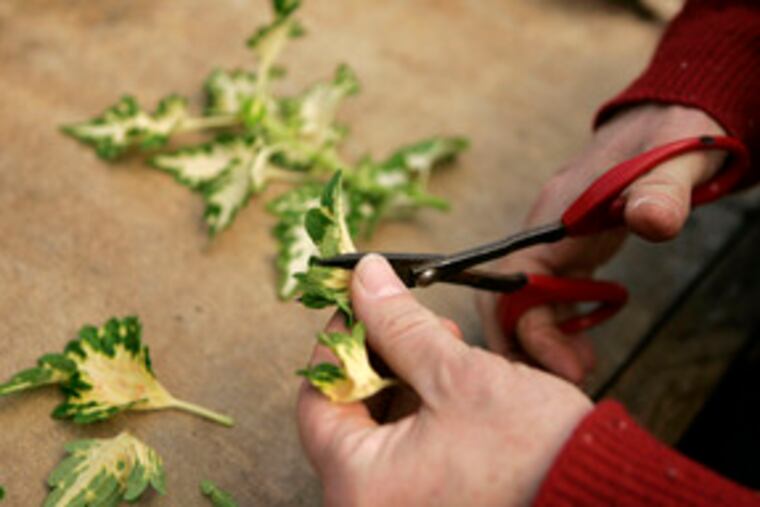
You gotta love a plant that comes in oddball varieties like 'Pistachio Nightmare,' 'Kiwi Herman' and 'Brooklyn Horror.'
It's kooky coleus, the old Victorian favorite that three years ago became Amanda Davies' latest obsession in the garden. But this time, the fixation was different - and instructive.
Davies' Schwenksville garden had always been about flowers - how many, what colors and kinds. But gardeners pinch coleus to prevent blooming; the plants poop out after flowering.
"With coleus," Davies says, "came the realization that color could come from foliage. That, for me, was revolutionary. You do get some flowers, but that isn't the point."
And while we're talking revolution, yesterday's coleus was a bit of a snore. Today's is a total exhibitionist.
It's all dancing pinks and shouting greens on the one hand, translucent golds and meditative maroons on the other. You'll find raunchy reds and redolent browns, creamy whites to make you sigh, and leaves so splattered with color you'll think Jackson Pollock had opened a vein right into the pot.
Ray Rogers grows 120 kinds of coleus at Atlock Flower Farm in Somerset, N.J., and to visit him there is to understand the power of this plant. It's so unpredictable, so spontaneous, it's almost irresistible to novices and collectors alike.
Coleus is officially known as Solenostemon scutellarioides, but Rogers has a better name. "An unpedigreed mongrel," he says with obvious delight.
He's allowed. He's King Coleus at the moment, author of a new book called Coleus: Rainbow Foliage for Containers and Gardens (Timber Press, $29.95). After all that work, and despite his penchant for serial crushes on iris, then daffodils and who knows what else, Rogers is still stuck on these mongrels.
He has a million favorites, all revving up for spring inside five of the farm's seven hoop houses. He leads the way through the narrow aisles of one after another, pointing to baskets of coleus overhead, tiny seedlings on the sides, larger plants in the middle.
It's a horticultural Rorschach of shapes, patterns and colors. And Rogers knows every plant.
They're introduced like friends at a party. First comes 'Camouflage,' a dark khaki coleus that you agree is a standout. Then he's touting 'Inky Fingers,' which really does look like ink-stained digits, and 'Velvet Mocha,' which is positively smoldering.
We pass a deep maroon and chartreuse 'Pineapple Queen' with barely a glance because Rogers is already explaining "the infamous 'Tilt-a-Whirl.' It looks like mud in the spring, but it turns orange and twisty and gorgeous in fall," he says.
So he sells it in fall.
"A fascinating, living paint box," Rogers calls these funny plants, which - just as we might question our own relatives' planet of origin - are members of a surprising family: mint, because of the flower structure.
Once ubiquitous in the parlors and carpetlike flower beds of Victorian and vintage American estates, coleus' popularity plunged thereafter. It was up in the '20s, down in the '30s, reborn with suburbia in the '40s and '50s, and on and on in the way that plant fads go.
So here we are. Coleus is back again, with hundreds of new varieties and jolly names and fans like Davies, who got to know coleus three years ago and now builds beds and containers around it.
"I've been pretty restrained about buying," she says, "but this year, it's gonna get ugly."
Stephen Maciejewski of Philadelphia, just off a fourth-place overall finish at the Flower Show, is a coleophile, too. "With my social worker background," he explains, "I like Coleus 'Schizophrenia,' 'Bipolar by Golly,' 'Religious Radish' . . .
"If you have OCD [obsessive-compulsive disorder], this is a real problem," Maciejewski adds, "because you want to have one of these, one of those. What kind of crazed garden will you have?"
Actually, in all its varieties, coleus is very well-behaved.
Some mass and mound nicely, like a giant mushroom cap. Others creep elegantly along the ground, hang well in baskets or spill gracefully out of pots. Still others are easily trained as topiaries or tucked neatly under a big-leaf hosta, as Davies does.
Although the lighter-colored coleus need mostly shade, many others grow fine in part or full sun, including a trio of plant series called Florida City, Solar and Sun.
"The more light most get, the better they do," Rogers says.
There are about 1,000 kinds of coleus, with a great deal of hybridizing going on. Some, over time, have picked up more than one name. Combine all this with the fact that coleus mutate or "sport" frequently, and identifying plants becomes an amusing - if confusing - game.
The same coleus can look different in sun and shade, and spring and fall. "With a lot of coleus, if you think this is what it'll look like all season, you're wrong," Rogers says.
Even parts of a single coleus can look wildly different. "The same plant can look like five different ones, all in one pot," says Rogers, citing the aptly named 'Careless Love,' which is notoriously promiscuous.
One rooted cutting of 'Careless Love' can produce a genetic free-for-all of a plant: one part green, one part red, one yellow, the rest a mishmash.
"Coleus," Rogers says, "is a little bit nutty."