Clematis, down-sized
"American bells" are ringing: Compact viorna clematis are tiny-bloomed treasures, long-flowering, friend to hummingbirds, a no-prune native delight.
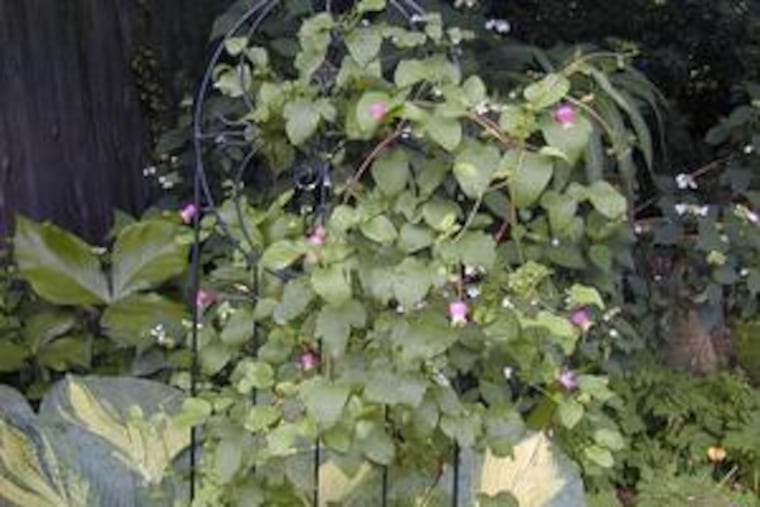
Americans love big stuff, and that includes flowers: tulips as dense as dahlias, dahlias bulked up like peonies, and peonies as grand as roses.
So it's not surprising that the group of tiny clematis known as viorna has never made the best-seller list. In fact, few gardeners know about it, and it's almost impossible to find. Garden centers, big-box stores, even growers and writers are too busy cashing in on the splashy, flat-faced stars of the clematis world.
Those would be hybrids such as champagne-pink 'Nelly Moser,' a dramatic heirloom with 8-inch blooms and a thick cherry stripe down the center.
"The large-flowered ones have what I call 50-mile-an-hour power. You plant it and people can see it driving by on the road," says Dan Long, owner of Brushwood Nursery in Unionville, Chester County, an online business that specializes in clematis and other vines.
But the fortunes of the small-flowered viorna group, especially the North American native species, may be changing. Long anticipates a "wave of interest" that will piggyback onto three strong trends: the 10-year popularity of the big-bang clematis, which shows no signs of flagging; the growing interest in native plants, and the fact that many gardeners live in apartments and condos with small planting spaces.
"Up close, these smaller-flower plants are really wonderful," Long says.
And viorna has a secret weapon: Carol Lim.
Eight years ago, Lim, a gardener from Broomall, saw one of these "wild Americans" in a friend's garden and was so enamored of its tiny bell-shaped blooms, she went online to the e-forums at http://www.gardenbuddies.com. There, she found clematis-crazed gardeners eager to share her newest horticultural fascination.
"They're beautiful, they flower a long time - some till frost - and hummingbirds love them," says Lim, who has 40 clematis in her garden, including about 20 natives.
When it comes to the natives, what's not to like? Especially when you get to the one topic around clematis that, rightly or wrongly, intimidates just about everyone: pruning.
Most nonnative clematis typically fall into three groups, each pruned at a different time, depending on when the plant flowers. It can get complicated.
But with viorna, "there's no pruning dilemma," says Lim, who has studied ornamental plants at Longwood Gardens. "They all die to the ground in winter, and you remove everything the following spring."
Last fall, buoyed by the enthusiasm she found online and among local gardening friends, Lim started a Web site, http://www.clematisviorna.info. It champions the plants she calls "American bells," in hopes that botanic gardens and arboretums will showcase and promote them and nurseries will grow and market them.
"I did it because people here don't know about them. There wasn't any information out there," she says.
Too bad, because the viorna species - Lim lists 17 on her Web site - can be quite fetching. Shaped like solitary, upside-down bells, urns or bonnets, they're rusty brown to violet-blue outside, pale yellow or green inside, with creamy tips.
Half are vines. Some are fragrant. Lovers of sun or semi-shade, they're often called "leather flowers" for the texture of their blooms.
The buds and flowers are surprisingly tough to the touch, and compact like tiny chocolates. Elegant, too, in the way a modest sapphire can sometimes outshine a mountainous diamond.
And not just hummingbirds love them. Bees and butterflies do, too.
Lim has nothing against the showoff hybrids. In her own garden, she's got quite a few, including old 'Miss Bateman,' with her 6-inch-wide white flowers, and the equally large, velvety red 'Niobe.'
But it's the native viornas that captivate Lim.
Clematis versicolor is just too adorable. Its tiny bells are purple at the base, fading to greenish white, and so prolific, Lim says, "it will eat the world!"
Clematis crispa, a dainty blue with white interior, wraps itself around a dogwood tree. And Clematis glaucophylla, with its bluish leaves and hot pink blooms edged in yellow, is inching up a native buckeye.
"Eventually, this vine will cover the whole top of the tree," Lim says. "I'll have hundreds of flowers till September or October."
Native clematis, like the publicity-hogging hybrids, love clinging to roses and climbing through airy shrubs and trees. In Lim's garden, they also cover tripods and trellises, sprawling around the front and deep into the back of her 80-by-170-foot property.
A physician's wife who worked as a bookkeeper before becoming hooked full time on horticulture, Lim has hundreds of perennials. She propagates many herself, including the native clematis, which she grows from seed and supplies to Long for Brushwood Nursery.
Even Long has favorites among the big-flowered clematis; his latest is creamy pink 'Omoshiro.' But he shares Lim's affection for the dainty natives and sells some at his nursery.
"It's a shame. They don't have 8-inch blooms, so they don't get as much attention in this country," Long says. That's not the case in England and other places, where "experienced gardeners appreciate that more is not always better."
"More," we have to say, is at least easier to see from a distance. Witness the giant-flowering, octopus-sized, hardy hibiscus along the road, just outside Long's nursery.
Virginia A. Smith blogs about gardening at http://go.philly.com/kisstheearth.
EndText