He keeps the foamflowers flowing
Sinclair Adam used to cringe when his pals called him "the pharaoh of foamflower." Now, he embraces his inner sovereign with only a slight grimace, hoping it helps get the word out about tiarella, the starry little wildflower he adores.
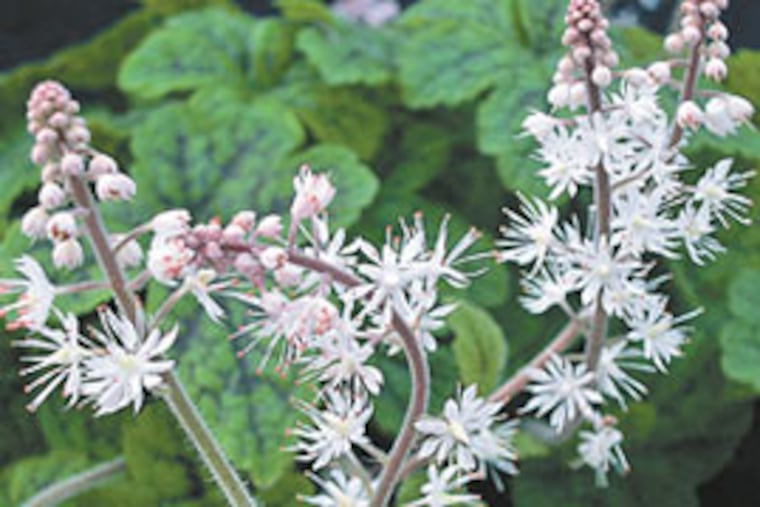
Sinclair Adam used to cringe when his pals called him "the pharaoh of foamflower." Now, he embraces his inner sovereign with only a slight grimace, hoping it helps get the word out about tiarella, the starry little wildflower he adores.
"Tiarellas rock," says Adam, a pipe-smoking plant breeder and horticulturist who runs Dunvegan Nursery with his wife, Kirsten, from an 18th-century farmhouse in Coatesville.
More properly known as Tiarella cordifolia, which refers to their heart-shaped leaves and small tiaralike flower sprays, shade-loving "foamies" have been an Adam preoccupation for two decades.
In the spring, five new varieties he's bred will be in the marketplace and available to home gardeners - fortuitous timing, given the growing interest in native plants, easy-care perennials, and shade gardening.
Most tiarellas sold now are clumpers that form a compact mound in the garden. Adam's discoveries are all ground covers that spread easily and mind their manners, making them attractive alternatives to the tiresome, impenetrable trio of English ivy, pachysandra and periwinkle.
To "raise awareness of regional and global water issues and the environment," he says, these spring-blooming, soil- and water-retaining creepers are named for rivers in eastern Pennsylvania. That suited Adam, who formerly taught plant propagation and other courses at Temple University Ambler, "since they are native plants and since we want the world to know they are from Pennsylvania."
The new guys are two to eight inches tall. They were bred to produce more stems and flowers, to bloom longer, and run smarter. Like other tiarellas, these have distinctive leaves.
They're dotted and veined, splashed and splotched like a pointillist painting. And their color can vary from dawn to twilight and summer to fall. There's the fun of foamflower.
'Delaware' has purple markings, prolific pink flowers, and dark red stems. 'Lehigh' has deeply lobed, apple-green leaves, maroon veins, and peachy-pink blooms. 'Octoraro,' the group's champion ground cover, spreads two feet in a season and has mauve-pink buds that turn to creamy light pink in bloom.
The artwork on 'Susquehanna,' another fast grower, is dark purple, almost black. Finally, 'Wissahickon' has shiny grass-green leaves and flowers into late July, way longer than most.
What, no Schuylkill?
"Schuylkill is the butt of many local jokes," Adam says, and so wasn't high on his list of name choices.
He argues, however, that fast-growing tiarellas should be a top choice not just for plant lovers or shade gardeners, but for anyone worried about all the nasty stuff that runs off our lawns and driveways when it rains.
"Home gardeners can help," says Jeffrey Featherstone, director of Temple's Center for Sustainable Communities in Ambler, "by putting in plants that suck up pesticides and synthetic fertilizers, filter it out and get rid of it. That's what plants do, and it's critical.
"That's just being a good neighbor," he says, "but actually, you'll be doing everybody a favor."
Adam points out that in Chester County alone, 60 percent of the land is privately owned. Think how much water could be absorbed and how much soil saved from erosion, he says, if even some of those homeowners planted clusters of plants like tiarella - and fortified them with organic matter such as compost to build strong roots and healthy soil.
Todd Greenberg, a former student of Adam's at Temple, is already a tiarella fan. He loves 'Oakleaf,' a clumper that Adam and others introduced to the marketplace in 1990. It's planted in front of native cinnamon and Christmas ferns in some low, shady beds at Bartram's Garden in Southwest Philadelphia, where Greenberg is head gardener.
It also starred in Greenberg's home garden in West Philly before he moved and inherited more sun. "I love the floral display of tiarella," he says.
So does Beverly Fitts, who has 'Oakleaf' and many running types growing on a shady, north-facing half-acre slope in Lower Merion.
"Around the second week of May, you have enormous drifts of these foamflowers under oak trees and hickories, and merged in with those are the phlox and trilliums coming up," Fitts says, describing the effect as "just this haze of foamy, airy, fairylike wands covering the woodland floor."
Imagine springs long ago, when the unspoiled woods of eastern North America, tiarella's native range, were frothy with these dainty blooms. Joel Fry, curator at Bartram's Garden, says that was probably true in the mountains and foothills of Pennsylvania and New Jersey, but not in and around Philadelphia.
As was the case with so many other plants, Philadelphia's famed botanist, John Bartram, likely was the first to cultivate foamies, though it's no surprise he didn't call them that. Fry quotes from Bartram's notes on foamflower specimens collected during a trip to the mountains of northern New Jersey in 1741: "This I gathered by the Rariton river the latter end of August."
Today, because of habitat disruption, deer browsing and other factors, tiarella is endangered in New Jersey and Wisconsin, a situation Adam may want to tackle. That is, after he's dealt with soil erosion, storm-water runoff, and other environmental problems in the unendangered state of Pennsylvania.
"We're going to sell Harry and Sue Homeowner on tiarella. Bit by bit in people's backyards, we're going to . . . slow the travel of those torrents of water runoff from lawns and paved surfaces," he says, sounding, in this election season, very much like a candidate for pharaoh.
Finding the Plants
Tiarellas are available at many garden centers. They will also be among the native plants for sale tomorrow from 10 a.m. to 2 p.m. at Bartram's Garden Fall Native Plant Sale, 54th Street and Lindbergh Boulevard. Information: 215-729-5281 or www.bartramsgarden.org.
EndText
Virginia A. Smith blogs at http://philly.com/philly/blogs/
gardening/EndText