Arboretum springing up at Chestnut Hill Academy
There is, perhaps, no more energetic creature on Earth than a 7-year-old boy, zipping here, crashing there, all elbows and knees.
There is, perhaps, no more energetic creature on Earth than a 7-year-old boy, zipping here, crashing there, all elbows and knees.
So it comes as a bit of a shock to see a half-dozen uniformed second graders from Chestnut Hill Academy standing still, eyes focused on a tiny tree, as one of them tilts a watering can downward to give the sapling a drink.
Young Nate McDowell explains: "This is an American chestnut tree. There used to be a lot of them on the East Coast, but they got a disease called blight, and a lot got sick and died."
Nate is right on the money. And there are now two four-year-old American chestnuts on this 26-acre, all-boy prep-school campus along West Willow Grove Avenue, nestled up against the Wissahickon Valley.
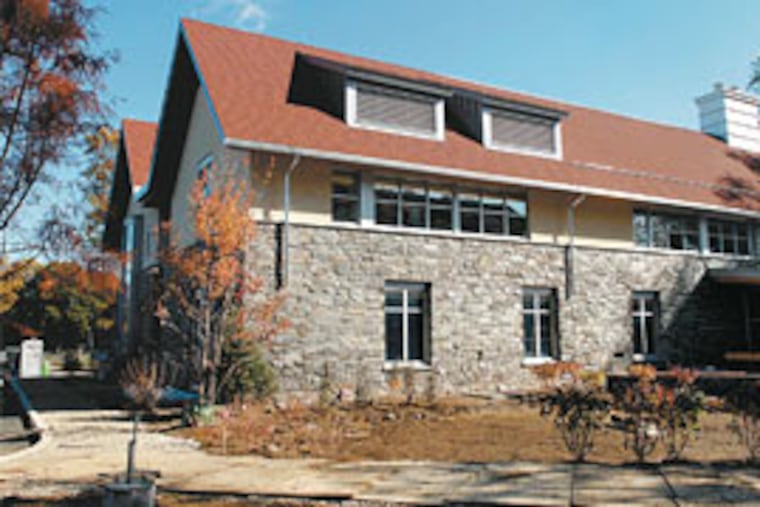
The saplings are part of a native-plant arboretum being created at the school, along with two rain gardens and a porous parking lot, to wrap around an environmentally sensitive Science and Technology Center now under construction.
"The whole campus will become a teaching tool," says Betsy Longstreth, development director.
The $12.5 million project is expected to be finished in January. And though the entire 570-student body - as well as sister school Springside Academy next door - will benefit from its many cool features, the 23,800-square-foot science center will serve primarily the lower and upper schools.
The middle school got two new science labs in 1999.
Daniel Brewer, who teaches art and woodworking, sees the arboretum as an outdoor laboratory, one that will reinforce the message he tries to instill in his indoor classrooms.
"It's an opportunity to look a little beyond just the basics of trees, to develop an appreciation for trees and our connection to them," says Brewer, whose woodworking students make furniture and other objects from walnut, oak, cherry, Paulownia, ash and poplar. "We already have a connection with wood as something meaningful, beautiful, tactile."
The arboretum is being planted with 72 trees and 596 shrubs, all native to the eastern United States. According to landscape architect Joe Cairone, the look will be naturally layered with ground covers, understory trees and shrubs, and larger canopy trees.
Pure "woodland Wissahickon," in the spirit of Henry H. Houston. In the late-19th century, Houston developed the area and planted trees and shrubs "to extend the sense of the Wissahickon into the community," according to Chestnut Hill historian David R. Contosta.
So, no boxy hedges, thank you, and no rigid rules like "the standard tree every 20 or 30 feet. That drives me crazy," says Cairone, who has replaced his own lawn in Havertown with native plants.
In classic arboretum style, Chestnut Hill Academy's native flora will be labeled (now there's a class project), and Cairone promises something will be blooming, producing fruit, or just looking "compelling" all year long. And it's all wildlife-friendly.
Imagine the richness to come from 400 Christmas ferns and oakleaf hydrangea, summersweet, arrowwood and cranberry viburnum; from sweetspire, shadblow serviceberry, flowering dogwood and sweetbay magnolia; from American and winterberry holly, red and sugar maples.
"We wanted it to be more evocative of a woodland edge, something that's not really defined by sidewalks . . . ," Cairone says.
The naturalistic landscape will mimic the look and function of the Wissahickon watershed, right down to the rain gardens that will absorb stormwater runoff from the roof of the new science center. The new parking lot also will soak up water to share with the native plants.
The school's science curriculum is already heavily invested in trees. Students do projects ranging from recording seasonal changes and studying tree roots to making paper from sawdust and maple syrup from sap.
But the baby chestnuts will surely be a talking point. They're the progeny of American chestnuts in Kentucky that somehow survived the blight that killed off four billion of their forbears.
The American chestnut, or Castenea dentata, Chestnut Hill's namesake, is often referred to as "king of the forest" and "the redwood of the East." It once dominated the coastal landscape from Maine to Georgia, but an aggressive fungus believed to have arrived on Asian plant stock around the turn of the 20th century proved devastating.
Only 30 are thought to have survived. Meanwhile, the American Chestnut Foundation has undertaken an ambitious breeding program to cross the American chestnut with blight-resistant Chinese strains, while retaining the American identity.
Donated by Morris Arboretum, the Chestnut Hill Academy seedlings were grown by the North Carolina Zoo and Trees Asheboro, an environmental group, in the city of the same name. Group founder Tom Womick, sometimes called "a modern-day Johnny Appleseed," is focused on urban trees, but he says his message is really about "human potential and how we, like trees, can grow under adverse conditions and how trees and people are interconnected."
Womick, an actor and onetime chef, ice-carver and sommelier, calls Chestnut Hill Academy "a perfect venue, with Morris Arboretum, where trees would be guaranteed the utmost care."
Morris' Bob Wells, who has been working with the school, cautions that the saplings could succumb to blight someday. "But they come from very resistant gene stock," he says. "There's a very good chance they could make it."
They are being helped along by Dirk Parker's second graders. Twice a week, they visit the chestnut trees, taking turns with the watering can, five seconds each.
"One, two, three . . . " Parker intones on a recent visit. Suddenly, a couple of the boys secede from the tree circle, and before you can blink, they're racing around and throwing fake punches. "Guys, guys, stop!" Parker yells. "Come back here!"
Today's lesson in the outdoor classroom: Seven-year-old boy or chestnut tree, biology truly is destiny.