Nonconformist coneflowers
Echinacea, the garden's tough cookie, dons new duds, in a rainbow of colors and surprising shapes.
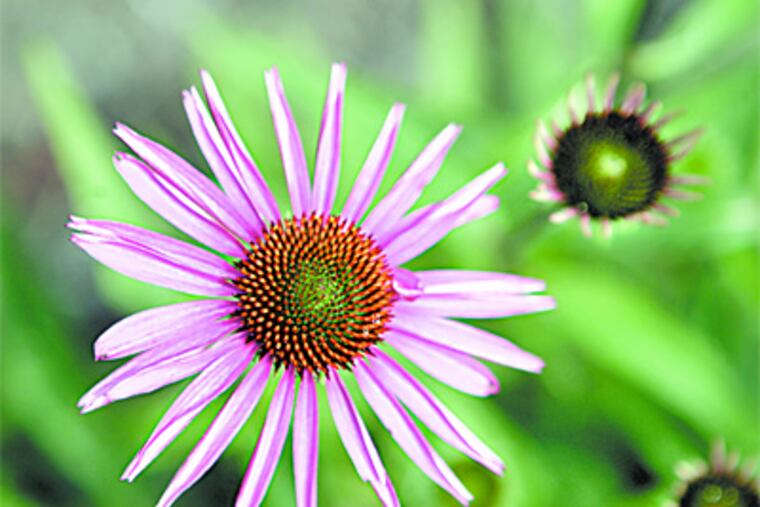
Evelyn Lovitz has waves of coneflower in her Cape May garden, mostly pink, purple and white, traditional colors for this popular North American wildflower.
But two relative newcomers in the exploding coneflower market have her attention this season: 'Sunset,' which has salmon-orange petals and a henna-brown cone or center, and 'Twilight,' whose deep rosy petals encircle a button-center in rare burgundy.
"Coneflowers are pretty, you can get them in all kinds of colors now, and if you want butterflies, they're like a magnet," Lovitz says. "I love them."
Purple coneflower or Echinacea purpurea is one of nine echinacea species native to North America. Although its home base is the Midwest prairie, it's long been popular in East Coast perennial gardens.
But like heuchera, hosta, coreopsis and daylily, the simple coneflower has blossomed into a diva over the last decade. This baby's a clotheshorse now.
"Definitely the plant du jour," says Victor Piatt, who's evaluating more than 300 coneflower plants at the Mount Cuba Center to determine the top performers for the Mid-Atlantic region's home gardeners. The 650-acre nonprofit Mount Cuba, on a former du Pont estate near Wilmington, studies regional native plants and wildflowers.
Piatt's winding down his three-year echinacea project, which looks at flower color and size, bloom period, height and width, leaf quality, staking needs, and resistance to disease and pests. (It does not address echinacea's longtime use as an herbal remedy for colds, although plant-breeding for this use is growing, too.)
Piatt's report isn't expected until later this year, but already he has a dozen favorites.
His No. 1 pick: 'Pixie Meadowbrite.' "It's the echinacea to have," Piatt says. It's a prolific bloomer, nicely compact, with flat, pink petals, gray-green leaves, sturdy stems, and "excellent branching."
'Chocolate Strawberry' is No. 2, and honestly, from afar these light pink petals and burgundy cones look plausibly edible, especially if it's getting near lunchtime.
Then comes pomponlike 'Coconut Lime'; wildly pink 'Conekim'; magenta 'Elton Knight'; 'Emily Saul,' with reddish-black cones; the dark-stemmed 'Fatal Attraction'; pure white 'Fragrant Angel'; and Echinacea pallida.
A word about this one.
It's coarse and hairy. Its petals are stringy, faded purple, and droopy, sort of the antithesis of the perkier newbies. Really, would you rush to buy a plant known as "pale coneflower" or one called 'Mac 'n Cheese' or 'Merlot'?
Still, E. pallida is strangely alluring, like a hedgehog in a grass skirt, which is entirely fitting, given that the echinacea genus was named in the late 1700s after "echinos," the Greek word for hedgehog.
Rounding out the list are watermelon-pink 'Pica Bella'; yellow 'Sunrise'; and 'Tiki Torch,' which Piatt describes as "a rich, velvety apricot."
'Tiki' debuted in 2007, one of about 20 coneflowers and more than 600 new plants brought out by Terra Nova Nurseries in Oregon. Terra Nova is one of a half-dozen or so coneflower breeders in the U.S. going at full tilt.
"In the future, you'll see everything in coneflowers that you see in dahlias or zinnias, all the different flower forms," says Terra Nova president Dan Heims. "We've got anemone-centered ones, doubles that are just delicious. I'd be on the lookout for doubles in reds, orange-reds, yellows and every color, with fragrance. Customers really want fragrance."
Some day, it seems, every flower may look like every other - coneflowers like dahlias, dahlias like roses, roses like peonies, peonies like coneflowers. It's starting to sound that way already.
"We're finding an exquisite array of new colors, different flower structures, petal length, foliage color, just a great deal of variability in coneflowers," says Jeanne Frett, Mount Cuba research horticulturist, who is overseeing the study.
While some gardeners complain that the new plants lack the old-timers' stamina, coneflowers generally have an excellent reputation.
They like full sun or very light shade and well-draining soil. They bloom all summer, make striking cut flowers (whole bloom or cone only), and draw butterflies, bees, and birds, especially goldfinches.
And coneflowers are tough. They can take a long dry spell and are pretty resistant to pests and disease - most of the time. Piatt has the stunning yellow Echinacea paradoxa in his home meadow and swears deer won't touch it.
But if lunchtime's looming . . .
At Mount Cuba last week, there were yellowed leaves and other signs of an incurable, virallike scourge called aster yellows. It's spread by the aptly named leafhopper and is decidedly worse when it's cool and wet.
Spring of 2009, anyone?
Piatt, who last studied asters and next will address coreopsis, suggested that a more diverse home garden would offer better protection against pests and disease. A test garden, with hundreds of plants of only one kind, is "an artificial environment," he says.
Still, a sea of sunny coneflowers is quite a sight.
"They're very nice and very popular," says Albert Ligameri, manager of Garrisdon Garden Center in Clementon, who sells a lot of the standard purple coneflower, along with 'White Swan' and 'Magnus.'
But yellow is a strong crowd-pleaser.
"We have one. . . . Its cone is up and the petals go downward, kind of like a Mexican hat in a way, very unusual. People like that a lot," Ligameri says.
Catherine Smith, owner of Redbud Native Plant Nursery in Glen Mills, prefers the old classic, Echinacea purpurea, for its wildlife-friendly seeds and nectar, and its classic beauty. "It's gorgeous in a meadow," she says.
That's Lovitz's favorite, too.
"The point of my garden is butterflies and hummingbirds and wildlife," she says, "and I know they come to these beautiful purple ones."
A Plant Breeder Talks in Del.
James Ault, director of environmental horticulture research at the Chicago Botanic Garden since 1995, will discuss his plant-breeding program at a Coneflower (Echinacea) Field Day at Mount Cuba Center from 3 to 6 p.m. Thursday. The center is located at 3120 Barley Mill Rd. in Hockessin, Del.
Ault, formerly plant propagator at Longwood Gardens in Kennett Square, is credited with producing the first-ever orange coneflower, called 'Art's Pride.' He also works with baptisia and phlox.
The field day program includes a presentation on the Mount Cuba coneflower study by Vic Piatt, trial area gardener, and Jeanne Frett, horticultural research manager, a tour of the trial garden, and a free coneflower.
To register, call 302-239-4244 or go to http://www.mtcubacenter.org/. Fee: $15, includes refreshments.
EndText