The Bard handled in a punk kind of way
The founders of the Missoula Oblongata experimental theater group credit William Shakespeare as a "significant and meaningful reminder of the values our company was founded on."
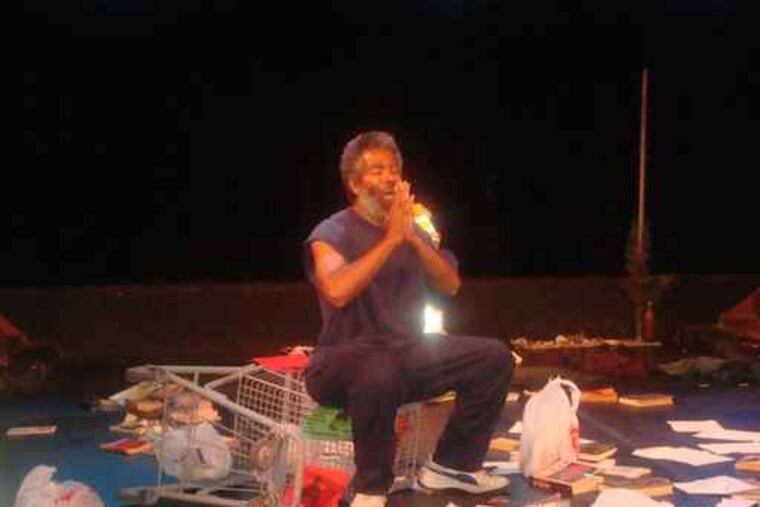
The founders of the Missoula Oblongata experimental theater group credit William Shakespeare as a "significant and meaningful reminder of the values our company was founded on."
Of course, these aren't the first performers to pay homage to the Bard, but their anarchist, itinerant, do-it-yourself troupe - which, with West Philly's Puppet Uprising, is co-staging a five-company gastro-theater production of Julius Caesar this week in a secret city location - sure seems like an unlikely admirer.
While the Missoula Oblongata's 2009 Fringe Festival show The Breakup Booth - wherein a ticket-holder gets dumped in public by a company member - is typical of its unorthodox approach, that quick-hit guerrilla style isn't the only trick in its well-traveled messenger bag.
Puppet Uprising cofounder and artistic director Morgan Andrews, 38, agreed to host Missoula Oblongata here in 2006 to perform its original, full-length The Wonders of the World: Recite, and recalls a riveting performance that ended with the audience "in the dark, holding umbrellas with fiber optics sewn in so it looks like stars, as the sound of the ocean is playing and a comet is about to come and destroy the Earth. Everyone was served birthday cake and splashed with water. It was incredible." The show returned in 2007 and sold out.
Puppet Uprising and the Missoula Oblongata share more than just a creative aesthetic; both were formed in response to what they saw as political persecution. Puppet Uprising was created following the 2000 Republican National Convention in Philadelphia, during which police raided a warehouse where puppets were being constructed for a protest march (a large group of puppeteers, dubbed "the Haverford 70" were arrested; charges were later dismissed).
The Missoula Oblongata - cofounded by Sarah Lowry, Madeline ffitch and Donna Sellinger - produced its first show, a subterranean Macbeth, in 2005 in Missoula, Mont. It was, Sellinger says, "a way to pass the time and rebel against the fire marshal," who had imposed a citywide crackdown on illegal arts venues. She, Lowry, and ffitch handed out secret invitations and met audience members - who were instructed to wear red carnations - at a designated spot, then led them to a hidden basement-theater.
Since then, the company has done four more Shakespeare productions, three of them in Philadelphia; this year's Julius Caesar follows last year's The Tempest and 2008's King Lear. (All have required audience members to show up at a specific location - this year it's the Vine Street stop on the Broad Street subway line - wearing a red carnation, to be escorted to the undisclosed performance venue.)
Along the way, the trio left Montana for Northampton, Mass., and finally split up - in mileage, if not in spirit. Sellinger is a graduate student in theater at Towson University near Baltimore; Lowry, a Haverford College grad, lives in Philadelphia, studied with the Headlong Performance Institute, and teaches Pilates classes; ffitch lives in Athens, Ohio, on what Sellinger describes as "23 acres of raw land with no electricity," and works as a substitute teacher.
Despite the obvious obstacles facing such a far-flung theater company, Sellinger says "it's actually really great for all three of us. It's the thing in our lives that's grounding us, our one committed, long-term, permanent thing we're doing."
Though these days the Missoula Oblongata's shows are openly publicized, their independent spirit lives on. Julius Caesar, which begins tonight, brings together an eclectic mix of local (Green Chair Dance Group, Fence Kitchen) and out-of-town companies. Each will perform a different act of Shakespeare's tragedy; no troupe knows what the others are planning.
There will be puppets, circus acts, dance, and, courtesy of generous bakers - among them Chinatown's New Harmony Vegetarian Restaurant and Northern Liberties' Brown Betty Dessert Boutique - between-act desserts to match. (King Lear in 2008 ended with a sweetened version of Gloucester's gouged-out eyeballs.)
Puppet Uprising's Andrews likens artists and shows such as this to punk and indie-rockers. He says, "Groups take their stuff and put it in a van just like a band would, only your band has puppets instead of songs." And just as bands build up a network and a following, so indie theater practitioners "build up an audience as a touring group."
Sellinger prefers the term "DIY theater," an extension of the handmade, localist movement that swept young urbanite culture in the 2000s (check Wikipedia for Etsy crafters and locavore eaters), and sees her work as an alternative to the regional theater system.
"The reason live art is different from mass and recorded media is that there's a direct relationship between the performers and people watching. They can reach out and touch each other, talk back to each other, address each other's concerns . . . DIY theater is theater people make from the ground up with the resources they have. It's operating outside established theatrical institutions."
Working outside the system means relying on a dedicated support network, and Sellinger credits community-minded local anarchists with caring for everyone involved. Volunteers offer apartment space, and in turn, Andrews cooks dinner for the artists and volunteers every night of tech week and the show's run, while others donate food for daytime munching.
Plus, Sellinger says, "It's amazing - we make money. The tickets are between $15 and $25 a person, which in our world is three to four times as much as we usually charge for our plays. So on our budget, it's like, 'Wow, it somehow all works out and we're able to get paid and buy insurance.' "
Still, in a nod to those days of dodging the fire marshal, right around the Ides of March Philadelphia audiences will once again pin on red carnations and, after meeting at the Broad and Vine subway stop, be whisked to a secret - but insured - performance space.