Teen students finding a reason to recite rhyme
On a recent Sunday, in a deserted Camden bookshop, a 17-year-old in church-crisp clothes summoned Shakespeare to life.
On a recent Sunday, in a deserted Camden bookshop, a 17-year-old in church-crisp clothes summoned Shakespeare to life.
Jason Stewart stood in the back room of La Unique African American Book Store, took a deep breath and thought briefly about his ex-girlfriend: "Shall I compare thee to a summer's day. . . ."
A few hours earlier, Stewart's recitation of "If," by Rudyard Kipling, had brought the congregants of Tabernacle Baptist Church in Burlington to their feet in a thunder of applause. But Sonnet XVIII was a different story, and Stewart kept tripping over the Bard's syntax.
"And often is his golden complexion dimm'd . . ."
"Gold complexion," corrected Lamont Dixon - poet, performance artist, and Stewart's coach for the afternoon. With a few more prompts, Stewart hitched his way to the closing line: "So long lives this, and this gives life to thee." He gave a sheepish grin. "I need to brush up on that one."
Never mind pundits who, every few years, pronounce poetry's epitaph. Poetry is not dead; for the last four years, it's been kicking in thousands of high school auditoriums from Anchorage to Altoona. Poetry Out Loud, a nationwide program sponsored by the National Endowment for the Arts and the Poetry Foundation, last year spurred 225,000 high school students to memorize and recite poems: 400-year-old sonnets, classics by Emily Dickinson, and contemporary pieces by Yusef Komunyakaa.
Like the National Spelling Bee, Poetry Out Loud begins with classroom competitions, amps up to regional and state contests, and culminates with a three-day poetry runoff in Washington D.C., this year from April 26 to April 28. Contestants are judged on criteria including physical presence, voice, dramatization, and evidence of understanding; the winner walks away with a $20,000 scholarship.
Stewart is eyeing that prize. He stunned his parents by winning Willingboro High School's contest with his passionate recitations of "If" and "The Slave Auction," by Frances Ellen Watkins Harper. Now, just days before the South Jersey regional contest, he practiced that last piece once more, starting softly, building volume as the words became more anguished.
"How'd you feel about that?" Dixon asked.
"Good. I felt it here." Stewart tapped his pressed black jacket, over his heart.
The creators of Poetry Out Loud acknowledge that the program, begun in Chicago and Washington D.C. in 2004 and expanded nationwide the following year, ran counter to educational trends. The brainchild of former NEA chair Dana Gioia, Poetry Out Loud aimed to capture the verve of the spoken-word and poetry-slam movements while reviving a practice that had gone out the pedagogical window along with diagramming sentences.
"We saw Poetry Out Loud as a chance to bring back some of the pleasures of poetry," says Stephen Young, program director of the Poetry Foundation. "It's a chance for kids to find a few poems that speak to them and that they want to make their own."
When Robin Middleman, arts education coordinator for the New Jersey State Council on the Arts, learned of the program, she thought, "Oh, how 19th century!" The first state competition, in 2006, made her a convert.
"Teika Chapman [from Trenton High School] recited 'One Perfect Rose,' by Dorothy Parker," Middleman said. "I'd read that poem, but it was like I'd never heard it before. I thought: This is the transformative power of the arts."
I remember that moment, too; as a teaching artist in the program's first year, I worked with students in Trenton and Glassboro to choose, interpret, and prepare their poems. This year, my Poetry Out Loud rotation took me to Charles E. Brimm Medical Arts High School in Camden, where every sophomore takes anatomy and genetics, and students might respond to The Old Man and the Sea by analyzing the effects of saltwater exposure on the human body.
Nakia Steele, a senior, had scanned the Poetry Out Loud anthology of 600 poems and given herself a challenge: Robert Browning's "My Last Duchess," a 56-line piece she memorized in an hour.
"When I first read it, I was so lost," she said. "I thought it would be fun to decipher it." For Brimm's schoolwide contest, which she won, Steele chose "Broken Promises," by David Kirby. "It's about a man who has several promises he made but didn't fulfill. The promises are acting a little immature. They're personified as children.
"Poetry Out Loud has allowed me to realize that each poem has its own voice. You can feel what the author was feeling when they wrote it."
Poetry Out Loud draws all kinds of students - straight-A kids bound for Ivy League universities, basketball stars with a secret love of poetry, quiet loners who barely speak in class.
"We often see kids prevailing in competitions who previously didn't do so well academically," says Maryrose Flanigan, Poetry Out Loud program manager at the NEA. "They are analyzing poems but don't even realize they're doing it."
The NEA distributes $1.6 million a year - about $20,000 to each state - for Poetry Out Loud curricula. The Poetry Foundation kicks in $500,000, which funds the prizes and expense-paid trips to the national finals.
Teachers say they can't put a price tag on the program's impact. Before Poetry Out Loud, students at Brimm "felt poetry didn't have anything to do with their lives," says the school's literacy coach, Elizabeth Ackroyd. "But poetry helps them see . . . that it doesn't make any difference when we've lived; we still have some of the same problems and joys."
On the day of the South Jersey regional contest, students from Seabrook, Galloway, Atlantic City, Linwood, Willingboro, and Camden - there to cheer their schools' winners - jammed the lobby of the Gordon Theater at Rutgers.
As Amanda Dubé, a senior from Haddon Heights High School, sauntered to the bathroom, a gaggle of classmates parted as if the quarterback were coming through. "We love you, Dubé!" someone shouted.
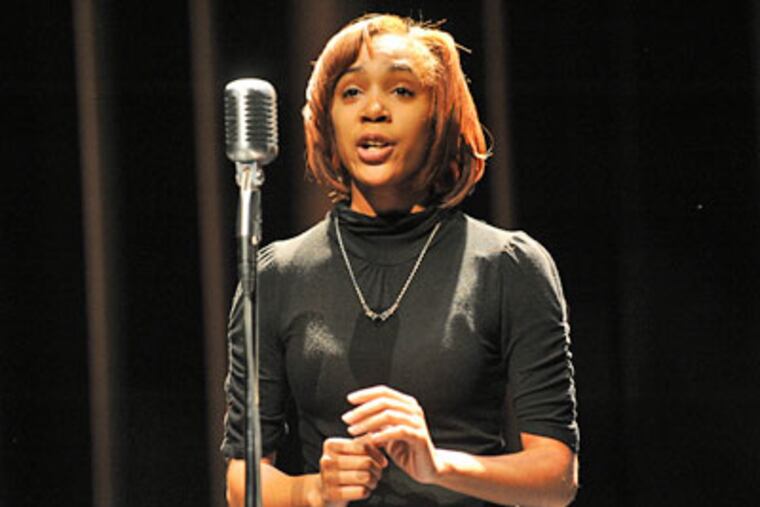
Onstage, Dubé hooked her thumbs in her jeans pockets before launching into "Unholy Sonnet 1," by Mark Jarman, an ironic poem about God. Steele clicked across the wooden stage in high-heeled boots to deliver "My Last Duchess."
There were eight contestants, three rounds of poetry. Stewart saved "If" for last. His voice boomed and fell, turning tender on the poem's final words, "You'll be a man, my son." His classmates - 50 of them - hooted and clapped, and a student from Dubé's school muttered, "He's fantastic. He's going to win."
He did - along with a girl from Mainland Regional High School in Linwood who offered a tear-provoking reading of "the mother," a poem about abortion by Gwendolyn Brooks. The two will compete, along with four students from central and northern New Jersey, in the state contest tomorrow in Trenton, where poetry will - for a few hours, anyway - be alive and at center stage.
"People who say poetry is dead are dead wrong," Stewart said. "Look at Maya Angelou. She's still doing her thing. There's a whole culture of poetry underneath our feet."