Flu absences present challenges to schools
Last night's scheduled homecoming dance at Rancocas Valley Regional High School in Mount Holly was postponed after the H1N1 death of a student last weekend and recent high absenteeism.
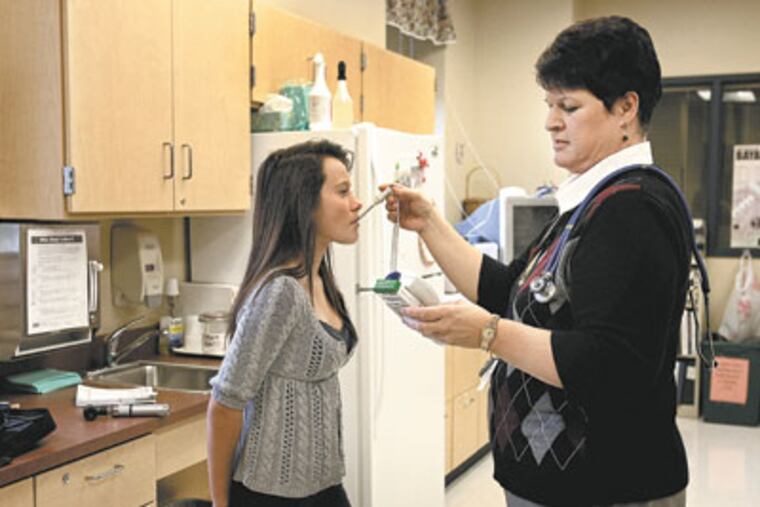
Last night's scheduled homecoming dance at Rancocas Valley Regional High School in Mount Holly was postponed after the H1N1 death of a student last weekend and recent high absenteeism.
In Pemberton Township, 15 percent of the district's 5,000 students were out Wednesday, double the usual rate this time of year.
And in the Pennsylvania suburbs, attendance has been off 10 to 12 percent in past weeks, up to three times the norm. Some schools have reported as many as 23 percent of students absent; two parochial schools closed temporarily.
Whether it's H1N1, seasonal flu, a cold, or extra parental caution, teachers across the region are facing many vacant desks. And that leaves them with a big assignment: helping students keep up with their studies.
The challenge is likely to keep educators busy all school year as the flu hits in waves, officials said.
"We've seen some classes with half their kids out. That makes it very tough on teachers, trying to juggle classwork and makeup work for students," said Timothy Quinn, superintendent in the 5,400-student Methacton School District in Montgomery County.
"There are things that have to be done," Pemberton Township Superintendent Michael Gorman said. "Teachers have contractual hours, and then there are the hours beyond the school day for the best interests of the students."
Helping children recover academically after they've recovered physically is "going to be a continuing issue," said Michael Moskalski, superintendent and principal of Rancocas Valley Regional High, who anticipates a large number of sick children in the spring.
"This is a pandemic," he said. "There's a lot of unpredictability."
High absentee rates are not new, but this year, sickness began to take its toll just weeks into the semester.
There were so many absences among the staff and students at the Freedom Academy Charter School in Camden that it closed Monday. It will reopen tomorrow.
Two Philadelphia archdiocesan high schools, Archbishop Carroll in Radnor and Bishop Shanahan in Downingtown, closed in early October because of H1N1. They were the only schools in the Pennsylvania suburbs to cancel classes.
At Carroll, absenteeism peaked at 38 percent, and about a third of students were out at Shanahan. "Everything's back to normal now," archdiocesan spokesman Kevin Mulligan said.
Some districts, such as Philadelphia and Camden, have not been hard hit by flu. Tracey Williams, assistant director of health services for the Philadelphia School District, attributed the lack of cases to an education campaign launched in the spring.
The district encouraged parents to keep sick children home and emphasized proper hand-washing, coughing techniques, and other precautions, she said.
But in other districts, sickness has decimated classrooms. Kathleen Sheehan, a third-grade teacher at 290-student Aronimink Elementary in the Upper Darby School District, had 12 of 19 students absent at one point, and nearly all of her pupils have missed some time. In her 22 years at the school, she said, "I've never seen anything like it, not even close."
During the week of Oct. 19, Sheehan watched the progression of empty desks in her class. "I could see the flu moving across the room. The kids by the window were still there, but the middle of the class and toward the door - they were gone."
To cope with the lost time, an increasing number of students are taking tutorial and prep classes. They've gone online for assignments while home sick.
"We have teachers putting in more hours," Pemberton Township's Gorman said. "We have an extensive tutorial program at the beginning and end of the day, and teachers have Web sites where students can access assignments."
Sheehan made her ailing students homework and review packets that were picked up by parents or delivered through classmates or siblings, she said.
In some ways, "it was good to have everybody sick at the same time," she added. "I could catch everybody up at the same time once they came back."
At Aronimink, 67 students - 23 percent - were absent Oct. 23. By comparison, two children were out on some days in September. Last week, 12 were absent.
The H1N1 death of a 17-year-old sophomore at Rancocas Valley Regional High and others across the region have so concerned parents that some have kept children with a sniffle home to be on the safe side, school officials said.
Nineteen people have died of H1N1 in New Jersey, four of them younger than 18. At least 18 people have died of it in Pennsylvania, none children.
Asked if she had gotten panicky calls from parents, Sue Leimbach, health-services coordinator at the West Chester Area School District and a nurse by training, said, "All day, every day, every hour."
"Parents are very anxious, and there are a lot of rumors," she said. For example, they "say they heard that if one more kid is out, the schools will close. I always tell the parents that if there's 10 percent out, there are 90 percent in, and we are in the business of educating children."
Parents with sick children are stressed, Leimbach said, both about their children's health and lost time at work while their children recover.
"We're begging parents to keep kids home until they've been fever-free for 24 hours without medicine, but it's really, really tough on them," she said.
"But when they send their children in too soon, it doesn't work. The fever goes back up, and we have to call the parents and tell them, 'You'd better come and get them again.' "
The surges in illness and absences also have taxed maintenance crews. At Rancocas Valley Regional High, workers are using disinfectants to clean all hard surfaces daily rather than weekly, as they had before. Other schools are doing the same.
Students also are doing what they can.
In a high school telecommunications class in the Pottstown district, students made a Sanitizer Man video in which the superhero jumps in to spray antibacterial mist on the hands of a student who sneezed into her palms instead of a tissue or her crooked elbow.
District communications coordinator John Armato has even changed the goodbye message on his cell phone from his trademark "Have a great day" to "Have a great day, and remember to cough into your elbow."
In the Methacton district, where student absenteeism has gone as high as 13 percent, illnesses among teachers have been manageable, said superintendent Quinn. The big worry is bus drivers who get the flu.
The district has its own bus fleet, and qualified replacements are hard to come by. Administrators have asked people in the maintenance department who have driven buses to be ready to step in, Quinn said.
But the major focus at Methacton and elsewhere in the region has been on helping students catch up on their studies. That responsibility falls on teachers.
West Chester District Superintendent Jim Scanlon feels for them. "They tell me that it's been exhausting," he said. "They would have eight kids out of 25 out one day, and the next day another eight would be out."
Will academics be hurt?
"We go through flu season every year. This isn't that different, so far," Scanlon said. "We're all coping."