Senior scholars enjoy college learning stress-free
Mae Pasquariello doesn't have anxiety dreams about hourly exams, finals, or overdue papers. She doesn't worry about grades, or even class participation.
Mae Pasquariello doesn't have anxiety dreams about hourly exams, finals, or overdue papers. She doesn't worry about grades, or even class participation.
It could be because the 78-year-old earned her bachelor's degree in economics back when Dwight D. Eisenhower was president.
Yet Pasquariello is still in school - actually, at the same Ivy League campus in Philadelphia. It's just that this time around, she's taking classes as a senior auditor. That means she gets all the perks of a University of Pennsylvania classroom with none of the pressure.
"It's so liberating just to be concerned with learning," Pasquariello says. Senior auditors don't take tests, and they aren't allowed to speak up in class unless they're invited. They just get to sit back and enjoy being educated for education's sake.
These "silver scholars" are part of a growing movement. An estimated 60 percent of American colleges are offering some kind of auditing opportunities for those typically no longer on the sunny side of 60, and according to the National Association of Continuing University Education, it's rising in popularity.
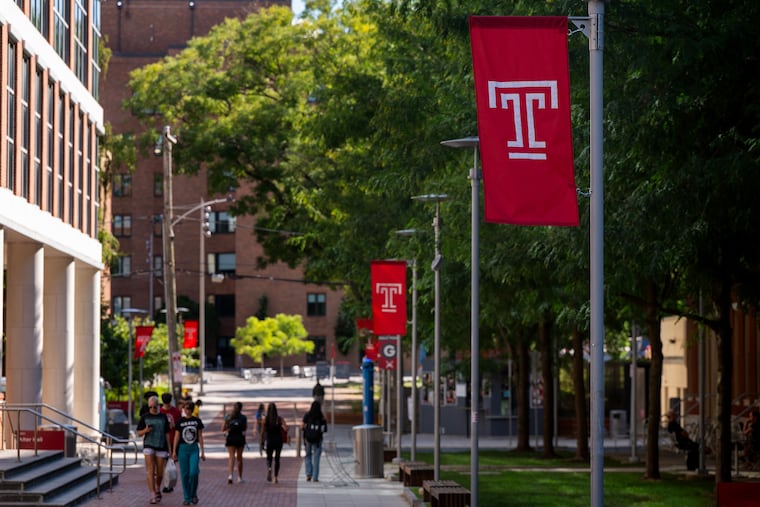
Besides Penn, Temple has an auditing program for alumni and spouses that has seen a 40 percent jump in enrollment since last year. This semester, 170 are taking classes.
At Villanova's Senior Citizens Personal Enrichment Program, enrollment is at 95 this semester, up from 60 auditors at the same time last year.
And at Rutgers University, this year there are 384 auditors at the New Brunswick campus. And Newark and Camden's enrollments are climbing steadily, according to program administrator Kay Schechter, a trend she attributes to word-of-mouth endorsements and a more aggressive information campaign.
Penn's Senior Auditing Program started in the 1970s as a noncredit offering open only to retired Philadelphia schoolteachers. The program soon expanded to include anyone older than 65, and each course cost $50.
These days classes cost $500 a course - all of it goes toward funding scholarships for undergraduates in the College of Liberal and Professional Studies - and about 160 seniors are enrolled.
For people like Pasquariello, it's still a bargain.
The Bala Cynwyd woman has always had a passion for education. She originally got her undergraduate degree from Penn in 1953, but she later earned two master's degrees from Temple and St. Joseph's.
"I got married and had three kids, but something was missing. I broke the unspoken suburban code of the 1950s when I was restless as a homemaker," she said. "Continuing my education saved me."
First she became a teacher for students with long-term hospital stays, then she was a guidance counselor.
Still not satisfied, Pasquariello started taking additional courses at Penn. Over the last 30 years, she has studied women and religion, Italian cuisine and culture, 20th-century American poetry. She even took a course about gun control that had her practicing on a shooting range.
"I'm committed to being a lifelong learner. I'll be doing this as long as I can walk into a classroom."
A 2007 study by the Education Resources Information Center based in Washington showed this age group comprises enthusiastic learners. Input from 135 college faculty members teaching classes audited by older adults showed the seniors were conscientious, motivated, and engaged. They also earned high grades for their attendance.
At 86, Leonard Feldman might be expected to bask in leisure. Instead, the CPA is managing a daily workload at the Morris J. Cohen & Co. accounting firm in Center City.
And then there's his student life.
The Penn campus is familiar to Feldman, who was an English and journalism major there, getting his undergradaute degree in 1947 after he served in World War II. He also earned a master's in business administration at Penn in 1949.
Then 50 years later, he returned. Since the late 1990s, Feldman has been hopping on the subway surface line to audit Penn undergraduate classes. It feels like it used to, he says, but with a few exceptions.
"I take notes the way I did back in the 1940s, but the kids today don't bother with notebooks and pens - they use laptop computers," Feldman said. "That made me realize that I'm in a new world."
Most seniors agree that technology has transformed the learning experience. Yet they say there are many other changes since their time on campus:
Students dress far more informally - and so do many professors. Few ties, few skirts, lots of jeans.
Course offerings are far more diverse, and more fun. Undergraduates are less focused on their future careers, more open to nontraditional possibilities.
What remains the same?
Students still complain about the workload and the food. Exams are stressful. Grades matter. Romance is alive and well.
The seniors' return to school also seems to increase their appreciation for their first educational experience. Feldman realizes how exceptional his professors were - and are. "I've had professors like Drew Faust, who's now the president of Harvard, and that was a privilege," said Feldman, who also praises distinguished history professors Jonathan Steinberg and Thomas Childers, both of whom have been particularly welcoming to seniors.
This year, it's Russian history that's rounding out this senior student's passion for learning. Yet he does far more listening than talking.
"The kids at Penn are paying about $50,000 a year to be there, so it's their show," Feldman says. "But I feel so fortunate that I can learn with them."
Penn professors have the option to allow auditing seniors in their classes. History professor Daniel Richter is one who flings open his classroom doors.
"I welcome the seniors," Richter said. "They ask great questions, they always seem deeply engaged with what's going on in class, and besides, they laugh at my jokes."
Richter's fall semester class in U.S. history has 60 students, including three senior auditors. "They bring a level of life experience that allows them to see things differently than 20-year-olds do. And they're never afraid to ask their questions."
Marvin Verman brings that life experience with him to Penn. Now 77, Verman came from Pittsburgh when he had the opportunity to earn a master's degree at Penn in architecture and to work under Louis Kahn. Verman's imprint includes Washington Square West and the 1200 block of Locust Street.
Today, the architect is officially retired. But not from learning.
"I've always wanted to plug up the holes in my education," he said.
Particularly in seminar courses, Verman had chances to interact with the undergrads, and recalls one class with only four students, all of them children of Soviet Jewish emigres. "I had been very active on behalf of Soviet Jews back in the 1970s, and I could share that with these kids. They really were fascinated."
Leila Verman, 76, a social worker with a background in community mental health, joined her husband as an auditor a few years after he signed on. She recalls a meaningful experience when she was paired with an undergraduate on a Holocaust writing project. "I'd worked on a mental health study with local survivors, so I had some real life experience to offer my undergraduate partner."
The intergenerational connection delights her. "These kids see that we grannies can be right there with them, still learning, still growing. That's a pretty powerful message."
Senior Auditing Programs
Temple University alumni and their spouses or partners, 50 and older, can take university classes on the main campus, the Center City campus, and in Ambler, for a fee of $100 per course. No course credits are offered. Temple also offers the Osher Lifelong Learning Institute (OLLI) featuring a broad spectrum of courses, primarily for retirees. Classes are at 1515 Market St. Registration, which entitles the learner to unlimited classes, is $240 per year. For information, 215-204-1505.
The Villanova Senior Citizens Personal Enrichment Program invites seniors 65 and older to audit undergraduate courses, free of charge. Admission is limited by space availability and instructor permission, and offers no college credit. For information, 610-519-6000
New Jersey residents 62 and older can attend undergraduate courses for free on a space-available, noncredit basis at Rutgers University campuses in Camden, New Brunswick, and Newark. For information, 732-932-7823, Ext. 682.
For more information on Penn's senior auditing program, call 215-746-7756 or go to www.pennlps.org.