No consensus on prevention at South Phila. High meeting
No one disputes that 30 Asian students were victims of racial violence last month at South Philadelphia High School. Yesterday, however, there was little agreement on the reasons behind the problem, who or what was to blame, or how to prevent it from happening again.
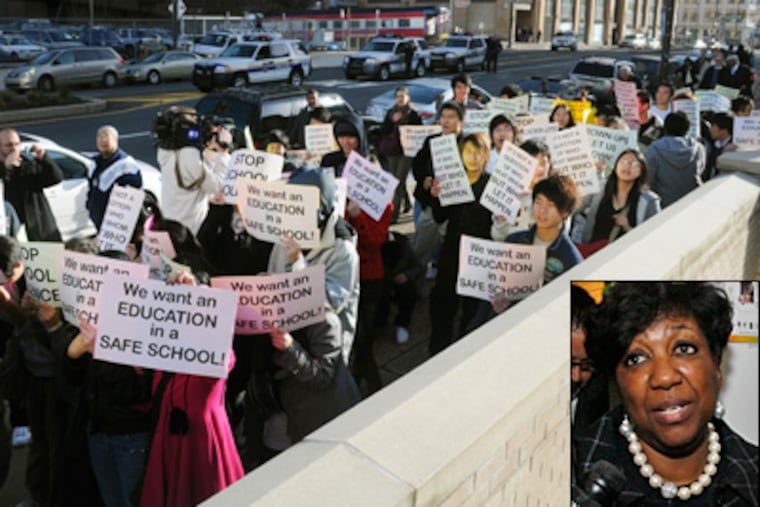
No one disputes that 30 Asian students were victims of racial violence last month at South Philadelphia High School.
Yesterday, however, there was little agreement on the reasons behind the problem, who or what was to blame, or how to prevent it from happening again.
As part of an investigation begun last week, the Pennsylvania Commission on Human Relations called a private meeting with representatives of the Asian community to get their take on the trouble.
Philadelphia Schools Superintendent Arlene Ackerman had not been invited. But on Monday, she contacted Commission Chairman Stephen A. Glassman and asked to be heard.
So for four hours yesterday, Ackerman and the Asian advocates presented widely divergent analyses of the Dec. 3 attacks, in which Asian students were beaten by large groups of primarily African American students.
The superintendent said that she wanted the finger-pointing to stop, that the underlying problem was citywide violence and racial discord spilling over into schools. She also suggested that the trouble at South Philadelphia High might be gang-related, a theory never before voiced.
Activists have accused the district of long turning a blind eye to the problems of immigrant students. The district's fixes - including more counselors, cameras, police officers, and diversity training for students and staff - are a start, they say, but only a start.
"There's clearly some disagreement about the nature of the violence and the nature of the remedies that are being put into place," Glassman said in recounting the meeting.
Ackerman had booked a bus and brought along a number of South Philadelphia High "student ambassadors" - predominantly African American students not involved in the Dec. 3 fights - to talk about their efforts to promote harmony at the school.
Absent were any Asian students who had been victims of the attacks or who had boycotted the school last month.
"We don't know" why Ackerman enlisted no Asian students who were involved in the strife or its aftermath, Glassman said.
"It was very disappointing to us that she brought a busload of students from South Philadelphia and not one of those was one of the students who had been victimized, or one of the students who had boycotted," said Nancy Nguyen of Boat People SOS, an organization that aids Vietnamese people in the Philadelphia area.
District spokeswoman Evelyn Sample-Oates said the meeting was "productive."
Ackerman told the commission "this is a citywide violence problem, not just a racial issue," Sample-Oates said. "It starts on the streets."
It was important that the superintendent address the commission, her spokeswoman said.
"They were hearing from the community, but the community is just one side of the story," she said. "She wanted to make sure that the commissioners heard the students' side - that's one voice that has been silent."
Sample-Oates said Ackerman was frustrated by the attention the case had received.
"She said, 'I'm the superintendent of almost 200,000 kids, and I care about them all,' " said Sample-Oates. " 'This is a distressed school district. We're losing money and cutting programs, and this is taking up a lot of my time.' "
Nguyen said that the district was generalizing and failing to take responsibility for a school where immigrant students, Asian and Hispanic, go to class in fear.
"We really hope we can have serious, face-to-face conversations and not have the school district hide behind a shield of students," Nguyen said.
The commission plans to interview student victims and others in the community, Glassman said. Public hearings will be announced soon.
In addition to the commission's investigation, retired Judge James T. Giles has been hired by the district to probe the case. His report is due later this month.
The city Human Relations Commission is holding hearings, and a federal civil-rights claim is expected as well.
Officials at the Vietnamese embassy to the United States also said yesterday that they had asked the federal government to monitor the situation at the school.
Last week, Nguyen Tien Minh, Vietnam's deputy ambassador to the United States, met with representatives from the Bureau of Consular Affairs at the U.S. State Department to discuss the safety of Vietnamese students at South Philadelphia High.
An embassy spokesman confirmed that the meeting occurred and that Minh would monitor the situation carefully, but offered no other details.
"It's just another set of eyes watching what's going on," Nancy Nguyen said. "They're stepping up the pressure."