Minicamp gives girls a look at math, science careers
Angel Hambrecht likes math and science and is pondering a job in biomedical engineering, but not many of her female friends at West Deptford High School, where she is a junior, share those interests.
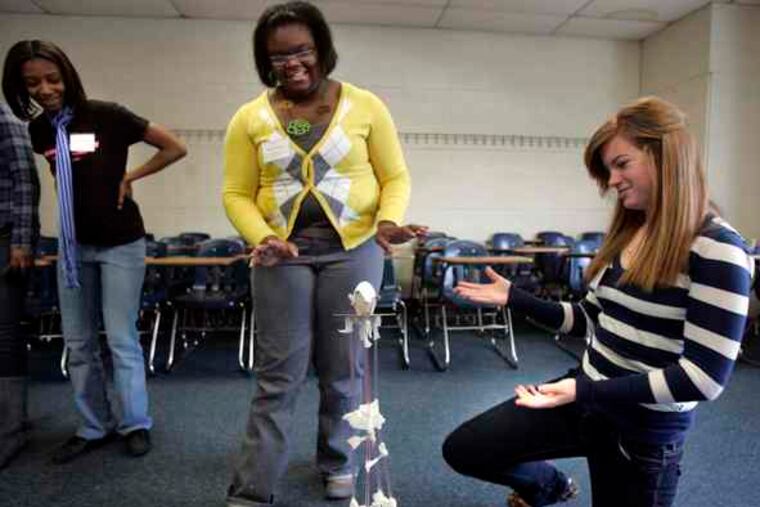
Angel Hambrecht likes math and science and is pondering a job in biomedical engineering, but not many of her female friends at West Deptford High School, where she is a junior, share those interests.
"It's different. It's kind of scary," she said, explaining why some girls avoid math and science.
On Saturday, however, she was surrounded by about 135 other female high school students who think it's cool to talk about polymers, the aerodynamics of roller coasters, and the similarities between chocolate and asphalt at Widener University's Engineering Mini-Camp for High School Girls.
Eleven years ago, the university created the camp to give high school girls a taste of what it's like to work as an engineer. At one of the 18 labs on different subjects offered Saturday, that taste was literal.
During the "Chocolate Asphalt" Lab, girls first sifted walnuts, coconut, oatmeal, and raisins. The sifters help engineers determine the size of the various materials and create the proper mix for real asphalt, explained Krista Pohl, a workshop leader and a civil designer in the rail department at HNTB Corp. in Center City.
The girls added chocolate to the oatmeal mixture and spread it with a rolling pin to mimic a steamroller while Pohl offered advice on engineering careers.
"Don't become an engineer just because you like math and science," she said. "I don't really like math and science, but I like making things. What they want in an engineer is for you to solve problems."
Keyanna Wigglesworth, 15, and a sophomore at Burlington Township High School, asked whether Pohl knew anyone who had obtained an engineering and a law degree. Those degrees work well for patent lawyers and for people interested in becoming general counsel at an engineering firm, Pohl answered.
"I hadn't really considered engineering, so I'm just kind of taking everything in," Wigglesworth said.
Other lab topics included programming robots, roller-coaster design, wind tunnels, and building electric-powered Lego cars.
At a lab on lie detectors, Ken Wochele and Kate Williams, both engineers at Boeing's Ridley Park facilities, explained Ohm's law, how electric current flows more freely when resistance drops.
"As you get nervous, as you lie, as your heart rate goes up, you sweat more, and resistance drops," Wochele said, allowing the machines to detect fabrications.
The students then connected pennies, transistors, a speaker, and other materials to make small lie detectors. Students pressed their fingers against the two pennies, and soon the room was trilling with sound as the lie detectors reacted to current in their skin.
The lie detectors would have to be calibrated to each person to detect falsehoods, he said, but the exercise demonstrated how circuits work.
Williams urged the students to seek out co-ops and other work-study opportunities.
"It's a great way to check a company out and for them to check you out," she said.
Widener student Patty Squicciarini said men make up the majority of her engineering classes, but she thinks that's starting to change.
"There are not a lot of females in my classes," she said, "but more are coming."
Several speakers said engineers must master math and science. "Get the technical stuff down," said Ruth Ochia, an adjunct professor at Widener who also provides expert research on accidents. "Do the math. Love the math, because you're going to use it."