Incoming Drexel president has ambitious plans
Two months before former Drexel University president Constantine Papadakis died, he met with John A. Fry, president of Franklin and Marshall College, to discuss starting a Drexel medical school campus near Lancaster General Hospital, where Fry is on the board.
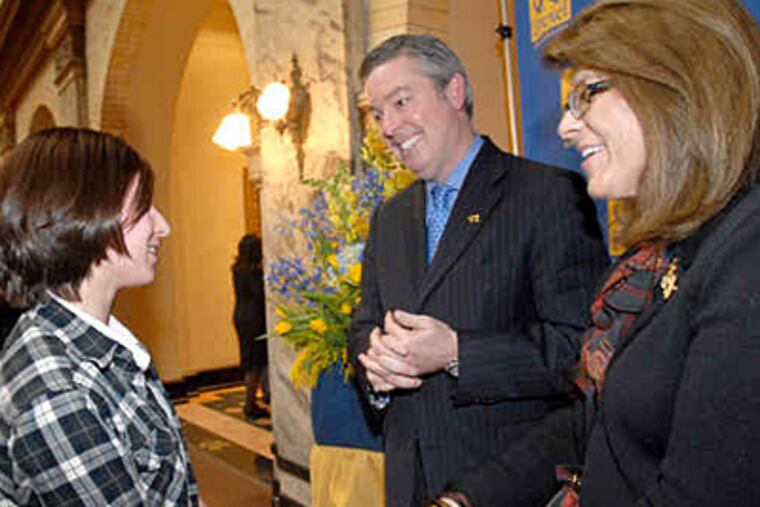
Two months before former Drexel University president Constantine Papadakis died, he met with John A. Fry, president of Franklin and Marshall College, to discuss starting a Drexel medical school campus near Lancaster General Hospital, where Fry is on the board.
The two - who had known each other since Fry's days as a University of Pennsylvania executive - were enthusiastic about the project, still in its early stages.
Fry said Friday that he was interested in pursuing the idea, only now as the incoming president of Drexel.
It's just one way in which Fry, 49, who was at Penn for seven years and at F&M the last eight, has kept his Philadelphia connections.
In a two-hour interview one day after Drexel's trustees had unanimously elected him to the post, Fry outlined areas to address when he takes the helm Aug. 1.
He envisions more living space for students on campus, closer ties with Penn, a development plan to improve the school's gateway to Center City, and a broadening of Drexel's network - probably through e-learning - to other states and countries, such as China and India.
Known for his boundless energy and aggressive agenda, Fry may be someone who can fill the shoes of Papadakis, who started medical and law schools, increased enrollment, and improved finances during his 14-year tenure.
Fry said he would start as he had at F&M - meeting people on campus to learn as much as he can before collaborating on a plan for the 22,000-student university.
"Within the not-too-distant future, I'll be able to have a really well-formulated set of ideas. It doesn't take me long," Fry said.
Born in Brooklyn, N.Y., to a government-relations worker for AT&T and a stay-at-home mom, Fry attended Catholic schools. A cross-country runner, he was lured to Lafayette College, a liberal arts school in Easton, Pa., by the coach. He became student government president, which earned him an ex officio spot on the board of trustees.
"That was my first real glimpse into the world of college governance and management," he said. "I really found it sort of fascinating."
After graduating, he worked in the auditing division of what is now KPMG and went to graduate school at night, earning a master's degree in business administration from the Stern School of Business at New York University. When the firm needed a consultant to help reorganize a Virginia university, he volunteered and confirmed his penchant for higher education.
Coopers & Lybrand tapped Fry to run a Philadelphia operation focusing on colleges and doing organization, governance, team-building, and planning. Eventually, he ran the national branch and worked with Harvard, Yale, Columbia, and Stanford Universities - and with Penn, his biggest client.
After he helped new Penn president Judith Rodin search for a new executive vice president in 1995, she decided she wanted him. At 34, he had never run anything larger than a 25-person consulting team - and told her so - but Rodin believed in him, he recalled.
"She knew I could do something that I didn't know I could do," he said.
At Penn, he oversaw finances, human resources, facilities, and other areas and was a key architect of the school's largely successful effort to revitalize its West Philadelphia neighborhood. He helped bring in a movie theater and grocer, was involved in the creation of the public Penn Alexander School, and launched the University City District, fostering relations among colleges, retailers, and residents. His ties to Penn remain: The day he got the Drexel job, he returned home to find a dozen roses from Penn president Amy Gutmann.
Anyone wondering whether Fry can keep up with the pace at Drexel need only consider: On commencement day last spring, he led the main ceremony at F&M and bid the speaker, Colin Powell, goodbye. He attended a private session for a group of minority graduates, then drove more than six hours to southern Virginia. There, he held commencement for seniors who had won the NCAA Division III national title in women's lacrosse.
By morning, he was back at F&M to greet prospective students on an admissions tour.
As he did at F&M, Fry plans to visit Drexel often before Aug. 1. Before he started at F&M, he spent Fridays on campus - "Fridays With Fry" - talking to staff. At F&M, Fry held office hours for students, which he also plans to do at Drexel.
"It's very easy for a new president to be spun by well-meaning colleagues [who say] everything is fine. A lot of times you find out . . . students are feeling these pressures and are unhappy," he said.
Over time, the meetings became "a little think tank for how to improve Franklin and Marshall, with students taking the leadership role," he said.
By showing respect for the faculty's work, Fry overcame skepticism by some members who were concerned he did not have a doctorate. He did the same at Penn.
"He seems to be able to negotiate that terrain incredibly well, even though he is the quintessential entrepreneur, go-go business guy," said Tom Kecskemethy, assistant dean of Penn's Graduate School of Education.
Fry conducted staff meetings at a remodeled dining-room table, sitting in the middle - not at the head.
"It creates a lot of dialogue," he said.
Fry moved out poor-performing staffers if giving them support had failed. He would tell his team that he needed all A employees, and that they needed to help Bs become As and Cs become Bs, said Thomas J. Kingston, former F&M chief financial officer.
"To me, it's not fair to people who pay tuition, people who give donations, people who give government grants to have people who don't carry their weight," Fry said.
At F&M, Fry launched major land-development projects, which caused friction.
"Too many times the deals are done before they are announced to the local neighborhood. That creates distrust," said William Cluck, a lawyer representing a citizens group.
Despite his busy schedule - he rises at 4:45 a.m. and goes to sleep at 11 p.m. - Fry served on the boards of his church and the private school his three children attended. He plays squash and tennis, bikes, and works out daily. He recently bought a 3,000-book collection of university histories and college presidents' biographies, which he can't wait to dig into.
While Fry put down roots in Lancaster, he thought about returning to Philadelphia. He kept his Penn "Ben on the Bench" statue of Benjamin Franklin on his desk and a "dragon" statue - a gift from the Papadakis team in 2002 - at home.
He met several times a year with Papadakis to talk shop. They had planned to collaborate on a medical school campus connected with the Lancaster hospital, possibly offering a bachelor's/medical degree on a fast track, Fry said.
Given his track record at Penn and F&M, Fry said he was excited about helping Drexel build a gateway to Center City, especially on Market Street and on Walnut and Chestnut. While the university has created additional retail and food options, more are needed, he said.
He'll try to smooth intersections with Penn and neighborhoods: "I see edges where Drexel looks like it touches Penn but doesn't quite lock."
For students, he's interested in creating more residence-hall space, nurturing ties between faculty and students, and breaking down the school into smaller units with stronger bonds. About 4,250 students live on campus.
He'll also look closely at costs (annual tuition and fees average $36,000) and would like to explore options to allow students to get their degrees in less time, in three or so years.
Fry plans to visit Drexel's graduate campus in California and look at the viability of a Papadakis proposal to start an undergraduate campus there.
But he's more excited about creating a wider network of graduate campuses for Drexel in growing cities and other countries, possibly through the university's growing e-learning network.
Where he will live depends, he said, on where he can find the best schools for his two youngest children, ages 9 and 15. He will consider the Drexel president's residence in Wayne, he said.
"I take my kids to school every day," he said. "I don't want to change that."
John A. Fry's Favorites
Book: A First-Class Temperament: The Emergence of Franklin Roosevelt, by Geoffrey C. Ward.
Musician: Jack Johnson.
Movie: Chariots of Fire.
Vacation spot: A family house in East Hampton, N.Y.
Sports team: Philadelphia Eagles.
Food: His wife's chili.
TV show: The Office.
Leader in his field: John McCardell, president emeritus of Middlebury College in Vermont, and the late Constantine Papadakis, who was president of Drexel.
EndText