Competing at the "Olympics of Science Fairs" scientists compete
Paul Harryhill was curious. Which is the better bat? Wood or aluminum? So the seventh grader at St. Aloysius Academy in Bryn Mawr decided to find out. Measuring vibrations, he determined the location of each bat's sweet spot. Then, with a homemade batting machine and a hitting T, he tested how far each bat, wood or aluminum, drove a series of balls.
Paul Harryhill was curious. Which is the better bat? Wood or aluminum?
So the seventh grader at St. Aloysius Academy in Bryn Mawr decided to find out. Measuring vibrations, he determined the location of each bat's sweet spot. Then, with a homemade batting machine and a hitting T, he tested how far each bat, wood or aluminum, drove a series of balls.
His conclusion: Aluminum bats are better. "The sweet spot is closer to the end of the bat, and there's more bat speed at the end of the bat," Harryhill explained. "The more speed, the farther the ball goes. It increases power and hitting distance."
Harryhill, 13, was one of 973 students from 237 schools who competed Wednesday in the 62d Delaware Valley Science Fairs at the Greater Philadelphia Expo Center at Oaks, Montgomery County.
The fledgling scientists, inventors, and problem-solvers in grades six through 12 had placed in school, county, and regional science fairs to advance to this competition, which bills itself as "the Olympics of Science Fairs."
Nearly $1 million in scholarship and prize money was at stake, and winners will vie next month in the Super Bowl of Smarts, the Intel International Science and Engineering Fair in San Jose, Calif.
"The quality this year is really impressive," said Henry Disston, president and executive director of Delaware Valley Science Fairs Inc., the nonprofit that runs the event with considerable support from Drexel University. "If you read the newspaper, you may think the younger generation is falling apart. But not all kids are watching The Simpsons or playing video games. Look around here, and you'll see we have a bright future. There are so many problems in this country, and these people here will solve them."
Volcano models and mock-ups of the solar system were conspicuously absent. Instead, there were exhibits that reflected current concerns such as wind energy and water quality.
The students competed in such fields as biochemistry and botany, earth and space sciences, medicine and health, physics, and microbiology.
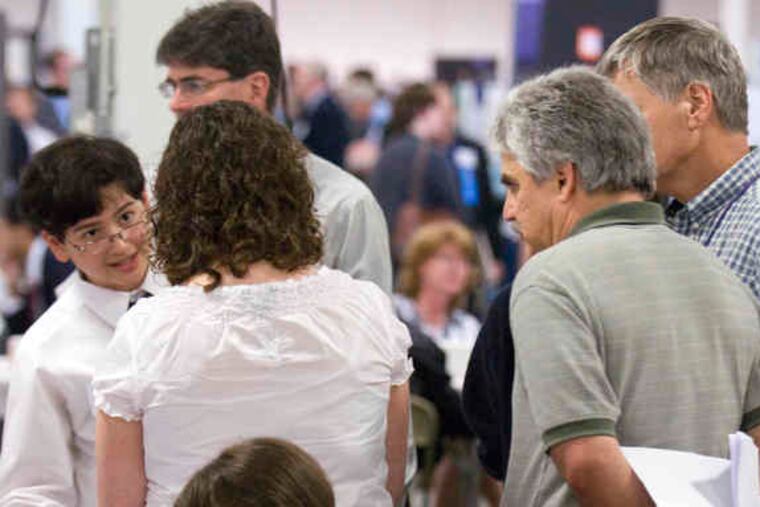
Parents, teachers, and the public were barred from the exhibition hall Wednesday as knots of judges, learned in the sciences, examined the projects and questioned the exhibitors. Polite and eager to impress, many of the boys wearing ties and the girls wearing dresses, the exhibitors - sweet, shy, nervous, winsomely confident - explained their theories, methods, and conclusions with the conviction and enthusiasm of doctoral candidates defending their theses at Oxford.
"There's plenty of reason for excitement here today," said Francis Waller, 67, a retired organic chemist charged with choosing medalists from among 10th-grade category winners. "Some of what I've seen is master's-level work."
The hall vibrated with intellectual energy, but not every project was freighted with scientific gravitas. For instance: Victoria Ward, 17, a junior at Middletown South High School in Monmouth County, N.J., undertook a statistical analysis of golf-ball performance.
Her conclusion: Don't waste your money on expensive golf balls.
"Medium-quality, medium-price balls are most beneficial," Ward said, "in terms of distance for a player with high-swing speed."
Stars have always been the passion of Nicole Melso, 17, a junior at Springfield High School in Delaware County. Her project's title: "A Continued Study of Quiescent Precursors to Cataclysmic Variable Star Outburst."
Last year, she won a gold medal at the science fair and advanced to the international contest. In preparing this year's exhibit, she sought guidance from professional astronomers as far afield as New Mexico. Asked to explain her work in layman's terms, she said: "I found that a certain type of light-wave frequency can predict a certain type of star outburst."
There followed then another question, impertinent and decidedly uncosmic:
"See any cute guys around here?"
Melso gave a look that telegraphed incredulity.
"This," she said levelly, "is a science fair."