Teachers' book bank in danger of closing
In the old audiovisual studio of Martin Luther King High School, "Junie B. Jones," "Captain Underpants" and "The Cat in the Hat" wait to escape cardboard boxes for the shelves of the Philadelphia Reads Book Bank.
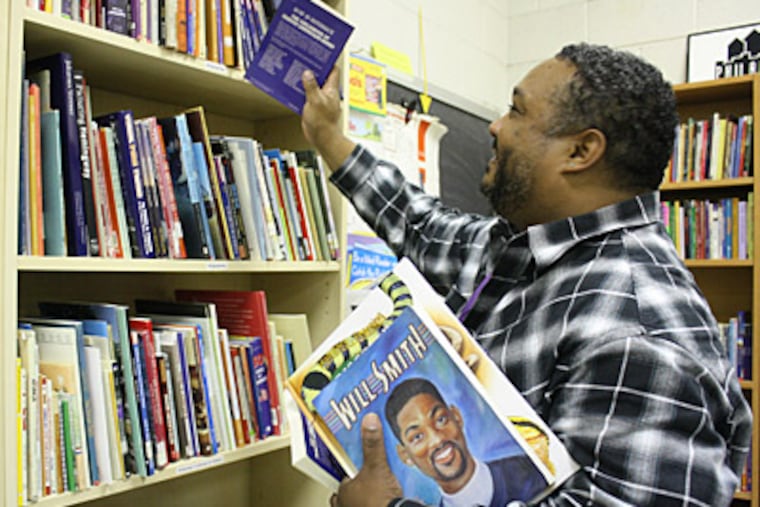
In the old audiovisual studio of Martin Luther King High School, "Junie B. Jones," "Captain Underpants" and "The Cat in the Hat" wait to escape cardboard boxes for the shelves of the Philadelphia Reads Book Bank.
Within the past month alone, more than 200 teachers have visited the book bank, open from 2:30 to 5 p.m. every Wednesday, to shop for their classroom libraries. Teachers from public and charter schools, after-school programs and day-care centers have walked out with more than 11,790 free books and 3,997 free school-supply items.
But unless Philadelphia Reads can raise an additional $40,000, the covers will close on this 5-year-old haven for teachers who often dug into their own pockets to encourage reading inside and outside the classroom.
"I was able to raise a little money this week to keep it open another month and a half," Executive Director Adrienne Jacoby said Friday. "But if the money doesn't trickle in, it will close."
In the past, donations from individuals and companies, as well as local book drives, have funded the nonprofit group, but this year the $100,000-a-year operation has seen its costs unmet by its donors.
"If people believe in children's literacy, and if they believe children should have books, they should support this program," Jacoby said. "The public needs to know that even though the books are free, running the book bank is not."
Run mostly by volunteers in donated space, the nonprofit still has expenses, including the cost of auto insurance and gas for the vehicle used to retrieve the books.
A project of Philadelphia Reads, a collaboration between the School District of Philadelphia and the Free Library, the book bank's goal is to encourage independent reading in a city where many children enter kindergarten already behind.
"Children might come into kindergarten without knowing the alphabet," book-bank coordinator Jim Remsen said. "They are behind from the get-go and easily fall farther and farther behind."
"We're trying to fill that gap, which has been in the public schools for a long time," Remsen added. "You want to have a lot of books because you have students on different levels. Teachers know this and will pay out of their own pocket to equip their library, which isn't fair."
Before discovering the book bank two years ago, Allison Meyer, a first-grade teacher at J. Hampton Moore Elementary in Northeast Philadelphia, had a small classroom library with books that were alike in genre and reading levels.
She now has three shelves full varied books that students sign out and take home. "I struggled my first year with books," Meyer said as she searched for dinosaur books, a favorite topic for one of her students. "If it weren't for this organization, I don't think I would have seen such a success rate. Now, when it's time for [silent sustained reading], they all stop what they're doing to read."
Though the book bank primarily focuses on books for kindergartners through third-graders, parenting books and other adult reference materials also line the shelves.
Sharon Harper teaches prekindergarten through second grade at an after-school program at Ellwood Elementary School, but also instructs teen moms and immigrants working for their GEDs. Harper said they use the developmental books to help them improve their life skills.
When Clyde Russell, a student adviser at Martin Luther King High School, meets with students, he usually offers a book he chooses from the bank's selection of biographies.
"I work with a lot of teen fathers, so it's good to give them positive messages and show them what they can do to work," Russell said, holding an armful of books. A biography on Philadelphia-raised Will Smith sat on top.
Though Meyer said that as a teacher "you never stop" buying outside-classroom supplies, the Greater Philadelphia Urban Affairs Coalition determined from surveys of book-bank users that those teachers spent much less of their own money, saving an average of about $100 each. It also reported the percentage of students reading at or above grade level shifted from 38 percent to 53 percent in classrooms where educators visit the book bank.
Depending on their classroom and school or program size, teachers are allowed to take from 200 to 400 books and 50 to 100 school supplies - notebooks, pencils, book bags, etc.
"Reading is so important, but we don't have the resources," first-day book-bank volunteer Brenda Cheeks said as she restocked shelves. "If you go to a library, the library closes. It's shameful for kids."
"It is very difficult to raise money in this environment," Jacoby said. "People are donating to shelter and food - which is good - but not to have an educated public is a very scary thought. When we have to shortcut children, that's not OK."
Donations to the Philadelphia Reads Book Bank may be sent to the organization's headquarters, 325 Chestnut St., Suite 903, Philadelphia, PA 19106. Or visit philareads.org/donate.html. The book bank is located at Martin Luther King High School, 6100 Stenton Ave., and is open from 2:30 to 5 p.m. Wednesdays.