Rutgers in India? It could happen
That's just one of the ideas of the business school's new dean, who is there now in an effort to pave the way.
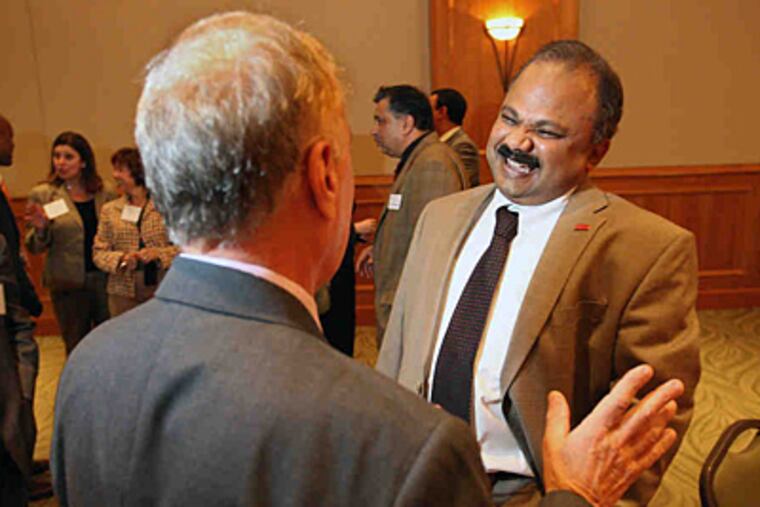
When it comes to training the region's business leaders, there is no such thing as a local curriculum, said Jaishankar Ganesh, the new dean of the Rutgers School of Business in Camden.
"Business is global. Period," he said.
Just months into his tenure, Ganesh is demonstrating that. He and Rutgers-Camden chancellor Wendell Pritchett are currently in India, where Pritchett was invited to sit on a panel on higher education.
If all goes as planned, the two also will lay the groundwork for expanding Rutgers to India.
The Indian parliament is considering a controversial measure that would allow foreign universities to offer programs in the country. Previously, they could do so only through a local partner. The measure has been championed by India's minister for human resource development.
Ganesh, who was raised in Chennai, the Indian city formerly known as Madras, met with the minister about six weeks ago. Their conversation was followed by an invitation to attend the summit, held during President Obama's visit to the country.
"Education is a big part of the Indian psyche," and the country's universities cannot meet the demands of the burgeoning middle class, said Ganesh, 45, whose parents also were teachers.
The move would advance Rutgers' commitment to international education, offering opportunities for students and faculty based in the United States, as well as attracting students who live in India. It would also provide new revenue for the university as it grapples with state budget cuts.
"This is a real opportunity," Pritchett said.
The idea that what's good for students is good for business has been a theme of Ganesh's development work since he began as a university administrator six years ago.
As associate dean of graduate programs at the University of Central Florida, a job he took in 2004, Ganesh inherited a failing executive education center.
The center had just one other employee and cost the university about $500,000 a year. It offered one program, a campus-based MBA for experienced business people.
The center now fills a building in downtown Orlando, offers several professional master's degrees, and clears about $4 million that has been used to offset state budget cuts.
Ganesh sent faculty to teach in areas of central Florida with business clusters that provided potential students. The accessibility boosted enrollment and serves as a model he hopes to emulate in New Jersey.
Ganesh's success at the center "really spring-boarded him forward in his administrative career," said Thomas Keon, dean of the Florida business school.
In 2007, in the midst of state cuts that slashed its budget 27 percent in five years, Keon asked Ganesh to oversee finances for the business school. Ganesh assisted a panel of faculty and staff deciding where to cut programs.
At the same time, he continued teaching and working with doctoral students. Students "absolutely love him," Keon said.
It's easy to see why. Ganesh is an engaging speaker, with a quick wit and a warm voice.
He received bachelor's degrees in physics and engineering in India. While working for a company that manufactured lab testing equipment, Ganesh became interested in marketing as he interacted with clients.
If his company's products fit the scientists' needs, he told them so. If they didn't, he told the scientists that, too.
"The sales guys hated me," he said. But the scientists trusted him, and sales went up, he said.
Ganesh moved to the United States and received a doctorate in international business from the University of Texas in Houston in 1995.
He began teaching marketing at the University of Central Florida. He took two years off during the dot-com boom to work with a Princeton company building data-mining software. After the bust, he returned to Florida.
Ganesh plans to live in Princeton with his 13-year-old daughter and his wife, a product manager with a background in applied mathematics and a master's in business administration.
At the 22-year-old Camden business school, which has 1,047 undergraduate and graduate students this year, Ganesh has been charged with broadening awareness of the programs offered and strengthening connections with the South Jersey business community. He plans to teach again after a year in his new role.
He also will continue to assist with Rutgers' pursuits in India. The connection to India could go beyond the Camden campus and the business curriculum, Pritchett said.
It is not yet certain that India will open its doors to foreign universities. The country has taken a "protectionist" stance, worried about the influence of Western institutions and ensuring academic quality, said Ben Wildavsky, a senior fellow at the Kauffman Foundation and author of the book The Great Brain Race.
Rutgers is among many U.S. higher-learning institutions scrambling to enter the market in India, where about 550 million people are under the age of 25.
"It's a country that's full of potential, full of people who are hungry for education," Wildavsky said.
If the doors are opened, Ganesh said, "we want to be in the mix."