Ursinus College's latest success: Its first Rhodes scholar
It's been a roller-coaster few months for Ursinus College, the small liberal-arts school with big ambitions tucked into the bucolic Montgomery County countryside.
It's been a roller-coaster few months for Ursinus College, the small liberal-arts school with big ambitions tucked into the bucolic Montgomery County countryside.
In September, the 1,750-student campus mourned the death of former president John R. Strassberger, the consummate gentleman scholar and academic leader, who transformed Ursinus from a good regional school to a nationally recognized institution.
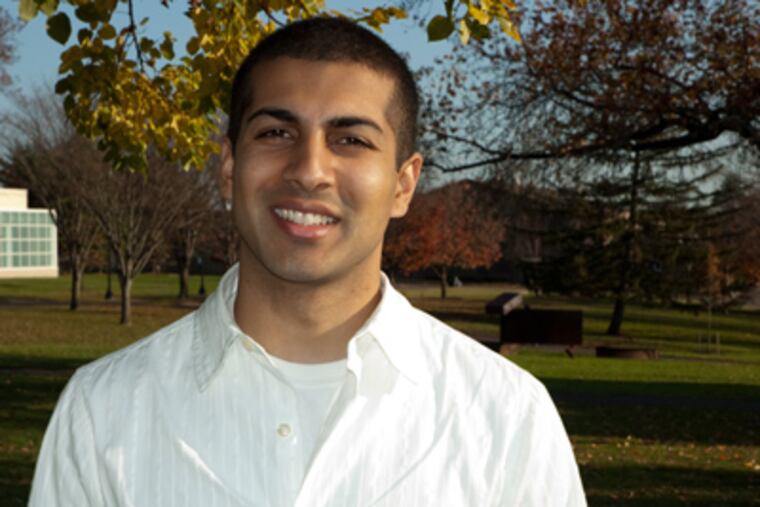
Then last weekend, something to celebrate: Aakash Shah, a 2010 graduate now studying at Harvard Medical School, was named the college's first Rhodes scholar.
"It's a vindication for all the work we've done to encourage student achievement on campus," said Gregory Weight, assistant dean for academic affairs, who worked with Shah on his application.
Shah, 22, called Ursinus "the idyllic small liberal-arts college." The Cliffside Park, N.J., native was "hell-bent" on attending a big-city college, and he strongly considered New York University. But he rejected the bigger, more famous school because Ursinus offered him a rare opportunity: the freedom to do research from day one.
New York University told him he would have to wait until his junior year, he said.
"Ursinus doesn't have the resources that NYU has, but it has dedicated faculty that are willing to reach out to you before you even set foot on campus. That absolutely sold me," said Shah, who will take a break from his medical studies to get a bachelor's or master's degree in health policy at the University of Oxford in England.
Ursinus, set on 170 acres in Collegeville, with brick walkways linking stately academic buildings and outdoor sculptures, has been on an upward swing for the last decade. Under Strassberger, the college grew from 1,100 students to 1,700; added majors in art, theater, and dance; hired about a dozen arts faculty; and added new buildings and landscaping. And it is especially known for its hands-on science programs.
It's not all good news for Ursinus, which famed author J.D. Salinger attended for one semester. A 2009 reaccreditation report from the Middle States Commission on Higher Education cited an underperforming endowment; a smaller percentage of students who accepted admission than a decade earlier; and a six-year graduation rate of 78 percent.
Yet, for the last three years, Ursinus was deemed the No. 2 up-and-coming liberal-arts college by U.S. News & World Report. The Princeton Review included it as one of 50 "Best Value" private schools, and USA Today ranked it as one of 20 schools that excel at creating "a campus culture that fosters students' success."
In the highly competitive world of academia, nothing shouts success like winning awards, especially a Rhodes. It's as exciting as sweeping the Oscars; as prestigious as having a Nobel laureate on staff; as valuable in attracting students as a brand-new gym.
Strassberger, who led the school for 15 years before stepping down in June, often said that Ursinus' reputation would be set when a student won a Rhodes or Marshall scholarship, said his friend Richard Ekman, president of the Council of Independent Colleges.
"It's a shame he didn't live to see it," he said. "There are many measures along the way in which to succeed, but this is the crowning touch."
Dallett Hemphill, a professor of history and co-adviser for the Rhodes on campus, who has worked at Ursinus for 23 years, said that, over that time, "we've been really transformed."
She credited Strassberger with driving student achievement and said she was sorry he wasn't there to enjoy the award.
Shah is one of five area Rhodes winners - including one each from the University of Delaware and Haverford College and two from Princeton University. Thirty-two scholars were chosen from the United States.
They will study for up to three years at Oxford.
Shah majored in biology and neuroscience, as well as an area that he devised: inequality studies. He came to college planning to become a medical research, but left Ursinus "completely transformed" and now wants to work on health disparities and policy.
At Ursinus, Shah was not only academically accomplished, but also popular and low-key about his many achievements, say friends and teachers.
"He's so amazing," said Rebecca Lyczak, his biology adviser. Shah found out Saturday that he won - after a day of interviews in New York - and immediately texted Lyczak.
"It was the happiest text message I ever got," she said. "In his ever-modest way, it said, 'We got a Rhodes.' "
Later, at 1:40 a.m., he sent an e-mail. "This says so much and, in my opinion, more about all of you who have provided me with opportunities, support, and guidance, than it does about me."
Lauren Mermelstein, 20, a junior biology and French major from Fort Washington, said the award "shows the level of academics that students are doing here. It really challenges you. It's really what sets us apart from a lot of other schools."
Another student, Karli Scott, 21, a senior business and economics major from Gladwyne, said a lot of people outside of Philadelphia still hadn't heard of Ursinus, "so this will bring more national attention."
That the school still has a way to go to compete with top-tier liberal-arts schools like Haverford or Swarthmore was evident when Ursinus' new president, Bobby Fong, was announced last month. Fong will step down as head of Butler University in Indianapolis.
A story in the Indianapolis Star wondered why Fong would want to become president of "a little-known undergrad college in Pennsylvania."
"Ursinus College - yes, many Butler students and alumni had to Google it - has less than half the student population, does not appear to be as highly regarded as Butler in some national academic rankings, and does not have much of a financial endowment."
All true. But Ursinus is Butler's equal by one other measure.
Each has a Rhodes scholar.