After a chaotic summer, schools open with optimism
When 800 students report this week to West Philadelphia High, it will be a fresh start in more ways than one.
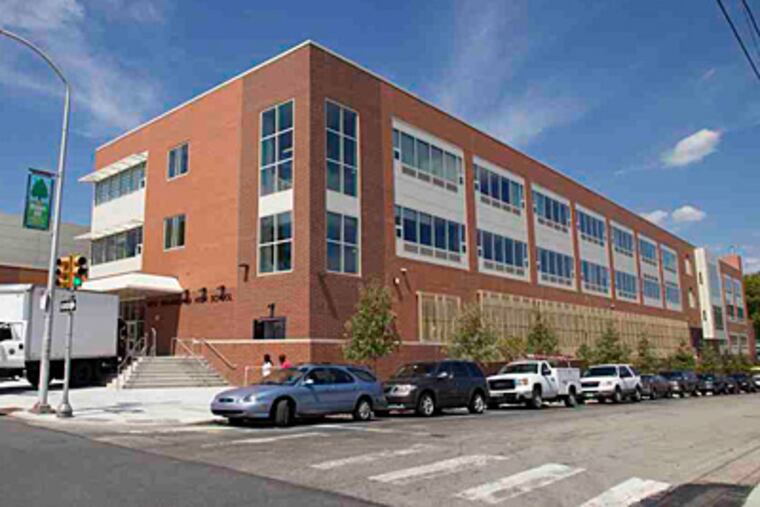
When 800 students report this week to West Philadelphia High, it will be a fresh start in more ways than one.
After a long and acrimonious summer marked by deep budget cuts, staff reductions, and the departure of Superintendent Arlene C. Ackerman, Tuesday is the first day of school for 151,000 students in the Philadelphia School District.
And West Philadelphia will open a brand-new, $66 million building, a gleaming brick-and-glass structure at 49th and Chestnut Streets, a few blocks away from the old site. It boasts bright tile floors patterned after 19th-century African quilts, abundant natural light to a recording studio, and classrooms with interactive white boards and sound systems.
"When you're doing a modern facility, you need all the bells and whistles," principal Mary Sandra Dean said. "The community and the students and the parents - they deserve this."
The facility is the final project from the $1.5 billion construction plan begun under Paul Vallas, the district's former CEO, who resigned in 2007.
Apart from West's building, the 2011-12 academic year will be marked by belt-tightening as the district adjusts to a $2.8 billion budget, down from $3.2 billion.
Students will see fewer nonteaching assistants, nurses, counselors, school police officers, and other staff in their schools. And while a late spring infusion of funds from the city enabled the district to keep class sizes under 30 students in kindergarten through third grade, older students can expect the 33 maximum allowed under the teachers' contract.
Still, Acting Superintendent Leroy Nunery II remains upbeat about the opening of school and the year ahead.
"I'm excited," said Nunery, a former deputy superintendent promoted two weeks ago by the School Reform Commission. "I think it's important that we bring some confidence, some stability, and a sense of optimism into this year, given all of our challenges."
And despite the turmoil caused by eliminating 3,800 jobs over the summer - including laying off 1,522 teachers - nearly 1,000 teachers were recalled, and 606 of them took jobs with the district. Nunery said all teaching spots had been filled.
"That is an enormous amount of work for people to take on with limited and constrained staff," he said.
There were 1,335 teacher vacancies in mid-August when the Philadelphia Federation of Teachers and the district settled a dispute over whether teachers at district Promise Academy turnaround schools were exempt from layoffs.
Promise Academy teachers, who work longer school days and years in exchange for extra pay, tend to have less seniority than teachers in other schools. Although the district wanted to exempt them, it ultimately agreed with the PFT that seniority would determine all layoffs.
Nunery said all the Promise Academy teaching slots had been filled as well.
PFT president Jerry Jordan said the district moved quickly to fill vacancies.
"It has been a tremendously fast-operating process," he said.
Jordan said teachers had been doing what they do every fall - getting their classrooms ready, gathering school supplies, and focusing on a new school year.
"We are not going to let the kids down," said Robert McGrogan, president of the local Commonwealth Association of School Administrators.
But McGrogan expects it will be a challenging year for principals and other administrators.
"This is a year that certainly will test their capacity for being resilient and resourceful," he said.
Jordan said teachers will not know how all the budget cuts will affect them and their students until school begins.
"Will every school have a librarian? Will every school have a nurse?" Jordan wondered. "Will there be enough instructional support personnel . . . such as nonteaching assistants and classroom assistants? Those are people who many do not think about as being part of the fabric that help support schools and what teachers do in the classroom."
Nunery said the district was looking forward to a 10th year of rising test scores and the fourth year of Ackerman's Imagine 2014 academic reform strategy.
"Rather than try to introduce a whole lot of new initiatives, the first few months for us are going to be focused on the execution of the plan," he said.
In the fall, he said, the district will move forward with its facilities plan to cope with 70,000 empty seats in classrooms across the city. Besides closing some schools, Nunery said, the district is considering redrawing school boundary lines, consolidating programs, and finding new uses for some buildings.
Some key components of Ackerman's signature academic improvement initiative have been scaled back.
The number of new Promise Academies - historically low-performing schools the district tries to turn around with a blend of additional funds and programs - was cut from 11 to three. The new academies are all high schools with a history of low-performance and other problems: West, Martin Luther King and Germantown.
Those three, along with the six Promise Academies launched in 2010, will receive an extra $215 per student. That's half the amount the district provided in the last academic year.
The district also eliminated Saturday programs at Promise Academies, cut the number of longer school days, and trimmed teacher training.
As part of Imagine 2014, the district also is increasing the number of low-performing district schools being converted to charter schools from seven last year to 12.
And, for the first time, the mix will include large neighborhood high schools. Mastery Charter Schools is taking over Gratz. Aspira Inc. of Pennsylvania, a Latino educational organization, is combining Olney East and Olney West into one charter high school. And Kenny Gamble's Universal Cos. is converting Audenried into a charter as part of Universal's effort to create a Promise Neighborhood in Point Breeze and Grays Ferry with educational, social service, and health programs.
At West, the Promise Academy changes include new extracurricular opportunities and even new uniforms, complete with blue blazers.
Dean, the principal, said she wants to get beyond the school's tumultuous past: controversy over West's future; the removal of a popular principal, then a revolving door of leaders and a spike in violence.
"Coming in the door, this is a different place," Dean said. "I told the students, 'It doesn't matter what happened last year. The focus is academic achievement from Day One.' "