Penn State enmeshed in law stemming from 1986 slaying of student
When two grim-faced policemen showed up at her Bryn Mawr home 25 years ago, Connie Clery started saying the Lord's Prayer.
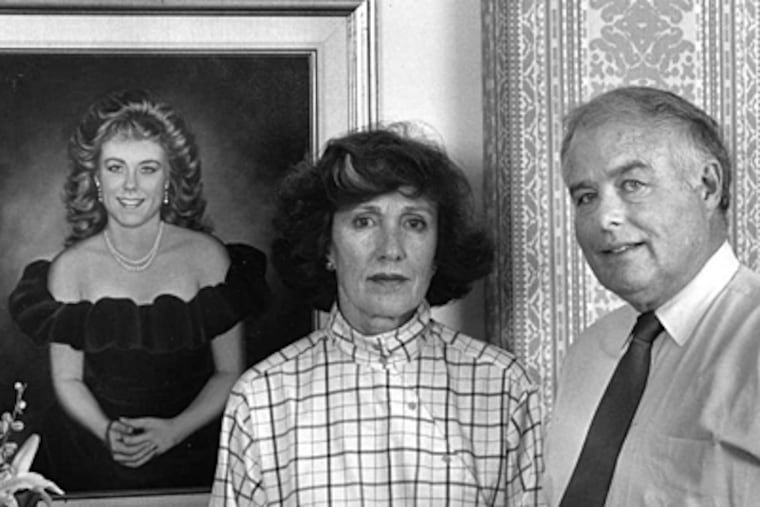
When two grim-faced policemen showed up at her Bryn Mawr home 25 years ago, Connie Clery started saying the Lord's Prayer.
It would turn into a prayer for every college student in America.
The officers told Clery and her husband, Howard, that their daughter, a 19-year-old freshman, had been found dead in her Lehigh University dorm room - raped and strangled, they soon learned, by a sophomore.
Today, as Pennsylvania State University administrators stand accused of failing to report a young boy's rape on campus, the school finds itself in the glare of a federal law born of the murder of Jeanne Clery.
The 1990 Clery Act requires all institutions of higher learning that receive federal aid to keep a public record of crimes on and around campus. Citing that law, a U.S. Department of Education team arrived at Penn State last Monday seeking details of not only the alleged rape by former assistant football coach Jerry Sandusky - but of all crimes committed at the school since 1998, plus its response to each.
Penn State could face fines of up to $27,500 per violation and cuts in federal student financial aid.
"Maybe this will teach them to put every student's safety first," Connie Clery, now 80 and a widow since 2008, said last week from her winter home in Florida.
The intensifying scrutiny of Penn State, she said, makes the couple's campaign for campus safety "all worthwhile."
In the months after Jeanne Clery's April 5, 1986, murder, Connie and Howard Clery discovered there had been 38 other violent crimes on Lehigh's campus in Bethlehem, Pa., in the previous three years.
A year later, they launched a campaign to force colleges to make public all sexual assaults, burglaries, thefts, and homicides affecting student populations.
"You're never told it's dangerous," Howard Clery said in a 1987 Inquirer interview announcing their effort. "So the kids are not careful."
Expanded five times since President George H.W. Bush signed it on Nov. 8, 1990 - with a sixth modification now before a Senate committee - the Clery Act requires colleges to keep a public log with the nature, date, place, and time of all crimes affecting the school.
Schools must also issue prompt warnings if their populations face imminent physical danger (such as a gunman), post their procedures for investigating and prosecuting sexual crimes, and provide descriptions of their security forces and safety programs.
The U.S. Department of Education, which enforces the act, has fined dozens of colleges for violations in the last two decades. The fines included $357,500 levied against Eastern Michigan University for failing for 10 weeks to warn the campus of a student's rape and murder in 2006, and $55,000 against Virginia Tech for its slow response to the initial shootings in 2007 of two students by a deranged senior; he went on to kill 30 more and wound 25.
Penn State's alleged scandal would seem more insidious.
On Nov. 4, a Centre County grand jury reported that school officials had failed to notify police in 2002 upon learning Sandusky was allegedly seen assaulting a 10-year-old boy in a locker-room shower.
Five days later, the Education Department's Philadelphia office sent Penn State president Graham B. Spanier a three-page letter notifying him of an impending investigation "relevant to the university's compliance with the Clery Act."
Spanier never received it. On Nov. 9, he and football coach Joe Paterno were fired.
"I suspect they'll receive a fine," said Alison Kiss, director of Security on Campus, an advocacy group the Clerys founded. "Many times, when you find one violation, you find systemic problems."
Barbara Meeker, a university spokeswoman, said Thursday the school was "absolutely making every effort to provide the review team with everything they have requested." The school has posted a copy of the Education Department's information request at live.psu.edu/story/56522.
Justin Hamilton, a spokesman for U.S. Education Secretary Arne Duncan, said the Penn State investigation was the latest of more than 50 the department had undertaken at colleges and universities during the Obama administration. Investigations averaged two or three a year under President George W. Bush.
Clery admits she and her husband "didn't know what we were doing" when they launched their campaign 24 years ago. "We started with petitions, and it was a flop."
They soon turned their attention to state legislatures, starting with Pennsylvania's, which in May 1988 mandated that colleges and universities must keep a public record of all crimes on campus.
Eleven other legislatures followed, but some reporting laws were weak. Many other states - New Jersey and New York among them - showed little interest.
"We realized we needed a federal law," said Clery, so she and her husband began lobbying Congress.
In hearings and interviews, they warned that "colleges are dangerous places" with porous borders where naive students - especially freshmen - are easy prey.
Their daughter's killing was a graphic example.
A mentally ill sophomore, drunk and angry because he'd lost a student election, had entered her dormitory through a propped-open emergency exit.
Josoph Henry, 20, went down the hall, trying the doorknob of each room until he found one unlocked. He later told police he had intended only to burglarize it, but when Jeanne Clery awoke, he slashed her neck with a broken beer bottle, raped her, and strangled her.
A soft-spoken Barnard graduate, Connie Clery would sometimes dissolve into tears when reporters asked her to recount her daughter's death.
But Howard Clery, the gruff, cigar-smoking head of a business forms company, would describe it without flinching, denouncing Henry in unprintable language and heaping scorn on "limp-wrist university presidents" who failed to arm campus police and winked at underage drinking.
Their bill won swift approval in the U.S. House - one congressman became a convert after his daughter's college roommate was raped - and it caught fire in the Senate after four college coeds were found slain and mutilated in apartments around Gainesville, Fla.
President George H.W. Bush not only made it law at a public signing ceremony, but he declared the Clerys one of his administration's "points of light."
"Looking back, I'm amazed at how much we accomplished," Clery said last week. "All of a sudden, I realized it was considerable."
With an annual budget of about $550,000, largely from private donations and foundation grants, Security on Campus now focuses on training colleges to comply with the Clery Act, and teaching students the hazards of date rape and binge drinking.
"We've seen the field change a lot over the years," Kiss said. Schools used to caution female students "not to walk alone or wear short skirts," she said. "Now the responsibility is being placed more on men to take ownership" of their behavior.
"We also tell everyone to stand up and speak out if you see something wrong. It's tough to do. It's much easier to walk away."