Author of 'Enrique's Journey' to speak at Rosemont
As a teenager in Buenos Aires in the 1970s, amid Argentina's "dirty war" on dissenters, Sonia Nazario came upon a sight that settled her future: a pool of blood "where two journalists had been killed for trying to tell the truth of what was happening."
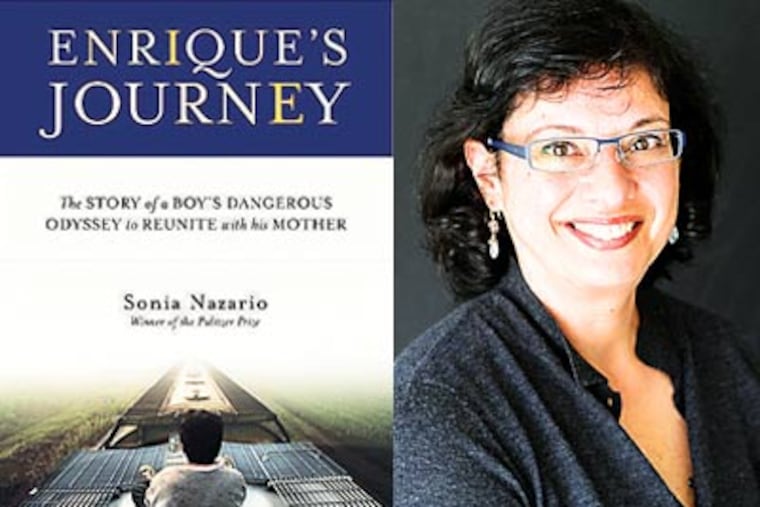
As a teenager in Buenos Aires in the 1970s, amid Argentina's "dirty war" on dissenters, Sonia Nazario came upon a sight that settled her future: a pool of blood "where two journalists had been killed for trying to tell the truth of what was happening."
"I experienced friends being disappeared and killed," she said recently from her Los Angeles home.
But this sealed it, said Nazario. "I was 14. I wanted to be a truth-teller."
Now an award-winning author, Nazario, 52, is scheduled to speak Monday at Rosemont College about Enrique's Journey, her nonfiction account of a Honduran teen's dangerous trek to the United States as an illegal immigrant.
The truths she tells in Enrique's Journey put a human face on the debate about illegal immigration in America. The book is this year's choice for Rosemont's "common reading," in which one book is assigned to all incoming freshmen in the hope of prompting passionate discussions.
Nazario "shows the conflict all around" illegal immigration, said Melissa Sullivan, an assistant professor of English who was instrumental in choosing the book. "It has a real-world, practical application, but is also a coming-of-age tale. There are no good guys and bad guys. She's not a black-and-white kind of author."
Nazario vividly presents the poverty and hunger that drive immigrants to seek jobs in the United States, and the lingering resentments when parents leave children behind in native lands. She explores the impact of illegal immigration on U.S. citizens, particularly blue-collar workers.
"For them," she acknowledges, the influx of newcomers doesn't mean "cut-rate nannies and gardeners," but "heightened job competition, depressed wages, overcrowded government services, and a reduced quality of life."
In the book, Enrique is 5 when his mother, Lourdes, moves illegally to the United States, eventually landing in North Carolina. There she works in factories and as a hotel maid to send money home to him and the rest of her starving family.
Eleven years later, Enrique is getting high by sniffing glue when he sets off across Mexico to try to find her. Dodging bandits and corrupt police, he clings to the sides and tops of freight trains on a perilous journey north. He is beaten, robbed, and turned back by border police a dozen times before finally making it across the Rio Grande near Laredo, Texas.
At first, Enrique's reunion with Lourdes is joyous. Then comes animosity.
That's a common trajectory, Nazario writes: "The children show resentment because they were left behind. ... The mothers, for their part, demand respect for their sacrifice. ... When their children say, 'You abandoned me,' they respond by hauling out tall stacks of money transfer receipts."
The book is based on Nazario's Los Angeles Times series, which won two Pulitzer Prizes in 2003 - for feature writing and for feature photography by Don Bartletti. The pair retraced Enrique's route, including the perilous passages on the tops of trains.
Sullivan assigned her classes to write an essay about the book and one of the college's core values - "persistence and courage in promoting justice with compassion."
Several students, she said, focused on "the act of Nazario riding the rails, putting her life on the line to reach the public with this story."
Nazario, a graduate of Williams College, has a master's degree in Latin American studies from the University of California. She left the Times in 2008 to write books and lecture.
Her Rosemont talk, which is free and open to the public, begins at 7 p.m. in McShain Auditorium.