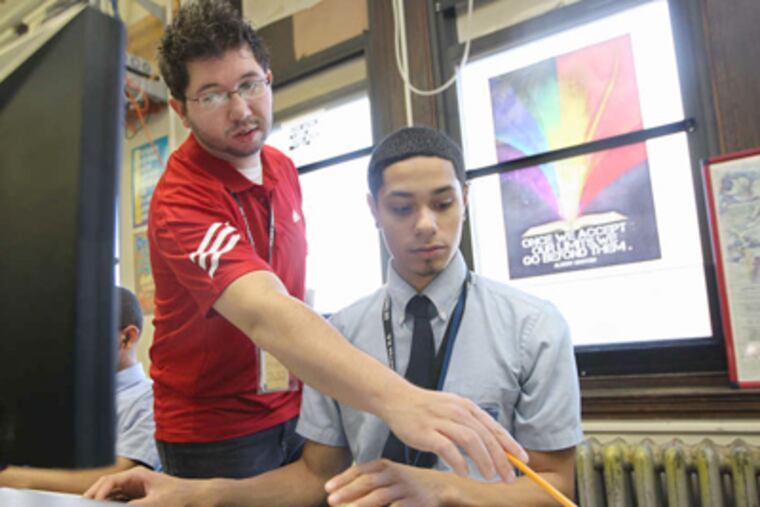
At his lowest, Manuel Rosado thought he would never amount to anything.
He was 14, a dropout. His mother, struggling with mental illness, kept him locked in their Feltonville house. He had no job, few friends, and saw no way out.
"I felt worthless," he said.
That two years later Manny is on the cusp of graduating from Olney ASPIRA Charter High School as class president and possibly valedictorian is nothing short of miraculous. That he is within striking distance of college - a career in pharmaceutical sciences on the horizon - represents a turnaround of the most astonishing sort.
The adults Manny has chosen to help him navigate life say he is one of the most remarkable people they have met.
"Manuel is the epitome of resilience," said Christina Garcia, a social worker at Olney Charter High School.
"He realizes nothing is handed to him in this world," said Liza Meiris, an English teacher at Olney. "He knows that if he wants something, he's going to have to work for it himself."
"He is who he is on his own," said Adriana Rivera, college coordinator of a Philadelphia Education Fund program that's helped Manny zero in on his goals. "I look up to him myself."
School was never a haven for Manuel. He was smart, but he talked constantly in class; kids picked on him because he asked a lot of questions and was often in trouble. He changed schools frequently.
Home life was tough, too - it was just Manny and his mom, with his older brother kicked out of the house at age 16, and she treated him like an adult, someone to tell her problems to.
Even so, Manny pins his school troubles squarely on himself.
"It was me," he said. "I was not a good student. I was going to school, but I wasn't really there."
Ninth grade at Maritime Academy Charter School was a disaster. Manny was truant and doing poorly; he left, he says, at his mother's insistence.
And then things got worse.
His mother "kind of lost it," Manny said. She stopped eating, stopped working. For two months, she kept them shut-ins inside their Feltonville home. They ordered food by phone; days started to lose their meaning. Manny would play video games for hours. He once stayed up for three days in a row, "until I passed out."
Eventually, his mother left for Puerto Rico, where she first lived with a relative, then in a psychiatric hospital. But Manny stayed in Philadelphia.
"I was kind of on my own," he said. He was 14.
A few family members chipped in to help cover basic living expenses; an uncle moved in for a time, then his brother for a while. Manny learned to cook his own meals, how to fend for himself.
He started worrying all the time, thinking about a way out - not just a quick fix, but a path to a better life.
"I didn't care about school when I was in it, but once I left, I thought, 'I don't want to be nothing,' " Manny said. When he saw friends bragging on Facebook about school shopping, then talking about classes and school activities, he felt anxious. He wanted to stop feeling useless.
Six months after he dropped out, Manny persuaded his uncle to sign papers to enroll him in Olney High School. By November 2010, he was a high school student again, enrolled in 10th grade - his old school gave him credit for ninth grade.
It was a rough transition. Olney, then still part of the Philadelphia School District, had a reputation as a tough place, "and it lived up to its reputation," Manny said. "Kids were in the hallways instead of in class. It was a mess. The kids were wild; I had trouble learning."
But he buckled down, and started showing up in his counselor's office, trying to talk his way into honors classes.
"I kept telling them that the kids in my classes were distracting, and the classes were too easy," he said.
Eventually, he said, he wore school officials down, started getting strong grades, feeling growing pride at a solid string of A's.
His mother came back to Philadelphia and the family's home in Feltonville, better for a while, then worse. She doesn't work, but she pays the bills, and the Olney school community sees to it he has any extras he needs, they say.
Olney became a charter school run by ASPIRA of Pennsylvania last year, Manny's junior year, and he has thrived there, connecting with teachers, support staff, and friends who don't laugh at his devotion to his schoolwork, his lofty goals.
He can be serious, all firm handshake and neat school uniform, but he can be playful, goofy, a teenager with a goatee, earrings, a tongue ring, and an easy smile.
Manny has a good circle of friends; he is seen as a leader, someone to look up to. He's very aware of others' feelings, and he stands up for the underdog, his teachers say.
And finally, for the first time, he is comfortable in his own skin.
"It took a while," Manny said, "to figure out who I was."
Several times a week, Manny, now 17, visits with Rivera, coordinator of the Philadelphia Education Fund's College Access Program. Sometimes he wants to talk about college applications, or financial aid, but sometimes he just wants to talk about what's going on at home, or in class, or with his friends.
"He's so goal-oriented, but he needs direction to achieve his goals," said Rivera. He needs pats on the back, too - someone to gush over his 98 average in Advanced Placement Calculus.
She chose Manny for the college program because on paper, he was a perfect fit - a bright student with challenges that could put him at risk of falling off track, or even dropping out. The graduation rate among Latino males in Philadelphia is abysmal - about half never earn a diploma.
But while the challenges are certain, Manny maintains a laserlike focus on the future, no matter how rough things are at home.
"His goals are written in stone," said Garcia, the Olney social worker and another member of his informal support system.
He has thrown himself into achieving, serving as president of his 230-student senior class and member of a leadership club, juggling honors and Advanced Placement courses, and volunteering in his community.
On a recent day, Manny stopped by to talk with Meiris, his former English teacher and senior class sponsor. He was upset about his physics class. He had an A, it turns out, but he felt he didn't understand the material deeply enough.
"He said: 'I don't know if I deserve the A. The important thing is to understand the material, right?' " Meiris said.
The night before the SATs, Manny called Meiris in a panic, stressed out about an exam he knew would help determine his future. There was no one to talk him down at home; Meiris stepped in.
"I said, 'OK, pack your bag tonight, make sure you have pencils, eat a good breakfast,' " she said. "Other kids would be in those circumstances and make excuses for not going to school, not doing well. But he wouldn't be the kid he was if it wasn't for his home life. It gave him nothing, so he had to make something of it."
There are still big worries - "oh my goodness, I don't have money for college, how am I going to pay for it?" - but people are starting to notice Manny. The Education Fund honored him this month with an EDDY award as its "rising star," a prize that took his breath away.
An internship at the St. Christopher's Hospital for Children pharmacy and a visit to the University of the Sciences set his sights on a career in pharmaceuticals. He's considering the University of the Sciences, Temple, Drexel, and the University of Pennsylvania, but only if he can live on campus.
"Got to get away," he said flatly.
He will be the first in his family to earn a high school diploma. If he continues on the path he's set, he will be the first to graduate from college.
"There is no doubt in my mind," Garcia said, "that this kid is going to get where he needs to go."
at 215-854-5146, kgraham@phillynews.com, or on Twitter @newskag. Read her blog, "Philly School Files," at www.philly.com/schoolfiles.