Confusion as state takes over Camden schools
On the day the state took over the Camden School District, teachers protested and board members were perplexed about their new role, while a new interim schools chief offered hopeful remarks.
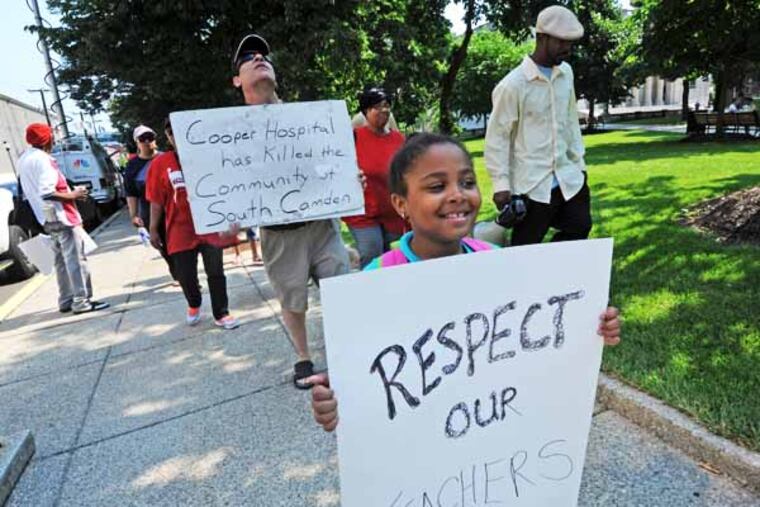
On the day the state took over the Camden School District, teachers protested and board members were perplexed about their new role, while a new interim schools chief offered hopeful remarks.
"I'm confused, and I don't see my purpose here," longtime board member Sara Davis said at the start of Tuesday's board meeting.
Under the full state intervention that Gov. Christie and state Education Commissioner Chris Cerf signed off on, interim superintendent Margaret "Peggy" Nicolosi assumed the powers of the local board and will answer directly to Cerf. The board's role became advisory.
But Davis and fellow board member Barbara Coscarello started raising questions as soon as the meeting began. Board attorney Lester Taylor quickly advised board members that it was best to discuss their new role in closed session. That session lasted about an hour.
The meeting room was at its capacity of 85, with many teachers and community activists waiting outside to get in as soon as someone came out. The teachers, all wearing red, were protesting that the state takeover took power away from the community.
Nicolosi, who had been Camden County executive superintendent since 2008, was appointed last week as interim superintendent. Her $120,000 salary as county executive superintendent will carry over to her new job but will be paid by the district.
Reuben Mills, interim superintendent since former schools leader Bessie LaFre Young took a buyout last year, will keep his $187,200 salary but will have the title of senior adviser to the superintendent. Mills' new position was created by the state but will be paid by the district.
In March, Cerf and Christie announced the state's decision to take over the failing district for at least three years. But it could be a long time until the board and district are deemed able to govern themselves.
"I would think this would be on the long end rather than short end," Nicolosi said Tuesday.
Nicolosi is not a candidate for the full-time superintendent's job. A national search to fill that post is continuing.
"I look at my term as enhancing a partnership, and that partnership is the kids first, their parents, and the staff working with the community," Nicolosi said.
Whoever lands the job will inherit a district that is continuing to shrink as new charter schools continue to compete for the city's 16,000 students. There are nine charter schools in the district, educating 4,000 students. Three more are expected to open this fall.
The new superintendent will also have to work with the local Regional Achievement Center, one of seven established last year when New Jersey received a No Child Left Behind waiver. About a dozen state-appointed and state-paid employees have been working at the Camden RAC, which oversees the district's 23 lowest-performing schools.
Various administrative positions, such as assistant superintendents, director of human resources, and business administrator, were abolished Tuesday as part of the takeover. The employees in those positions will continue to work during the 60-day transition, under New Jersey's statute on state interventions.
Another concern for the teachers is contract talks, since their contracts are up Sunday.
"Who do we negotiate with - and you know how Christie and Cerf feel" about teacher contracts," said Karen Borrelis, a teacher at Brimm Medical Arts High School.
Nicolosi said Tuesday she would begin gathering information for the negotiation. But she said she did not believe she would be involved because her stay is expected to be short.
During her stay, she said, she hopes to conduct professional development for staff in small batches, reconfigure classroom sizes and staff classes with two teachers each, and reevaluate attendance policies.
Each school has its own "performance targets," and once it reaches those targets, Nicolosi said, a school must demonstrate it can sustain that progress and continue to improve.
"If I can make one step in the right direction . . . then I feel like I can make a difference," Nicolosi said.