Temple opens all course-rating results to all students
Bailey Fuentes logged on to the new course-rating system at Temple University and checked out a sociology professor she will have next semester.
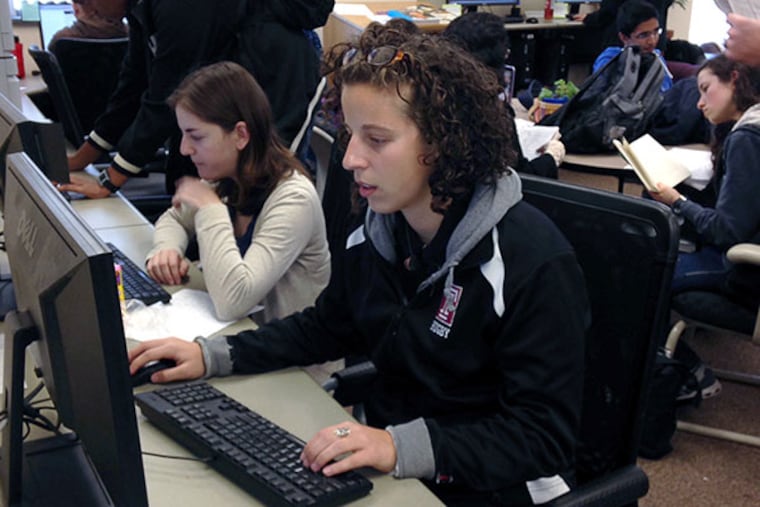
Bailey Fuentes logged on to the new course-rating system at Temple University and checked out a sociology professor she will have next semester.
For all categories - teaching ability, giving feedback, grading fairly, and imparting knowledge - the professor earned the highest marks.
"I'm pumped," said Fuentes, 21, a senior from York County.
For the first time this semester, Temple has made available to students course and teaching evaluations for all 2,500 professors and instructors. The evaluations are accessible to freshmen and new transfer students as well as all other students who graded their professors during the spring semester.
Temple is making the data available in response to the university's student government, which said undergraduates needed information to better select classes.
"It's all about informed decision-making for students," said Peter R. Jones, senior vice provost for undergraduate studies. "We feel we can make this into a major pathway by which students plan their career at Temple."
For years, students at Temple and elsewhere have learned about professors' performance through the website Rate My Professors or simply by word of mouth. But neither method offered statistically valid information, Jones said. Rate My Professors doesn't require a rater to prove he or she has had the professor - or even goes to that college.
Students note the ratings on that website are sparse for many professors and can be very negative or very positive.
"Rate My Professors is basically a rant," said Darin Bartholomew, 22, a senior management information systems major from East Stroudsburg and president of Temple Student Government. "This is quantifiable data that you can see."
Temple's Law School for years has allowed students to see evaluations.
Some colleges have gone so far as to make the evaluations available to the public, Jones noted. Temple isn't doing that.
Other schools
Locally, four of 15 universities that responded to questions from The Inquirer said they shared results of course evaluations with students: the University of Pennsylvania, Princeton, Lafayette, and the University of the Sciences.
At Lafayette, students can access up to seven years of data. More than 80 percent of students fill out course evaluations, spokeswoman Kathleen Parrish said. At Penn, which pioneered course evaluations years ago, participation is similarly high.
"The Penn Course Review was originally a printed publication sold by a student organization," spokesman Ron Ozio said. "About 10 years ago, it moved to an online publication. It is a searchable listing of all the evaluations of undergraduate courses, including the numerical ratings and an edited overview of the student comments."
Other universities, however, keep the evaluations private, citing lack of demand or a smaller faculty where students don't have much choice among professors for some subjects.
'Comfortable'
At Chestnut Hill College, nearly half of the student body doesn't fill out the forms.
"If only a small number respond in a particular course, their responses may not reflect the experience of the rest of the students," said Merilyn Ryan, acting dean of the school of undergraduate studies.
At Temple, more than 70 percent of students typically filled out paper evaluations. But when the university moved them online about a year ago, that rate dropped to about 50 percent.
"We feel comfortable that the information we're getting back is a good reflection of student response," Jones said.
To be fair, the university excludes courses with fewer than eight responses or less than 20 percent of a class, he said.
At Temple - as at many other universities - student course evaluations are one measure used in deciding whether a professor is promoted, receives a raise, or gets tenure.
The evaluations include 12 multiple-choice questions and three that allow open-ended comments. Under the new system, students see only the data from four of the questions - on feedback, grading fairness, teaching ability, and learning - and none of the comments.
If half or more of the students agree or strongly agree with a statement, a professor is given an "upper" rating. If 20 percent or more disagree or strongly disagree, the professor receives a "lower." The rest get a "middle" rating.
Forty percent to 45 percent of professors were rated upper, 40 percent fell in the middle, and 10 percent to 15 percent fell in the low category, Jones said. Professors were rated for each course taught over the last two years, providing a rolling average.
"You get a very quick visual display of a lot of information on the screen," Jones said.
Fuentes likes the new system because it offers data rather than opinions, though she wishes student comments were included.
"I know I'm the most honest when it comes to the questions that are more open-ended," she said.
At Temple, Fuentes said, she had only one professor she would rate badly. The professor stifled conversation in the class by overly emphasizing her own beliefs and personal life, Fuentes said.
Fuentes always fills out professor evaluations: "If I feel like if I've had a bad experience or a great experience, other students should know why."
Not all faculty like that the university has opened up the evaluations.
"We have serious concerns about this," said Art Hochner, president of the faculty union and an associate professor of human resources management.
He questioned whether the evaluations amounted to personnel records, and asked why professors couldn't access them - only their own. He wondered whether forms from only 50 percent of students offered an accurate picture.
"The administration says that their data indicate no significant difference [in feedback] from when it was done on paper," Hochner said. "A lot of faculty are skeptical."
One professor and administrator who helped create the new system argued the change increased accountability.
"Teaching should be a public event, and how I do in my class should be as public as possible," said Joe DuCette, senior associate dean of the college of education, who served on the committee that developed and reviewed the system. "If I do a terrible job, students should know."
He knows some faculty worry that students rate highly only those professors who give good grades.
Research shows "there is a relationship there, but it's pretty marginal," he said.
Temple is considering changes based on professor and student feedback. It may give faculty access to all professor ratings in the system. The university also may include hyperlinks to professors' Web pages and course syllabi.
"That means students will go into a class way more informed than they ever were before," Jones said, "and we hope that reduces the number of students who drop a class within a week or two."