Is Philly school district violating Sunshine Act over key hires?
In the last year, many new hires were not approved by the School Reform Commission as mandated by state law.
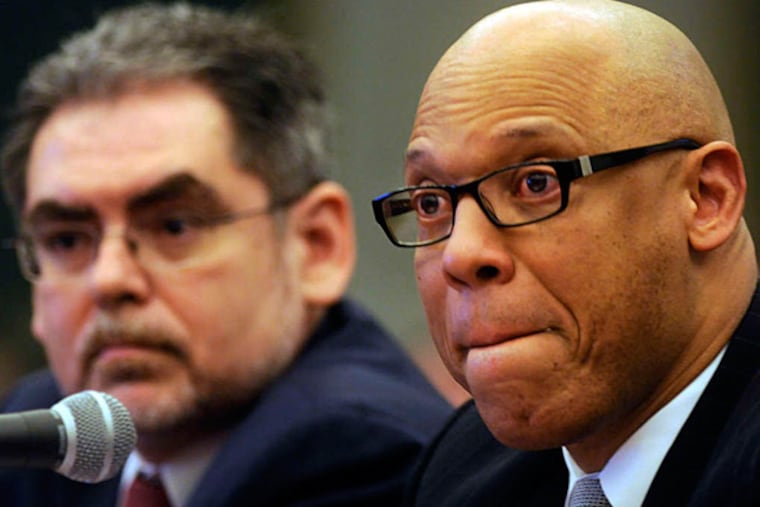
DAVID M. HARDY began work in September as chief academic support officer for the Philadelphia School District at an annual salary of $160,000.
But the hire wasn't made public.
That wasn't the first time. In the past year, the district frequently has flouted state law by failing to notify the public after hiring high-ranking personnel to lead departments in which decisions are made that affect students, families and staff.
According to the state's Sunshine Act - and the district's own employment policies - a school district's hires and terminations, listed in personnel resolutions, must be voted on in public by a school board - or, in Philadelphia's case, the School Reform Commission - before the new hires are officially employed.
But that's not how it's done in Philadelphia.
"If it doesn't happen that way, there's a Sunshine Act problem," said Melissa Melewsky, media law counsel with the Pennsylvania Newspaper Association in Harrisburg.
The Daily News reviewed a year's worth of school district personnel resolutions through September and found that no top-ranked officials or their starting salaries were made public or voted on by the SRC.
Besides Hardy, they include:
* Paul Kihn, deputy superintendent, starting at $210,000, September 2012.
* Matthew Stanski, chief financial officer, $175,000, November 2012.
* Sophie Bryan, director, charter-school office, $100,000, November 2012.
* Fran Burns, chief operating officer, $175,000, May 2013.
* Naomi Wyatt, chief human-resources officer, $180,000, July 2013.
In addition, 56 employees hired between April 18 and June 30 were not included in the reviewed personnel resolutions, which only listed two employees hired to work at district headquarters.
Responding to an inquiry by the Daily News, the district will launch "a full review of its personnel-resolutions process," said district spokesman Fernando Gallard.
"A preliminary review found that a computer error may have led to the omission of names of individuals appointed to positions within the school district from the personnel resolutions presented to the SRC for consideration," Gallard said.
The personnel resolutions voted on each month by the SRC include hires, their names, positions and start dates. And before the vote, pursuant to the Sunshine Act, the floor should be open for public comment.
"Any time you're hiring folks with taxpayer money, particularly when you're hiring and retaining people to educate and train our children, that needs to be done in the utmost possible sunshine and not in the shadows," said Terry Mutchler, executive director of the state's Office of Open Records.
When the vote takes place after the new employee already has begun to work for the district, said Melewsky, it "undermines the public-access provisions of the Sunshine Act and renders the board's vote basically meaningless."
"The public wasn't given an opportunity to witness and participate before the decision was made," said Melewsky, who said she believes that districts should include salaries in personnel resolutions because it's more transparent.
Melewsky also took issue with SRC guidelines for public comment, which the media lawyer called "quite strict" and "a barrier to access."
Speakers must register by 4:30 p.m. the day before an SRC meeting, a requirement that does not violate the law but is "unreasonable," Melewsky said. Also, speakers might not be able to register because they couldn't see the agenda until after the registration deadline.
"There needs to be some flexibility in the public-comment process," she said.
Gallard said it is the "SRC's preference to post proposed resolutions early enough to give the public some advance notice of resolutions to be considered by the SRC," but sometimes it's "not possible" to post them sooner. "It is always the intention of the SRC to be transparent in the conduct of its business, and [it] does not hold back the publication of proposed resolutions on purpose."
SRC speakers also are required to present seven copies of a prepared speech, according to SRC rules. Melewsky said such a rule is unique in her experience.
Gallard said the requirement enables public comments to "be included in the SRC's records." He said a person who doesn't have the seven copies is still allowed to speak at the meeting.
Parent Rebecca Poyourow, a regular speaker, said the requirement "discourages a lot of people who may feel intimidated from writing it down, or who don't have access to copiers. So people take themselves out of the running."
Online: ph.ly/DNEducation