Philadelphia Futures tries to help students soar
David Goldberg, a theoretical cosmologist, physics professor, and associate dean for research and graduate education at Drexel University, is one of those academic superheroes who can translate complex scientific topics into language that mere mortals can comprehend.
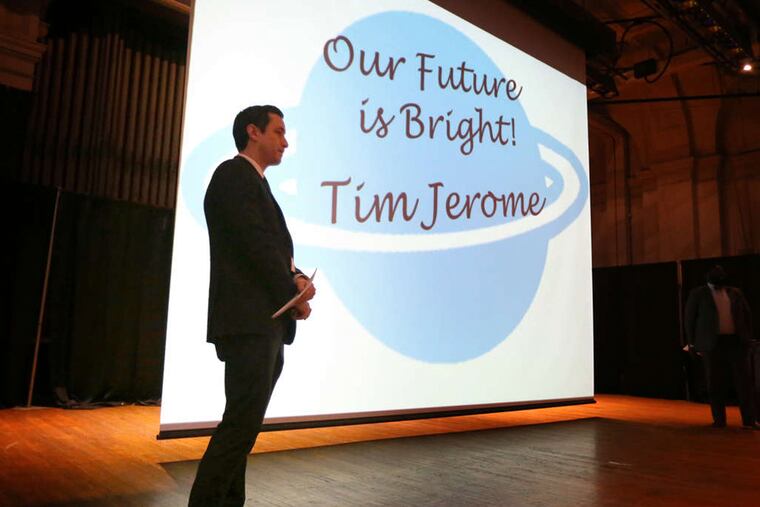
David Goldberg, a theoretical cosmologist, physics professor, and associate dean for research and graduate education at Drexel University, is one of those academic superheroes who can translate complex scientific topics into language that mere mortals can comprehend.
That talent was a major reason that Philadelphia Futures chose him to address nearly 600 parents, mentors, and students at the nonprofit's 25th annual conference Saturday at Drexel.
Every teen in attendance came from a low-income family. None had parents with college degrees. And all had enough intelligence and ambition to qualify for the program that has provided mentorship and scholarships to thousands of disadvantaged students in the city since 1989.
They had come together, eagerly, earnestly, voluntarily, for a day of stimulating discussion, inspiring oratory, and practical advice about how to succeed in school and in life.
Goldberg's job was to start the fireworks.
But it was barely 9 a.m., not only during winter break, but on a weekend. So as he frolicked through explanations of black holes, escape velocity, Hawking radiation, and spaghettification, in nearly every row, a few kids could be seen furtively texting friends, or lolling their heads in the lost battle to stay awake.
Not Celina Jones, though.
Jones, a junior at West Catholic High School, stayed with Goldberg every step of the way. And at the end, when he asked if anyone had questions, she was the first to raise her hand.
"Where does the gas surrounding black holes come from?" she asked.
"Good question," Goldberg said, then answered it.
Jones is not planning a career in astrophysics. She said she might want to be a nurse practitioner or a physical therapist. Her mind is open and hungry, however, and as galactically abstract as the cosmos might be, she wants to understand it.
Through Philadelphia Futures' new program, College Connection, Jones receives academic and financial support, help with college applications, practice preparing for admissions interviews, guidance in choosing the schools that will suit her best.
"We jumped on the idea," said her mother, Winsome Neil, a single parent originally from Jamaica. "I told her if it will help you with schoolwork, go for it!"
The program currently serves 100 Philadelphia high school juniors and seniors who hope to go to college, said Joan Mazzotti, Philadelphia Futures' executive director.
It supplements the organization's original "Sponsor-a-scholar" program that pairs children, beginning in ninth grade, with mentors who hold college degrees and have experience in professional careers.
Over time, Mazzotti said, the organization has "matured," and learned that first-generation college students need more academic preparation before enrolling and continued support throughout the four years on campus.
By expanding its services, Mazzotti said, Philadelphia Futures has seen a marked increase in graduation rates among its students. Since 2005, she said, the percentage earning four-year degrees has grown from about 50 percent to more than 70 percent.
"That's quite a difference," she said, "especially when you consider that the national college graduation rate for low-income, first-generation students is 11 percent."
Brandon Medina was not "college-oriented" and had never heard of Philadelphia Futures when he was stopped in the hallway at Samuel S. Fels High School six years ago by a man who asked him where to find the auditorium.
The man, a representative of the program who had come to give a presentation, invited Medina to attend.
That afternoon, he went home and told his parents about it. "I wasn't sure what they would think," he recalled.
Now 19 and in his second year at Drexel, Medina said, "I probably wouldn't be here without Philadelphia Futures."
The youngest of three boys, Medina said he is close to his family. But his mother, a full-time homemaker, and his father, who runs a taxi business, had no experience applying to or attending college.
Ironically, he said, his older brothers, who went to high school in a relatively wealthy suburb in New Jersey, did not do as well academically as he did after the family moved to Frankford.
With help from his mentor, an accountant who graduated from Villanova University, and Philadelphia Futures' enrichment programs after school and during the summer, Medina said, he joined a robotics team, became the staff editor of the monthly newsletter, and went on to graduate first in his class from Fels.
Unlike some of his peers, who need to work to help support their families, Medina said, he was able to make the time commitment and take advantage of all the program had to offer.
"I can talk to my mentor about certain things that I can't discuss with my parents," Medina said.
Last year, one of the most difficult of Medina's life, one of his brothers was murdered in Camden. Medina's mentor and several other members of the Philadelphia Futures staff helped him through this very trying period. Still, he said, as compassionate and kind as his mentor was, there are limits to such relationships.
"He can't really understand what it is like to grow up in a family like mine," Medina said. "That is a gap he will never be able to reach."
215-854-2590
@dribbenonphilly