Council leader wants more university aid to city schools
City Council President Darrell L. Clarke said Thursday that he wants to see Philadelphia's universities give more to its struggling school system - and not just to schools in their shadows.
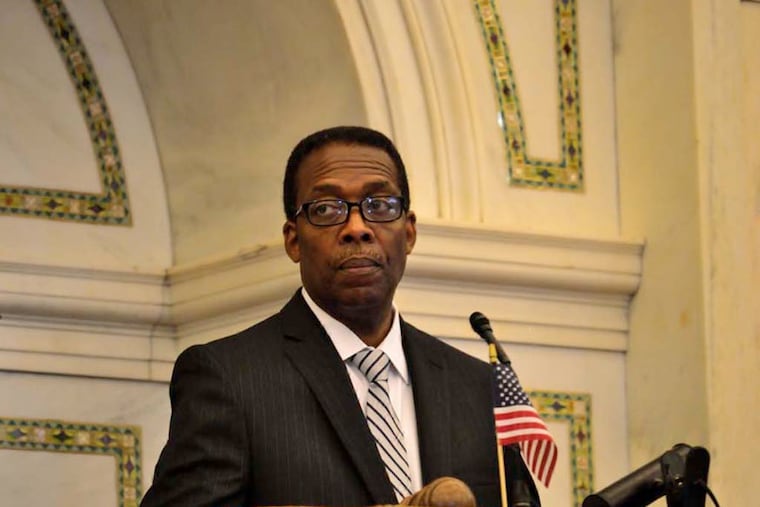
City Council President Darrell L. Clarke said Thursday that he wants to see Philadelphia's universities give more to its struggling school system - and not just to schools in their shadows.
Clarke, speaking on the first day of a new Council session, did not offer specifics, but said conversations were taking place to "formalize" how universities support local schools.
"My preference is actually having them commit the resources, be it in personnel support, be it real hard dollars, or be it in other initiatives," he said.
Like other nonprofits, many of the city's universities get a break on property taxes, which riles those who believe they should set aside money for city schools. Those advocates have pushed payments in lieu of taxes (PILT).
Many of the city's universities have said the schools contribute to communities through other channels.
Clarke's office said that in light of the tension over PILT, he is seeking innovative ways for universities to provide for schools.
At a news conference Thursday morning, Clarke dubbed his program SUPER (School-University Partnerships and Education Resources). He called it unfair that schools near major universities benefit more than other city schools, mentioning by name West Philadelphia's Penn Alexander Elementary School, which the University of Pennsylvania subsidizes with an annual contribution of $1,330 per student.
Clarke said he is not sure whether Council has the ability to formalize the partnerships between universities and the Philadelphia School District through legislation. But his office said he was looking to launch the program quickly.
Also Thursday:
Clarke said he would introduce a resolution next week to create a committee to explore the state of the Philadelphia Gas Works. Since Council's controversial decision in October to not hold hearings on the sale proposed by Mayor Nutter of PGW to UIL Holdings Corp., Clarke said other companies have expressed interest in partnering with PGW. Clarke said the committee would review those proposals and other options, and issue a report.
Clarke's bill to put the duties of the Department of Licenses and Inspections and six other agencies under a new department was sent back to the Committee of Law and Government over concerns expressed by developers. The committee approved the bill last month.
Dennis O'Brien introduced a resolution to hold hearings on the state of housing for people with disabilities.
Ed Neilson introduced legislation calling for the creation of a committee on income inequality.
Council has recently shown a large interest in wage-equality legislation. Groups have pressed Council to set a citywide minimum wage and challenge the belief that only the state can set that level.
At his news conference Thursday, Clarke said he did not believe the city has the authority to set a minimum wage. Council is expected to hold hearings on the possibility.
Council on Tuesday will hold a hearing on another effort to help the city's blue-collar workers: mandatory paid sick leave.
A bill introduced by William K. Greenlee would require businesses with 10 or more employees provide at least one hour of paid sick leave per 40 hours worked. Greenlee said he was not willing to budge on the bill's key points and that he had the support of 12 members of Council, enough to override a mayoral veto. Nutter has blocked similar bills.
Nutter spokesman Mark McDonald said the mayor supports sick-leave legislation but Greenlee's bill must be vetted. He called talk of a veto premature.