Villanova project tells early history of what would become Cheyney University
Patrons of the Institute for Colored Youth in Philadelphia founded the historic school in the mid-19th century so their students would be prepared for the day when equality arrived.
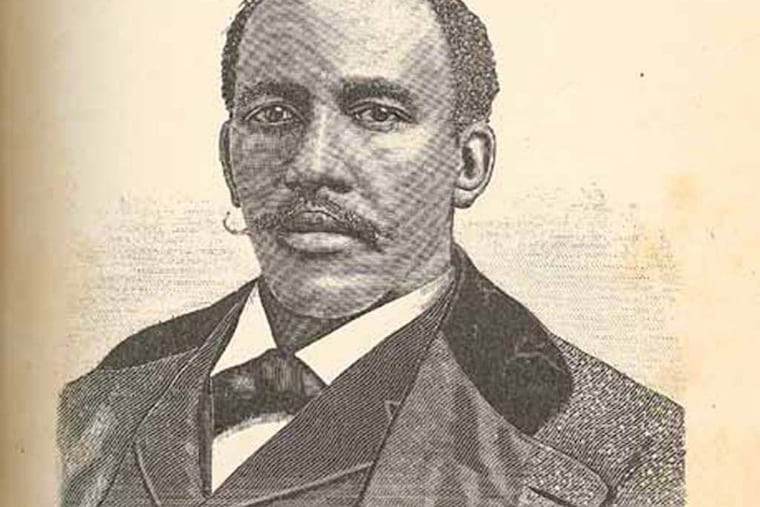
Patrons of the Institute for Colored Youth in Philadelphia founded the historic school in the mid-19th century so their students would be prepared for the day when equality arrived.
But graduate Octavius V. Catto couldn't wait that long. The civil rights hero took what he learned at the school that would become Cheyney University and used it to speed up the process.
So did many of his classmates - but with much less attention paid to them. A new digital history project at Villanova University aims to change that.
"The Institute of Colored Youth in the Civil War Era: Classes of 1856-64" tells the story of the school's first 37 graduates, many of whom devoted their lives to an impatient pursuit of equality.
Rebecca Cole, an 1863 graduate, earned the second medical degree in the nation to be awarded to an African American woman. Graduate John Henry Smythe, an early devotee of Pan Africanism, served as ambassador to Liberia.
"At this moment, when things looked possible, these young people were poised to take advantage of it - and did," said Judith Giesberg, a professor who led the project. "They pushed political and gender issues. They were confident in their own abilities and intolerant of those who questioned them."
The students' biographies are brimming with accomplishments that include founding schools, desegregating institutions, and being among the first blacks to fight for the Union cause.
There are even notable family connections. Sibling graduates Raymond and Letitia Burr were great-grandchildren of Vice President Aaron Burr and a housekeeper who worked for him.
Each of the 37 is featured on a Villanova library website (http://exhibits.library.villanova.edu/institute-colored-youth) devoted to the project. The site outlines the school's history, the graduates' involvement in social action, student speeches, and final examinations, which were oral, open to the public - and very difficult.
"What is the ratio of the solidity of a sphere to the surface of its circumscribing cube?" was one of the scores of questions in an 1862 finals exam.
The Villanova project evolved out of an earlier one: researching the diaries of Emilie Davis, a young, free black woman living in Philadelphia during the Civil War.
Giesberg edited a book on the diaries and, with her team, produced a website on Davis, who attended the institute, but didn't graduate.
The professor instructed research assistant Michael Johnson of Berlin to look into the school.
What Johnson, 25, found was "a fantastic story," he said.
Johnson and fellow graduate students James Kopaczewski, 24, of Philadelphia, and Elizabeth Motich, 25, of Harrisburg, scoured books, area libraries, and historical societies and newspapers. They toured the Philadelphia sites where the school was located.
The institute was founded in 1837, five years after the death of Richard Humphreys, a Quaker elder who had bequeathed $10,000 to start the school. It began as a trade school, but later switched to an academic curriculum.
Teachers and administrators included Fanny Jackson Coppin, for whom Coppin State University in Baltimore, is named, and Jacob C. White Jr., also an early graduate, who went on to become the first black school principal in Philadelphia.
Historian Charles Blockson calls them "the elite of the elite," who "paved the way for the modern day Martin Luther Kings."
The institute was first located at Seventh and Lombard Streets and later moved to Ninth and Bainbridge Streets. In 1902, the school moved to Delaware County and eventually became Cheyney University, now the nation's oldest historically black institution of higher learning.
The professor and her team of students visited Cheyney to research the school and conferred with the school's archivist, Keith Bingham. Bingham, only the second to hold the position, has annual reports from the school's board of managers that help illuminate the institute's history. But efforts to preserve and organize Cheyney's historic holdings began only in the 1990s.
Lawyer Michael Coard, a Cheyney graduate, called the Villanova project impressive and powerful, one that brought him to "joyful tears of cultural pride."
But Coard, who interviewed Giesberg and the students on his radio program on WURD-AM, said he wished for more African American involvement in the project.
He cites the awkward feeling of being a black man who is having "white people tell me about my history."
The dilemma is not lost on Giesberg.
A hoped-for collaboration with Cheyney never worked out, Giesberg said. The potential partnership didn't happen because of the troubled university's financial, staffing, and enrollment issues, Bingham said.
At Villanova, the project was open to any student who wanted to work on it, Giesberg said.
Coard, who is representing a coalition of Cheyney alumni, students, and others who are suing the state and federal government over what they contend is unfair funding, plans to use the website and its information to help escalate pride in the school's historic roots, and encourage scholars and students to dig even deeper.
Giesberg agrees that much more work is needed, that the Civil War and, ultimately, the fight for civil rights involved more than Gettysburg and Appomattox.
"You can study the war period as one in which the battles were waged on the battlefield, but when you do, you lose a big part of the story," Giesberg said. "People were waging battles at home as well."
610-313-8211