Haddonfield to host Chinese students
Program will ease their transition to college. District gets tuition.
The college transition brings with it the stress of packing, making friends, and getting adjusted to a new learning environment. For international students, coming to a new country also involves an additional anxiety: fitting in.
For the first time, the Haddonfield School District is working to ease that transition for some high-achieving students from China, Superintendent Richard Perry said.
In September, Haddonfield Memorial High School plans to enroll four students - one junior and three seniors - from southern China's Guangdong Country Garden School for stays of 10 to 12 months.
"When [students] come right from China to these universities, they don't know much about the American culture," Perry said.
The school board has approved the enrollment of as many as eight international students for the 2015-16 school year, Haddonfield Memorial principal Chuck Klaus said.
Five more New Jersey public school districts - Burlington Township, Highland Park, Piscataway Township, West Windsor-Plainsboro, and Linden Township - are also certified by the Department of Homeland Security to enroll international tuition students, according to an online government database of Student and Exchange Visitor Program (SEVP)-certified schools.
In North Jersey, Linden Township has an international program similar to Haddonfield's, said Tracy Matozzo, Haddonfield's dean of student life. Linden administrators could not be reached for comment Thursday, but their international program costs $20,000 a year, according to its website.
This type of arrangement is a moneymaker for public school districts and private schools nationwide. In Haddonfield, the 12-month program - complete with meetings with government officials and road trips to Philadelphia and Washington to teach the students about American history - will charge $30,000 per student. A 10-month program costs $22,500.
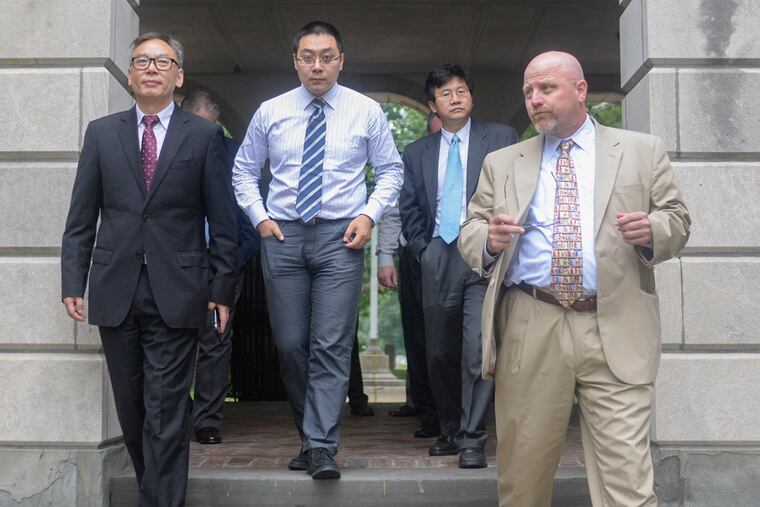
"We have needs in terms of revenue," as well as for cultural enrichment, Perry said Thursday as he met in Haddonfield with administrators from the Guangdong school, a private boarding school, as well as officials from Princeton Educational Services (PEDUS), an educational placement agency for Chinese students, which is facilitating the program with Haddonfield.
A small but growing number of public schools across the United States have been enrolling foreign students on F-1 visas, which require they pay tuition. Some private schools do it, too, but their visa status allows international students to stay for four years, whereas certified public schools are only allowed to enroll the student for one.
Camden Catholic High School in Cherry Hill has about 40 international students living in a dormitory on the site of a former convent, and about 20 others living with host families, said administrative assistant Trish Bianco. Many of these students - natives of Italy, China, Japan, and Croatia - enroll in the private school for several years, at a cost of $40,000 for 12 months.
"It's a learning experience for all of us," Bianco said of the program, which began in 2006 but did not include on-site boarding until 2011, when the convent was refurbished.
Across the country, many public schools with international tuition programs have struggled financially. At some, the program was their last hope of avoiding closure.
Haddonfield is consistently ranked as one of the nation's and New Jersey's best public school systems, and the town is one of the state's most affluent. But the school district has been looking for ways to raise revenue in the face of state aid cuts. The high school, with 806 students in grades 9 through 12, is already enrolling about 35 tuition students from nearby districts, Matozzo said; the tuition for these students is closer to $10,000.
The Chinese students will be staying with one of two host families - one in the district and another in a neighboring town, Perry said, and hosts will be compensated $1,000 per year per student.
Robert Pupchik has worked as an educational consultant for PEDUS for two years. He said he has seen firsthand how much the international students take away from immersion in American culture.
At one PEDUS summer camp, "we made the mistake of giving them a meatball sandwich," Pupchik said. "They ate it with chopsticks."
Pupchik had to hold an impromptu instructional demonstration on how to eat a meatball sandwich. Then, the Chinese students taught the Americans how to eat with chopsticks.
For these students, learning opportunities are everywhere, "even going to a place like Burger King," when they might not know how to eat a hamburger.
Pupchik said he is already in regular communication - via Skype and instant messaging - with the students who will be coming to Haddonfield.
They're excited - and inquisitive.
"They'll say, 'Can you help me get into a college?' or, 'I heard you had a Super Bowl. Tell me about it,' or 'Should I buy Nike or Adidas sneakers?' " Pupchik said.
The program is not so much about getting the students into Ivy League colleges; most would be accepted into them whether they stayed in China or came to America, he said. Of the three seniors coming to Haddonfield, two dream of attending Yale and another aspires to go to Princeton after graduating from Haddonfield, Pupchik said.
While the tuition program is not an exchange program, Pupchik said, it does focus on cultural exchange, for both the American and Chinese students.
"We are allowing these students to learn about democracy. We are providing them with experiences they can take back to China," he said. "I think Haddonfield will fall in love with these students . . . [and] benefit from a respect for the Chinese culture."