EducationWorks to honor social-justice pioneer
In some circles, Washington law professor Edgar S. Cahn, 80, is a social justice icon and poverty law pioneer whose many accomplishments changed the legal landscape.
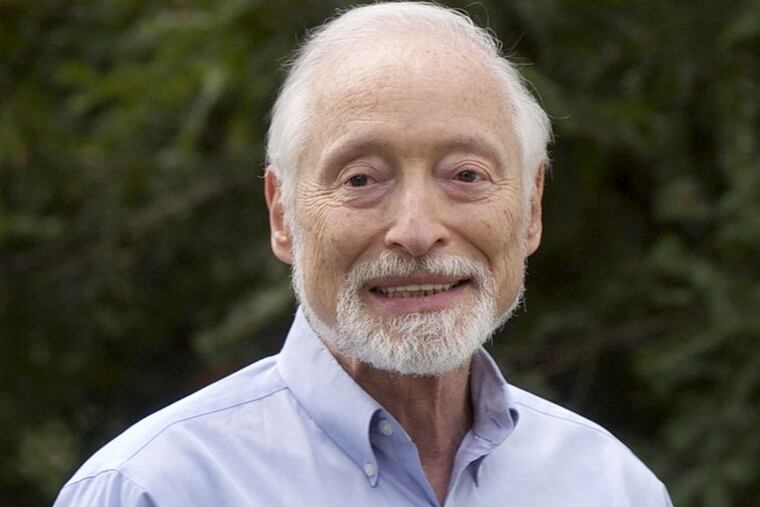
In some circles, Washington law professor Edgar S. Cahn, 80, is a social justice icon and poverty law pioneer whose many accomplishments changed the legal landscape.
"The people who know him think he's a saint, but far too few people know him," said Martin Friedman, executive director of EducationWorks.
Friedman and his local nonprofit, which runs after-school and social-justice programs in Philadelphia, Chester, and Camden, wants to change that. It hopes to increase Cahn's public profile in the region by awarding him EducationWorks' inaugural Social Justice Award at the National Constitution Center gala on Sept. 10.
The annual, noncash honor will be named for Cahn in subsequent years.
"Even though he is famous in his own little sphere, it is still a little sphere," said Gregg Volz, who directs EducationWorks' Youth Court Support Center, which trains teachers to run student-led courts modeled after Cahn's work.
"I think he's one of the most remarkable people I have ever known," Volz said. "He transformed the face of the legal system from the 1960s to the present day."
A native of New York City, Cahn is a 1956 graduate of Swarthmore College, and holds a doctorate and a law degree from Yale University.
Throughout his career, he has advocated for the rights of the poor and the powerless.
When Robert F. Kennedy was U.S. attorney general, Cahn was a speechwriter and special counsel for him.
Cahn and his wife, Jean Camper Cahn, now deceased, wrote a groundbreaking article for the Yale Law Review in 1964 that ultimately led to the creation of the National Legal Services Corp. Established by Congress and signed into law by President Richard M. Nixon in 1974, the nonprofit provides legal aid for low-income people in civil matters, including custody disputes and foreclosures.
Also with his wife, Cahn in 1972 founded what is now the David A. Clarke School of Law at the University of the District of Columbia, which altered the training for public-interest law by requiring students to participate in community legal clinics.
Now a distinguished emeritus professor of law, Cahn still teaches a course on law and justice, and directs the school's community service program, which requires students to perform 40 hours service their first year.
In 1996, Cahn and District of Columbia Superior Court Judge Arthur Burnett Sr. established one of the nation's largest youth court programs. The program was aimed at keeping first-time offenders with nonviolent acts out of the juvenile justice system and in school.
"I think this is all about advancing justice," Cahn said this week. "My father was a legal philosopher. . . . He didn't believe that any one of us could understand what 'justice' meant, but we were born with an innate sense of injustice, and could recognize and respond to situations that could not be tolerated."
Cahn said he was spurred to launch a youth court when he learned that more than half of Washington's African American men between the ages of 18 and 24 were either in prison, or on parole or probation.
"I believe you have to create institutions that enlist the clientele you are serving as partners if you're going to be effective," Cahn said.
And recognizing that "kids don't listen to adults," his program - as is the norm for youth courts - trained students to act as attorneys, judges, and jurors to determine how fellow students who have admitted committing low-level offenses can remedy the damage and disruption their acts caused. Those students might be directed to perform community service, write a paper, or apologize. Offenders are required to serve as jurors in other cases.
Research showed the program reduced recidivism, kept teens in school, and improved school climate and graduation rates.
"It is one of those things that I think is essential if we're going to dismantle the school-to-prison pipeline," Cahn said.
Volz heard Cahn mention youth courts during a speech at Swarthmore in 2000.
"I researched them, and I thought it was a cool idea," said Volz, who went to Washington to see Cahn's program in action.
Volz launched a school-based model at Chester High School in 2007.
In the last school year, EducationWorks' Youth Court Support Center trained 400 students at a dozen area elementary, middle, and high schools to serve as attorneys, judges, and juries. They handled 160 cases involving low-level infractions, such as dress-code violations and disrupting class.
Students from local law schools and pro bono attorneys assist, but Volz said his center cannot meet the demand from schools.
Proceeds from the National Constitution Center ceremony where Cahn will be honored will support EducationWorks' youth court program.
Cahn said he hopes that the announcement of the award will help expand the Philadelphia bar's tradition of advancing justice.
"I don't live in the past. I live in what's possible in the future," he said. "I ask myself, 'What can I do?', and I realize you can never do enough. But it's what you set in motion that matters.
"It's my hope [the award] will set in motion good things."