Psssst... Looking for a free Ivy League education?
Does the rise of the "massive open online course" spell the end of the university as we know it? Through its academic and financial partnership with Coursera, Penn has professors in the fray, skin in the game, and a front-row view of higher education's next big frontier.
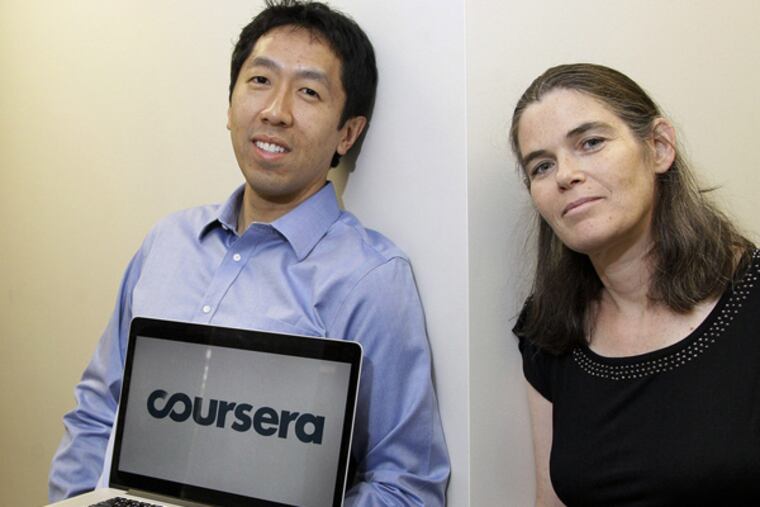
As you've probably heard, we are living in the age of the MOOC. In the last year, "massive open online courses" have spread through the higher-education landscape like kudzu on a Carolina roadside. Among the several providers that have gained early prominence, Coursera stands out as a particularly fast-growing enterprise. Founded by two Stanford professors in April 2012, the for-profit online education platform attracted more than a million users in its first four months—a faster start than either Facebook or Twitter, according to The New York Times.
Penn accounts for a significant portion of that growth. So far the University has offered 19 courses on the platform—more than any of Coursera's 32 other academic partners aside from Stanford, which has also offered 19. Penn's MOOCs range from "Corporate Finance," by Franklin Allen, the Nippon Life Professor of Finance and Economics, to "Experimental Genome Science," by pharmacology professor John Hogenesch and assistant professor of genetics John Isaac Murray. And the University is expanding its offerings.
Penn also has a financial stake in Coursera. Three months after the company launched—with $16 million in venture-capital funding and initial academic partnerships with Stanford, Penn, Princeton, and the University of Michigan—Penn became an equity partner by making a joint investment with Caltech of $3.7 million. (As of press time, Coursera had attracted a total of $22 million in equity funding.)
What the rise of the MOOC portends for higher education is an open question. Coursera has been enrolling tens of thousands of students in single classes (all of which, so far, have been offered for free). They live everywhere from Kansas to Kazakhstan, and are turning to MOOCs to get everything from casual intellectual enrichment to actual college credits. Coursera co-founder Daphne Koller aims to offer "most of the full university curriculum"—which she pegs at about 5,000 courses—within three to five years.
"I hope that in 10 years," she adds, "we will look back and say, "Boy, I can't believe that the most predominant method of teaching our students was to shove them into an auditorium for an hour and a half twice a week."
Koller, along with her co-founder Andrew Ng and a great many other people, believes that MOOCs will radically change the world of higher education.
"The question is," as Penn Provost Vincent Price puts it, "How?"
REBOOT THE MISSION
"We are in the business of creating and disseminating knowledge," says Edward Rock, the director of Open Course Initiatives at Penn. "That's what we do. We do it on campus, teaching students and doing research. We disseminate it in journal articles, we disseminate our research in books, and we disseminate our research in conferences all around the world. We have a few satellite campuses. And the Internet is a place of knowledge. So to be there—to be a presence on the Internet and disseminate the knowledge that we've created through the Internet—isn't some tangential kind of activity. It's core to our mission."
Rock, the Saul A. Fox Distinguished Professor of Business Law, is the University's designated deep thinker on all matters MOOC. Last year he was tapped as a senior advisor to Price and President Amy Gutmann on the issue.
Part of the motivation for Penn's embrace of MOOCs is altruistic. But while administrators trumpet Coursera as a way for Penn to spread enlightenment, the University's self-interested hopes for Coursera are more varied and interesting.
"What Coursera has made possible," says Rock, "by virtue of the hype, if you will—the glamor, the potential of teaching hundreds of thousands of students—is it has jumpstarted a conversation about technology in the classroom at Penn that we've been trying to get going for a long time."
Like a growing number of educators, Rock and Price believe that the traditional approach to both teaching and assessing students is outdated.
"This is an opportunity," says Price, "for the faculty to grapple more seriously with that whole range of technological opportunities—some of them not yet developed—to think about the way they inform not just delivering course material, but assessing student learning, and doing it on a broad scale and in more efficient ways."
One of their fondest hopes is that the MOOC format holds the key to "flipping the classroom." This idea dates back to the 1990s, but gained a fervent following around the time an MIT grad named Salman Khan started tutoring his niece in math over the Internet. When Khan started uploading his instructional videos on YouTube in 2006, their popularity and apparent effectiveness sparked widespread enthusiasm for the notion of "flipping" the conventional balance between classroom lectures and homework. Perhaps high-school teachers could take advantage of Khan's knack for YouTube teaching by assigning his tutorials (or others like them) as homework, and using class time to help students apply the concepts to problem sets.
Khan left his job as a hedge fund analyst in 2009 to devote himself to Khan Academy, a non-profit educational organization that currently offers 3,900 "micro lectures" on its YouTube channel, which has racked up over 230 million views.
Price thinks MOOCs hold the same potential for college classrooms.
"If you have well-developed technologies to provide that didactic component," he says, "it actually frees you up to do more of the intense, smaller-scale, what's often called 'high-touch' kind of teaching. And for places like Penn, I think that's likely where the value-added will be."
Karl Ulrich, the CIBC Endowed Professor of Entrepreneurship and e-Commerce, is already on that path. He teaches a handful of classes on product design, management, and innovation at Wharton, and a Coursera class titled "Design: Creation of Artifacts in Society."
"I believe my Coursera videos are more effective educationally than the same content delivered live," he says. So he's been using them at Wharton. "I typically assign a module comprised of a handful of short videos and ask my students to complete a challenging assignment based on that material. They do this before our class meeting. We then use our class time for an experience that can only be delivered with a group of 60 people sharing the same time and location." For example, he recently ran a competition in which teams of students produced product prototypes, and then simulated a market in which purchasing decisions were made and profits computed.
"For some years now," Price adds, "students entering institutions like Penn have grown up in a media environment where many of these tools seem second-nature to them. And they're puzzled as to why their faculty members aren't using them."
PEDAGOGY AND PROFITS
University officials decided to partner with Coursera for several reasons—not the least of which is that the company's founders reached out to Penn before anyone else did. Another factor, Rock and Price say, was Penn's lack of expertise in online education.
Free, high-quality, online collegiate classes are not a brand new invention. MIT has been putting entire courses on the Web since 2002, and now offers, at no charge, more than 2,100 classes encompassing "virtually the entire curriculum" of the university on its Open CourseWare (OCW) website. More recently, MIT teamed up with Harvard to found edX, a non-profit MOOC platform that currently offers 24 courses produced by one of six participating colleges.
"MIT, to their credit, did much to advance those technologies, and launched in many respects the Open Course movement," Price says. "But that investment in the technology per se is what led them down that road. Our lack of investment in this technology was what permitted us to focus on what I think matters, which is the content and the pedagogy, and to leave the technology to Coursera."
In Rock's view, "There's a really optimal division of labor with a for-profit venture-capital company taking care of, and taking the risk of, developing the platform— something that Penn has no comparative advantage at internally—and the universities doing what they're best at, which is producing high-quality instruction."
It's also attractive that, as both an academic partner and an equity investor, Penn has the potential to cover the costs of producing these courses—which run to about $50,000 a pop (consisting primarily of stipends for professors and teaching assistants, along with the cost of videography)—with a double cut of Coursera's profits, should profits materialize.
(Penn has not disclosed the details of its agreement with Coursera. According to the company, academic partner institutions will keep between 6 and 15 percent of revenues from classes taught by their professors, plus 20 percent of the profits. Penn has also not disclosed how much of this revenue will flow to individual professors; Rock says the formula is modeled on the University's patent policy.)
"I think of this largely as a set of investments I'm willing to make as an educator," says Price. "They're necessary investments, and I would make them in any event. But the idea that we might defray some of those expenses makes the proposition that much more interesting."
Coursera's venture-capital backers, of course, are betting on—and will no doubt push for—profits well beyond that modest expectation. Which makes some Penn faculty members uneasy.
"Penn always goes where the money is," remarks John Puckett, a professor in the Graduate School of Education who is currently working on a history of the University since World War II. "Coursera seems to be another way of providing non-traditional instruction in a way that's going to make money for the institution, because we're one of the anchor institutions of American capitalism.
"For all the pablum about pristine academic values," he adds, "they sometimes play a second fiddle. The question is, where does the slippery slope become a mudslide?"
Price appears to be keeping Puckett's question in the front of his mind, and notes that Penn has a nonexclusive agreement with Coursera. "We put our energy into this partnership," he says. "It makes sense to play this out in a way that benefits both Coursera and Penn. But if at any point the company moves in a trajectory that's not consistent with our mission, there's really nothing lost by that. And to some extent one could imagine a scenario where our investment in that company proves to have been a wise investment in a financial sense, even if we part ways and move in very different directions."
In the meantime, as Rock puts it, "What we're doing, in an incredibly cost-effective way, is jumpstarting the integration of technology into teaching on campus."
SMALL-SCREEN SCHOLARS
As it happens, some Penn faculty members are old hands when it comes to Internet teaching. Peter Struck has been doing it for 10 years. He got his start in a broom closet on Market Street.
This story originally appeared in the Pennsylvania Gazette, the alumni magazine of The University of Pennsylvania.