Study: Penn students likelier to name-drop ‘Ivy League’
Penn students helped give credence to a theory about status-defending behavior: Those with less status in a group tend to mention membership more.
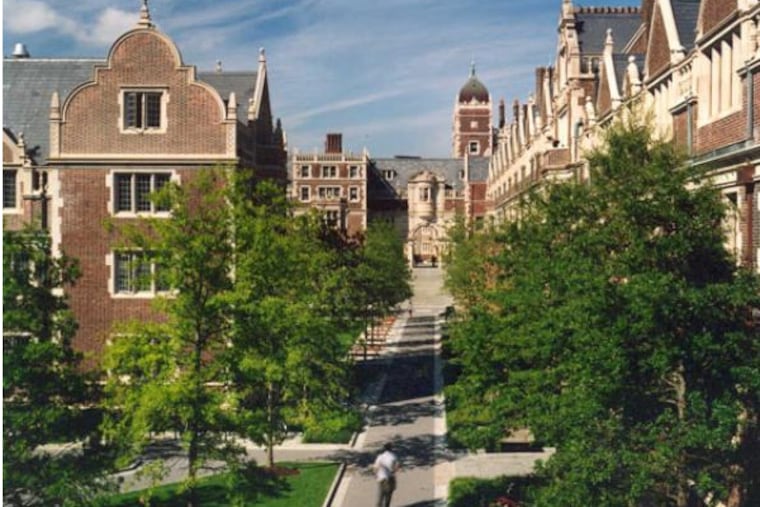
Penn students have helped lend credence to a theory about status-defending behavior: People toward the lower end of an esteemed group tend to mention membership more.
Three examples were cited in a study out of the University of Pennsylvania that appears in the October issue of Psychological Science.
Smaller international airports are more likely to describe themselves as "international."
Master's degree universities mention being a "university" more often.
And Penn students are more likely to mention being in "the Ivy League" than Harvard students.
The trend even applies to the academic journal that published the findings, the study wryly observes. It's one of five relatively new psychology journals that chose to include "science" in its title – something colleagues in physics, chemistry or biology "rarely feel compelled to do."
The study seems to confirm common sense.
"Most people when they look at it, they say, 'Yes, that makes sense in my world,' but it's never been actually shown," Penn psychology professor Paul Rozin said this morning.
It's easy to think of examples, not so easy to find ones that can be measured, he said.
The nouveau riche may be more likely to flaunt their wealth than families with old money. Lieutenants might outdo colonels in showing off their officer status. True M.D.s might be less concerned about being called "doctor" than dentists and chiropractors.
"By using hypercorrected pronunciation borrowed from the upper social classes, speakers on the border between upper and lower classes emphasize their membership in the upper classes," the study notes, summarizing earlier research.
The Penn-Harvard example began with asking 204 people for associations with the term "Ivy League." Eighty-three mentioned Harvard, while only three mentioned Penn, even though national rankings demonstrate Penn is quite an elite school.
Next, students coming out of similar psychology classes at each school were given one of two questionnaires.
One asked them to "write down 7 things you think of when you think of your university."
Seven of 20 Penn students mentioned "Ivy," but only four of 24 Harvard students did.
The contrast became even greater when the question addressed social interaction: "Please write down 7 things you think of when you describe your university to other people."
Nine of 33 Penn students mentioned "Ivy," but none of the 30 Harvard students did.
Maybe Harvard students didn't want to rub it in, while students at the more generically named University of Pennsylvania often lean on "Ivy League" to clarify confusion with Pennsylvania State University, better known as Penn State.
Rozin, 78, has been at Penn for 51 years, and said that even after he officially retires next year, he'll continue to teach an interdisciplinary course on food that includes working in a school cafeteria and visiting restaurants.
A lot of his research has been "contrarian," he said. He argues, for example, that obesity is not an "epidemic," since it's not contagious, and dieting seems to be a failed approach. Americans would be wise to be more like the French by taking longer to eat smaller meals (which doesn't mean snacking) and relying more on legs and bicycles to get around.
Contact staff writer Peter Mucha at 215-854-4342 or pmucha@phillynews.com. Follow @petemucha on Twitter.