Supper bell follows school bell for some students
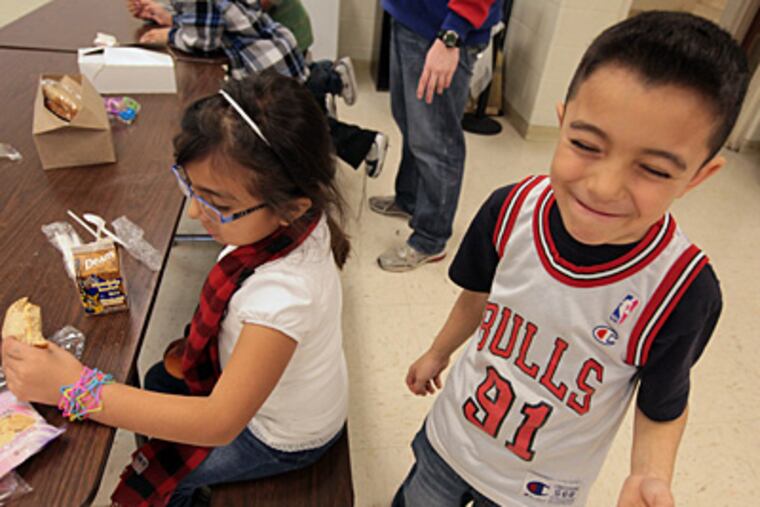
CHICAGO — Just after the final afternoon bell, Camren McGee turned the corner in the corridor of his South Side Chicago school and slid into the bustling cafeteria line.
It was 3 o'clock, and Camren had been at Donoghue Elementary Charter School since 8 a.m. He had another three hours of homework, academic study and crafts before his mother would pick him up after work.
The 8-year-old's stomach growled at the thought.
But Camren's school serves three square meals — breakfast, lunch and supper — to help students manage the long day and ensure children have a warm helping of food before they head home at a time when a record number of families nationwide are struggling to provide a basic meal.
"I have a very big appetite," Camren said as he dug into a serving of whole grain ravioli in tomato sauce. After what he calls his "school supper," he said, "I feel ready to go."
While breakfasts and lunches remain the bedrock of school nutrition programs, educators increasingly are adding supper to their menus.
This year, 333 schools across Illinois, about 85 percent of them in Chicago, dished up dinner with help from a federal initiative that targets low-income students in an effort to narrow the nutrition gap. Demand spikes in January and February, state records show.
Federal officials plan to expand school dinners as part of the reauthorized Healthy, Hunger-Free Kids Act. Championed by the first lady, the law extends to all states the federal reimbursement for school suppers, a program initially limited to Illinois, 12 other states and the District of Columbia.
This month, the government proposed new nutrition standards that would increase the allotment of fruits and vegetables and ensure students have a broader choice of green, leafy foods or legumes. Suppers currently include two servings of fruit or vegetables, a protein such as meat or eggs, milk and a serving of grain.
"Because of the long days that children and their parents are having, as people are struggling and working longer hours, (the idea of the law) is to look at ways to close the hunger and nutrition gap for children," said spokeswoman Jean Daniel of the U.S. Department of Agriculture.
Funding is available to schools in areas where more than half of the students qualify for free or reduced-price meals, under federal poverty guidelines. If a school meets the poverty threshold (currently a family of four living on an annual income of $28,665 or less), all students in afternoon programs get a free supper.
To serve meals, schools also must offer after-school academic or enrichment programs that open a door to all children. The French club qualifies; the football team doesn't.
Privately run after-school programs also can get funding to offer supper.
Officials with the Illinois State Board of Education alert each school about the program as soon as 51 percent of the student enrollment is considered low-income, agency spokeswoman Mary Fergus said.
Responding to the rising need, the Northern Illinois Food Bank sent its own letter last year to every school district superintendent in the 13 counties the organization covers. They explained the supper program and offered to deliver after-school meals.
"What we realized was kids will often leave school activity programs and go home to either a limited amount of food or no food," said Elizabeth Donovan, the group's vice president of hunger relief services.
East Aurora School District 131 took up the offer.
The west suburban school system began serving a snack at 13 of its 16 elementary and middle schools in October. Three other buildings where after-school classes stretch into the evening added a cold supper, district officials said.
One Monday afternoon, as most kids raced for the playground, more than four dozen students at Brady Elementary School checked into the cafeteria, grabbed a box of food and ate a quick meal before homework club began. About 9 percent of the students stay past the closing bell for tutoring and activities that run until 5:30 p.m.
Jackie Rivera, 11, joked with two friends as she ate a turkey and cheese on wheat sandwich, a pear, carrots and animal crackers with low-fat milk.
"Most people don't get that much food," Jackie said.
"Yeah, some people don't have food at home," Nadia Garcia, 10, added.
School officials and after-school tutors collect students' uneaten items into "sharing bins." As they leave, kids can grab an orange or carton of milk to take home.
In Illinois, a state that joined the supper initiative nearly a decade ago, 2.8 million school suppers were served from October 2009 through September, up from 1.8 million five years ago.
In the northwest suburbs, Community School District 300 last year added supper to the menu of seven schools where more than half of students qualified for a free or reduced-price meal. In Decatur, Ill., four schools dished up an afternoon meal in 2007, with a fifth added last year. And in southern Illinois, Mount Vernon recently extended supper to three schools.
The increase has been seen across the country, where 124.7 million suppers were served to students from October 2009 through September. That's 4.2 million more meals than were served just the year before. What's more, 95 percent of the suppers were eaten by children who qualified for a free meal, not only a discounted fare.
And while some may question whether it's the schools' role to serve three meals to students, food advocates contend the cafeteria is an easy place to reach kids who need the help.
"The more normal it is, the less stigma there is and the less stigma there is, the more families who need it will have their children participate," said Diane Doherty, executive director of the Illinois Hunger Coalition.
Parent Michelle Torres drops her fourth-, sixth- and seventh-grade students at Daley Elementary Academy at 7:30 a.m. each day and picks them up at 5:45 p.m. when she's done with work. They eat breakfast, lunch and supper — baked chicken and pizza are their favorites — on campus.
"It helps me out that I'm not worrying if they are hungry," Torres said.
Back at Donoghue Elementary Charter School, 245 students cycled through the cafeteria for supper in an hour.
When the last group left for afternoon classes, school officials turned their attention to the brown paper bags opened and stacked along one wall of the cafeteria ready to hold tomorrow's breakfast.
"So many times people forget what role food plays in students' being able to be attentive," said Todd Barnett, the school's director of family and community engagement.
Fresh from his afternoon meal, Camren worked through his math worksheet on decimals. Bent over his desk, a pencil in his hand, he said his belly was no longer growling.
"I'm ready. I can do my homework," Camren said, a grin creeping across his face. "And not talk back."