Eric Idle talks, a bit touchily, about what he thinks is funny
When asked why there were so few women in the original Monty Python skits, Eric Idle grows querulous. "Listen, Monty Python was a show written by six men and performed by the writers. We weren't women, so we didn't have many women in what we wrote. We just wrote comedy. Not male, not female, just purely - uncompromisingly - comedy."
When asked why there were so few women in the original Monty Python skits, Eric Idle grows querulous. "Listen,
Monty Python
was a show written by six men and performed by the writers. We weren't women, so we didn't have many women in what we wrote. We just wrote comedy. Not male, not female, just purely - uncompromisingly - comedy."
Yes, but it's so different from American comedy of the same era, namely Saturday Night Live. Who can think of SNL without thinking of Jane Curtin and Gilda Radner? They were women and integral members of the troupe.
Despite the bad phone connection, Idle's annoyance comes through. "I know all about them. I hosted SNL. I wrote for SNL. They used to say to me, 'Write something for Gilda, or write something for Jane.' I'd say, 'I write comedy, I don't write comedy for someone.' "
Idle seems to be making the case that comedy is gender-free, but that's so clearly not the case with Monty Python (wink, wink; nudge, nudge). Perhaps, though, the Pythoners didn't choose to be a boys' club but were simply at the mercy of their times in England. Maybe there were just no female comics at Cambridge in the 1960s when Idle got his start as a comic writer and actor in the Cambridge University Footlights Club (whose other members included John Cleese and Graham Chapman). It's worth asking.
"Listen, the year I was president of the Footlights Club, the first thing I did was change the bylaws so we could have girls. I wanted girls to be able to audition and the first audition we had was Germaine Greer."
The mind boggles trying to picture Greer, the soon-to-be author of The Female Eunuch, auditioning before Idle, et al. Could Greer's experience with Cambridge's male undergrads have influenced her thesis that women don't realize how much men hate them and thus how much they are taught to hate themselves?
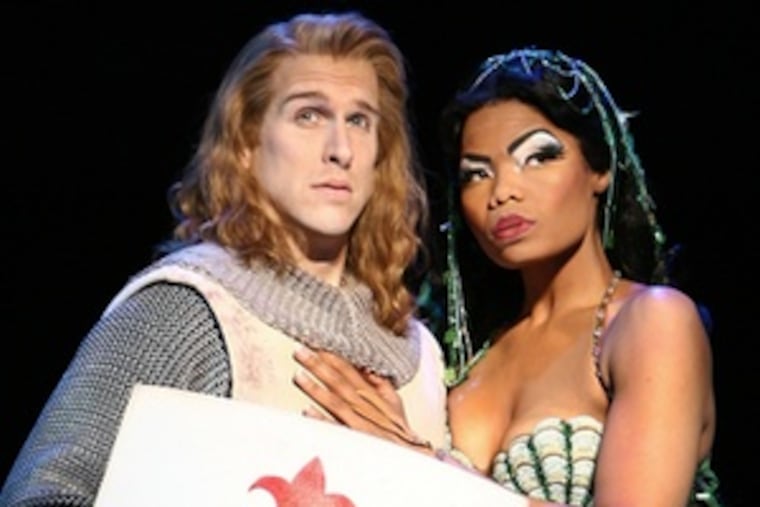
One would like to pursue this, but not at the risk of further irritating Idle, who, after all, only wants to promote Spamalot, his hugely successful musical based on the boys' beloved film, Monty Python and the Holy Grail. Idle, the most musically gifted of the Pythoners ("Always Look on the Bright Side of Life" is one of his ditties) adapted the movie, wrote the lyrics, and collaborated with John Du Prez on the score. The play, a Tony winner on Broadway, has now begun a U.S. tour and will open a two-week-plus run at the Academy of Music on Tuesday.
Idle, however, is still musing on the dearth of girls in Python. "When we began adapting Holy Grail into Spamalot, I knew there was one big change that had to be made. I said, 'We must have girls.' I knew having girls would make it more American-orientated. And so we have a lot of girls in the show, dancing and singing."
Yes, the girls sing and dance, and so do the boys. One song sticks in the memory: "His name is Lancelot / he likes to dance a lot." He also goes to France a lot and wears tight pants a lot, and "you can all find him pumping at the gym / At the Camelot YMCA!" Darn, it's just impossible to get away from gender issues when talking about Spamalot and Monty Python.
New topic, then. Does Idle find it curious that Spamalot, like Mel Brooks' The Producers before it, was adapted from a very popular film? Did Brooks' success inspire Idle?
Alas, it's another nettlesome question. "People always connect Spamalot to The Producers. Let me just say this - I approached Mel Brooks in 1982 or 1983 and said I wanted to do a stage adaptation of his movie. I asked to play Bloom and have him play Bialystock. Obviously that didn't happen. But I was there for opening night. I always knew The Producers would be perfect for a stage musical, and I was right."
Who would have guessed turning The Producers into a play was Eric Idle's idea - although the popularity of Brooks' musical must have been on his mind when he wrote the song for Spamalot that goes "you can't have a play on Broadway if you don't have any Jews."
"It's not related," Idle says flatly. "It's simply a truism of Broadway. Most of the people in the theater business in New York are Jews."
Forget the new topic; the old one is more interesting. Why do British people find it so funny when men dress up as women? Does it go back to Shakespeare, where all the roles had to be played by men?
"Shakespeare?" Idle muses briefly. "I don't think so. We just find that funny. It's funny because everybody is playing a role. When someone is dressed up as a member of the opposite sex, it's just funny."
But it seems, somehow, more funny in England. Could it be related to all those boys' schools, like the one Idle attended before Cambridge?
"No, it's not boys' schools. It's probably related to pantos. Pantomime. Children's first experience of theater in England is being taken to see a pantomime. The essence of panto is that the principal is played by the opposite sex. The boy hero is played by a girl and his mother is played by a guy."
Idle's cell-phone service is getting dodgy. He's in the back of a limo approaching Vegas (Steve Wynn is mounting Spamalot at his new casino, Wynn Las Vegas; now in previews, it opens April 1) and the poor man is simply trying to plug the traveling version of the show coming to Philadelphia.
"It's just supposed to be fun," he says. "When we first thought of Spamalot, it was because we wanted to do something fun on Broadway.
"At the time, musicals weren't fun - you had helicopters and a guy with a plate on his face, but no comedy," he says. "Spamalot is fun."