Paint and life by the gobs
Cross Vincent van Gogh and Nick Nolte and you get Philadelphia artist Chuck Connelly, sort of, always throwing paint around, some of it landing in a New York gallery.
It is the circuitous and confounding fortune of painter Chuck Connelly that after two decades living in New York he now finds himself living in Philadelphia, which is the subject of his solo show "East Oak Lane," being exhibited solely in Manhattan.
The neo-expressionist created portraits of his neighborhood's 19th-century homes.
"I like the way they sit, the angles, the good bones, imagining what they once were," he says, standing before a hulking, decaying, multigabled yellow Tudor he painted for his DFN Gallery show in Chelsea, which runs through April 7.
An artist of 30 years, once shown in top galleries and collected by the Metropolitan Museum of Art, Connelly, 52, is currently without a local gallery, the Oak Lane paintings rejected by several area dealers.
Five of the 18 paintings sold in two weeks. The works range in price from $3,000 to $24,000.
Neighbors, like T. Michael Poxon, are delighted that their homes have been captured on Connelly's canvases. Several East Oak Lane residents went to the show's March 8 Chelsea opening. Poxon and wife Marita Krivda purchased the portrait of their 1888 home.
Connelly is a big man with a bigger personality and a worn, handsome face, given to doing nothing in half-measure, the sort of behavior typical of mid-century abstract expressionists or Welsh and Irish writers but generally anathema today.
He inhales three or four packs of cheap cigarettes daily, and loves expensive prime rib. He casually mentions imbibing eight Bass Ales in a sitting. Really, that many?
"No, I often like to drink more."
Frequently, he is asked to leave a restaurant, as he was the other week, for being louder and more obstreperous than the other clientele. Reciting his life's narrative over the course of a snowy afternoon of many cigarettes and much wine, sitting in his current manager's home, Connelly invariably mentions a friend or gallery dealer only to end with the coda, "but we're no longer talking."
In his prime, he must have been something with the women. He was married for seven years. It ended badly. No kids. He doesn't care for them.
Ideally, Nick Nolte would portray Connelly in a movie.
Which, as it turns out, he has.
In Martin Scorsese's roiling "Life Lessons" segment of New York Stories, the 1989 cinematic triptych, Connelly's hands stood in for those of Nolte's tortured Lionel Dobie. His paintings are Dobie's paintings. Though the Richard Price script was already written, Nolte studied Connelly, the two became friends, and it's hard to see where one man ends and the other begins.
And, in an act of foreshadowing, Connelly's wife left him prior to his last New York show, two years ago, mirroring Rosanna Arquette's action in the movie.
"Chuck's really a paintaholic," says Rick Davidman, his Manhattan dealer. "There's nothing else he can do but paint." True enough, Connelly's never held another job for more than a few weeks. "Chuck loves to throw the paint around," Davidman says. "All the inanimate objects look like they have a pulse."
Raised in Pittsburgh, a graduate of Temple's Tyler School of Art, Connelly moved back to Philadelphia in 1999 after living in the East Village.
"Chuck needed to quiet his life down," Davidman says. "He was out and about a lot with the downtown New York art crowd where he was, alternately, the most charming or least charming person in the bar."
The late diet doctor Robert Atkins was once his patron, supporting Connelly while he lived in Düsseldorf, Germany, for two years. "His neo-expressionist populist style was big in the '80s, then became less so when flat, ironic art came into fashion," Davidman says. "Now, it's cycled back."
Connelly no longer drives, which leaves him isolated in the neighborhood. "My driving tended to result in multivehicle accidents."
He claims to have little use for computers other than downloading images for paintings, though he maintains a Web site, chuckconnelly.com. Many people irritate him. His chief interests outside painting are true-crime books, Court TV, eating prime rib and smoking.
Though he once traveled extensively, Connelly has become agoraphobic. Plenty of life - actually, most of life - makes him nervous. His pleasures, he confesses, are few. "I used to enjoy walking to the store for cigarettes but now, with the hernia, I don't even like to do that," he says.
"Connelly is someone who people love," says his local art representative and manager, Caroline Millett. "I think it's easier to love Connelly than to like him."
She says this standing right next to him. Connelly nods in agreement.
It's a complicated relationship.
He gets angry and anxious when she steers the conversation away from him. She's polite, poised, pulled together, and he's barely any of those things. Her exquisite Powelton Victorian is a cathedral devoted almost exclusively to Connelly's art. In Philadelphia, his work is available through her Web site, millettdesign.com.
Millett says her job "is to keep Connelly out of trouble. I'm willing to put up with a lot if the person is a genius. Connelly is a genius."
His favorite painters are dead - van Gogh and Chaim Soutine (he's been compared to both, which he likes), as well as Rembrandt, Goya and Sir Joshua Reynolds. "Oh, I like Martin Kippenberger."
He's dead, too, of course. Cancer, 1997.
Connelly scorns modernity in most forms, to say nothing of his artist contemporaries, including Pennsylvania Academy painters. "Though I wish I'd gone there to learn those tricks, if only to forget them," he says, winning no points for diplomacy. "Then I'd know how to play the gallery game."
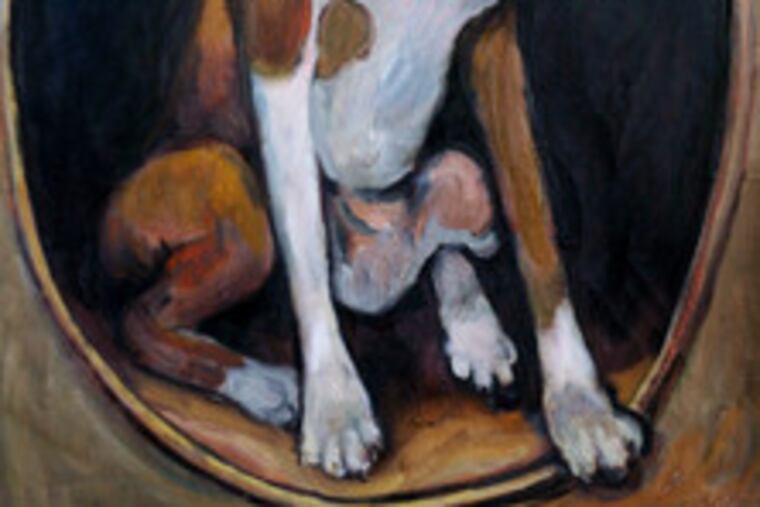
Right now, restless, he's painting dogs from photographs. "I like looking at them. But I don't want to have to walk them. They're like kids," he says, standing in his living-room studio, the splattered carpet a Pollock, the corner table a Johns jumble of a dozen cans stuffed with a couple hundred brushes.
Connelly's ambivalent about the city and the neighborhood. East Oak Lane "is too quiet, fallen on hard times, though I like it visually." And Philadelphia disappoints. "Like the neighborhood, it's too inner-directed, dull and shapeless. It suffers from a lack of ambition."
Connelly suffers from none of these things.
Shuffling through his neighborhood, he squints into the sun. "Maybe I've found something with these house paintings. I've been through everything else," he says with a laugh. "Perhaps I should move on to a ritzier neighborhood, you know, Chestnut Hill or something. After all this time, I've become a house painter."