Art hangs around
The walls of cafes, bars and bookstores are the cool new galleries for emerging artists. Commissions are low, exposure high, and the small spaces get ever-changing decor.
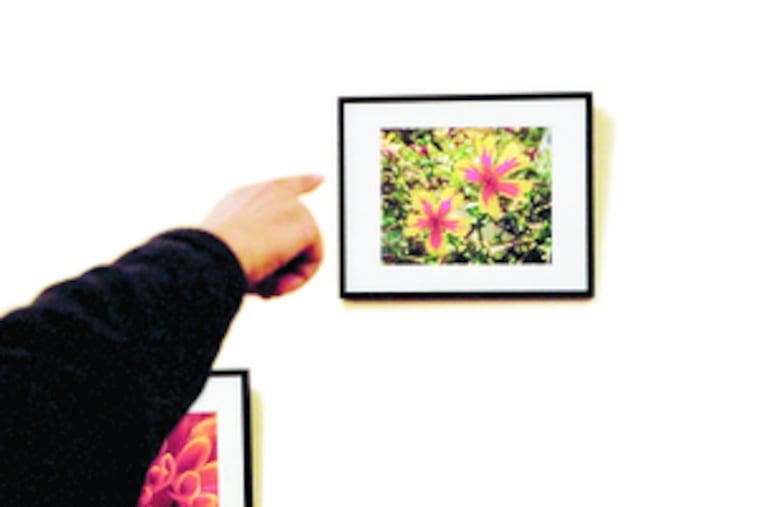
Surrounded by ballpoint-pen drawings of aliens, Howard Kleger tucked himself into a corner of the Flying Saucer coffeehouse and spent an hour trying to sell his own artistic vision to owner Troy Musto.
Kleger wants to set up a Web cam in his attic, and beam himself onto the wall of the Fairmount neighborhood space. That way, people can see him drinking coffee or writing or drawing, in his attic, but he'll still (sort of) be in the coffeehouse at the same time.
Musto, who has one of Kleger's pieces at home, thought the idea could work.
"I'm a little more open to unusual ideas, because I'm not really worried about selling," said Musto, who showed his own artwork at the coffeehouse's previous incarnation, the Crooked Frame. "I'm more interested in giving artists a chance to show their artwork - I mean, I have hula hoops hanging on the wall that a friend made."
Forget the white walls of galleries or the snooty atmosphere of a collector's house: The place to be seen is literally hanging in bars, coffeehouses or restaurants. Owners say soliciting works from local artists is a way to support the community, create a changing inner landscape, and bring in business. Artists say the commissions are low and the exposure is huge, making it easy to sell a $200 painting with a skim latte.
Plus, they say, there are venues everywhere.
"I've shown in coffee shops, bookstores and bars as well as schools and colleges," said Todd Marrone, 32, an art teacher with the Lower Merion School District. "I'd much rather have art out there for people to see, and it's good to have any opportunity to show and share my work."
His acrylic and latex works most recently appeared at MilkBoy Coffee in Ardmore, where he did some "live art," painting as a local band played. At a typical one-month show, Marrone will sell several $200 to $500 paintings, which go straight from his hands to the customers, the paint barely dry.
Showing in "unorthodox" spaces is nothing new, both owners and artists said; it's just more common, thanks to a coffeehouse boom and a new respect for showings in small spaces.
Alice Oh is an associate professor of fine arts at the Moore College of Art & Design who curates shows at the Kimmel Center and, surprisingly, Lincoln Financial Field, (the Eagles' stadium hosts shows for the school's alumni and students).
She said the coffee/bar/bookstore scene really exploded in the 1990s, first as an afterthought, now as part of the planning.
"The cafes I've been to have great walls to show up-and-coming artists, and they have the kind of light fixtures and walls to provide for the artists," she said. "It seems to be that the whole culture has started to evolve."
The upside is that it's easy to see the work, and that the snack/mocha/beer crowd is larger than a typical gallery showing. Then there's the commission: Galleries usually charge 50 percent, compared to coffeehouses or bars, where commissions range from nothing (Tangier) to 20 percent (MilkBoy).
Is there a downside? Well, many places won't show anything that might be inflammatory or has nudity. Depending on the place, they want big canvases or small, and sometimes anything besides paintings is hard to display, as Musto, of the Flying Saucer, found out when he tried to hang Brooke Hine's ceramic pieces.
And if the piece is damaged, it's rarely insured, Oh said.
That's particularly true for bars, which have started offering their walls. But with the city's smoking ban, more artists are willing to give up canvases that might have otherwise become smoke-stained. Dirty Frank's offers its "Off the Wall Gallery," with four shows a year (and gallery hours until 2 a.m.). And Tangier, a restaurant and pub in Graduate Hospital, started putting art on its walls four years ago.
Jack Roe, who owns Tangier and previously had places in Queen Village and Manayunk, said he had always had local color on his walls, but it had mostly been by artists who were working for him at the time.
At one point, an agent had come in with different artists each month, but Roe didn't like some of the work, so he went back to hiring his own folks.
Currently, it's Mark Bullock, 44, from Sicklerville, Camden County, who is a part-time cook at the restaurant. His paintings, a melange of aliens, poker players and banjos, adorn the walls.
"Our place has a certain vibe - eclectic, earthy, a little exotic," Roe said. "Abstract art doesn't work here. It doesn't have to be pointillism, but Mark's stuff has a very funky, folk vibe to it."
At the Kaffa Crossing in University City, an Ethiopian cafe specializing in fair trade, owner Yonas Kebede said he used to have to look for artists. Now they come and ask for space.
"I like more colorful works," he said. "It goes well with our ambience."
Although he likes a mix, he's partial to nonprofits that use the space to raise money for a cause and to new artists looking for a break.
That's how Sourav Banerjee, 50, a software quality engineer, found himself hanging 25 pictures after midnight on a school night. An amateur photographer taking pictures with a standard digital camera, his photos of flowers, water and landscapes had caught Kebede's eye over dinner (their wives knew each other).
A month later, two pictures had sold, and Banerjee was planning a new show at another cafe in Delaware.
"I never thought of myself as an artist, and I didn't know if I was making a fool of myself," Banerjee said. "I didn't know what professional photographers would think because I was using a consumer digital camera."
Banerjee discovered that those fears were unfounded. "What I realized from the pictures that sold was that people are looking for an original artistic vision," he said.