On Movies | Oscar by her side
Halle Berry's Academy Award has made all the difference, a friend that now gets her to high places.
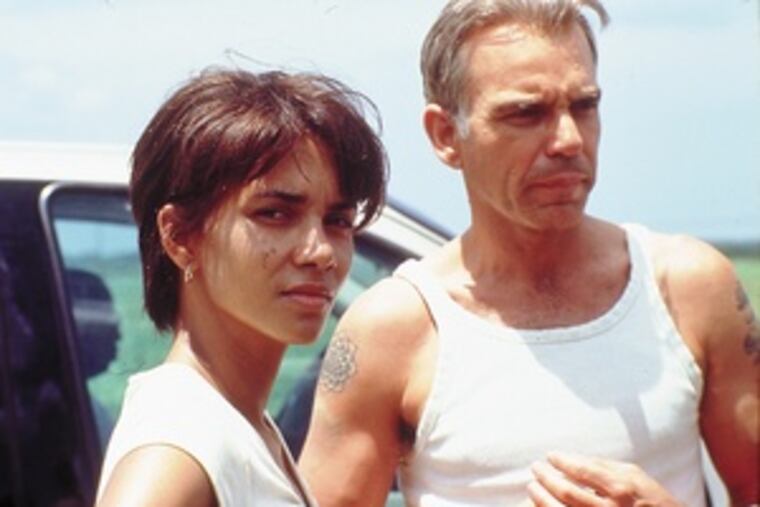
There's a big, bold demarcation line running through
Halle Berry's
life: before Oscar and after Oscar.
"There was a time, before Oscar, when I could not have even got in the room with certain directors," says the actress, who won her Academy Award in 2002, for the Southern-fried Monster's Ball, in which she played a Death Row inmate's wife who falls into an affair with the prison guard - Billy Bob Thornton - who executed him.
Now, Berry can get in the room, and more often than not leave with the part. In Perfect Stranger, a dark, tricky thriller opening Friday, she gets her name above the title (with Bruce Willis), as a tabloid reporter looking to expose an advertising tycoon's adulterous, and quite possibly murderous, ways.
She followed the very-Hollywood Perfect Stranger with the very-indie Things We Lost in the Fire - an intense character study slated for late-year release and costarring Benicio Del Toro. The project hails from Susanne Bier, the Danish director nominated this year for an Oscar for After the Wedding (opening Friday at a Ritz theater). The actress is a passionate fan of Bier's emotionally raw Brothers and Open Hearts. The Berry collaboration marks Bier's English-language debut.
"I fought really hard to be in that movie and work with her," says Berry, dressed in trim pinstripes, holding forth at the Four Seasons Hotel recently. "I was determined to have that experience, and it was everything I thought it would be."
It wasn't that Berry was hurting for work back in those pre-Oscar days. The first X-Men, in which she's suited up as the meteorologically powered mutant Storm, had come out; Warren Beatty had cast her in his brash political satire, Bulworth, and Berry gained gobs of notice - and a hefty bonus - for flashing her breasts in the crime caper Swordfish.
But the one-time Miss USA and Miss World contestant, a striking woman of African American and English heritage (her father's black, her mother's white), was, like so many Hollywood beauties, not really taken seriously.
"The great thing the Oscar does for me is it allows me the right to be in the room and have a meeting and make my case," says Berry, who keeps homes in New York and Malibu and continues her gig as a Revlon spokesstar. "As long as I can do that, then I feel like all is good in the world. Because the filmmaker absolutely has the right to say, 'No, Halle is all wrong.' But knowing that I have a shot at it, it's all that I ever asked for. And I get that these days."
James Foley, who directed Berry in the erotically charged, heavily promoted Perfect Stranger, points to Monster's Ball, too.
"That was the first time she was given the opportunity to use what I think is still an underrated talent," says the director, whose credits include At Close Range, After Dark My Sweet, and Glengarry Glen Ross. "The fact that it took so long for her to get in that position makes me mad about the movies she could have been making had Hollywood come to its senses, or luck had gone in different ways.
"But when you think about it," he continues, "in 90 percent of Hollywood movies, the lead is male. And 99 percent are white. And she doesn't fit those categories. So for her to get in a position of first billing with Bruce Willis, I can imagine the sort of perseverance she must have. . . . And she doesn't wear it at all. There's none of the 'I deserve this because I worked so hard' stuff. She's ambitious in the best sort of way."
Although Berry, at 40, is one of the few stars out there who doesn't want to direct, her ambition has led her to take control of the films she appears in - and ones she's interested in seeing, even if there isn't a part for her. Under her production company banner, Bellah Films - "Halle B backwards," she explains - Berry is developing Tulia, based on the real-life events surrounding the wrongful arrest of 46 blacks in a Texas drug sting; Class Act, another based-on-a-true-story, about Tierney Cahill, the Nevada schoolteacher whose sixth-grade students helped her run for Congress, and Nefertiti, a big-budget epic about the 14th-century B.C. Egyptian queen. (Her Monster's Ball director, Marc Forster, will steer her through that one.)
Berry's also overseeing a project for singer Alicia Keyes and a TV series for Lifetime, called Mixed. Although she won't appear in the latter, it's a subject rooted in her own experience.
"It's about growing up mixed-race," she says. "I think it's timely right now. We're all sort of becoming more tolerant of each other. It feels like with this new generation, they're not having some of the issues that I know I had when I grew up, and that my parents had."
Berry - raised in suburban Cleveland by her mother, a psychiatric nurse - says her own ethnicity wasn't an issue until she reached school. "When you grow up in that [multiethnic] environment, you see the world differently. Being a mixed-race child, I didn't always see color in people, I really didn't. It was other people that made me see the color all the time. But, left to my own devices, I grew up very much color-blind. Then I got old enough for other kids to start contaminating the way I thought."
Berry's experience with racism - in schools, in jobs, in Hollywood - has prepared her, she says, for another ism: ageism. Berry's at a point in her life where studio execs start looking elsewhere - as in younger - for their talent. Even with an Oscar, some parts might be harder to come by in future years.
"I started in this business 20 years ago, and I've always had to struggle, being a woman of color," she says. "So the fact that I might have to do that because I'm getting older will feel like normalcy to me. . . . I will continue on as I've been for the first 20 years of my career, fighting to get a good part for a woman like me.
" . . . I know what that fight is all about, and it doesn't scare me at all."
"First Snow" job. Two guys from New York - Mark Fergus and Hawk Ostby - head to L.A. in the 1990s to break into the screenplay biz. They come up with stuff they think will sell, and it doesn't. Then they write First Snow - a noir thriller about a shady floor salesman spooked by a clairvoyant's prediction of his demise - and the studios start calling.
Although First Snow - with its cool, Twilight Zone premise - didn't get made, it landed Fergus and Ostby an agent, and jobs.
"There were some good years, some not so good years, but I was able to eke out a living because of that script," Fergus says. "And I learned a lot about how the business works. I just thought you write scripts and then you try to sell them. I didn't realize you get hired to write things, adapt books, whatever."
One of those books was P.D. James' Children of Men, which Fergus and Ostby wrestled with for Universal. Although little of their draft remains in the Alfonso Cuaron-directed futuristic fable, their names stayed on the credits - and on the Oscar nomination for adapted screenplay.
It took Fergus almost six years, but First Snow - which stars a lean and mean Guy Pearce, along with Piper Perabo, William Fichtner and J.K. Simmons - finally became a reality. And Fergus makes his directing debut.
It opened Friday at the Ritz at the Bourse.
"Finally, it all came together," says Fergus. "Guy was available, I had convinced [producer/distributor] Bob Yari to let me direct, and casting the rest of it happened like lightning. It's kind of exhilarating, and kind of terrifying."
On Movies |
Movie
Perfect Stranger
Opening Friday in area theaters