Decemberists feature a hearty songbook
The Decemberists' Colin Malloy writes a very peculiar and fascinating kind of folk-rock song - radically anachronistic, with a classical air about it.
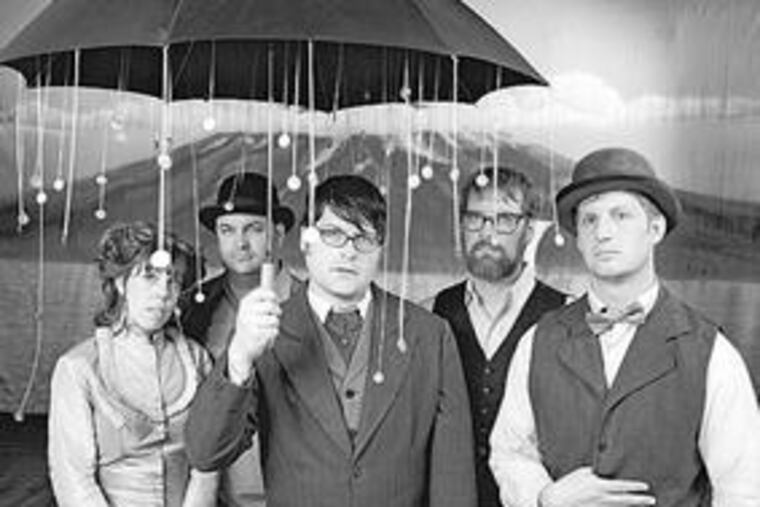
The
Decemberists
'
Colin Malloy
writes a very peculiar and fascinating kind of folk-rock song - radically anachronistic, with a classical air about it.
An English major's dream, Malloy's highly literate ballads beseech and bedazzle thee, often seeming torn from the Child Ballads. We're not talking kiddie tunes, but those ancient English and Scottish songs passed down orally from generation to generation and finally collected in the late 1800s by folklorist Francis James Child.
The Decemberists offer similarly hearty tales of rogues and trollops, and gallant soldiers trudging off to a certain death. And let's not forget the wildly surreal, fantasy visions the Decemberists evoke in a song like "Lesley Ann Levine," about a ghostly infant "born at nine and dead at noon.
Even the group's name evokes another age. The original Decemberists were a group of Russian idealists who unsuccessfully challenged a new czar's rule in 1825.
Malloy will see and hear his songs played out as the Decemberists perform at the Mann Center for the Performing Arts accompanied by the 65-piece Mann Festival Orchestra. We got him on the horn to converse about this most noble venture.
Q: How did this tour come together, and what music are you doing?
A: The idea came from a promoter in Los Angeles, Johanna Rees, who's done similar things in the past with other indie bands [Air, Dead Can Dance, Belle and Sebastian]. Her notion was to hook us up with an arranger, Sean O'Loughlin, who works with the L.A. Philharmonic and with the Hollywood Bowl.
Then it turned out there were other orchestras and venues interested in doing the same thing. So we built a tour out of it that's also taking us to Atlanta, Baltimore . . . and Chicago and to two cities without an orchestra: Central Park and Portland, Ore.
We'll do a set on our own, plus an hour with the orchestra that draws from a bunch of records. Songs like "I Was Meant For the Stage" and "We Both Go Down Together" originally had string arrangements that we built in the studio with our minuscule budget, with one player [Petra Haden] overdubbing ad nauseam. Now we get to do them justice.
Q: Doesn't this seem to be the year for string-endowed pop, with artists like Sufjan Stevens, Bright Eyes and Arcade Fire also venturing in that direction?
A: I think people in our peer group are getting inclined to do big music - grandiose, cinematic music. I myself come from a more egalitarian musical background. I like my music small and recorded in a basement. But that said, I also like the big stuff.
We've been inspired a lot by groups like the Waterboys, who had that big, grand music thing going, and also by Belle and Sebastian, who, in a way, were polar opposites but creating little pop masterpieces out of a church in Glasgow. Again, it was that idea of having slender means while creating something grand.
Q: The thought's been posed that you and the Decemberists are a pointed reaction to the dominant pop style of personal, confessional songs. Any truth to that?
A: I don't think I've ever had an issue with confessional songwriters. The girth of pop songwriting is built on that kind of music. But from my perspective, it just seemed more interesting to write songs about far-fetched things. To be honest, I didn't think they'd be interesting to other people. They were a little too weird. But then I discovered people liked them, so I kept writing.
I'm drawing from the folk tradition. You know, those confessional songs only came about relatively recently in the evolution of music from first-person folk and blues. It became this thing, this mechanism for teenagers to work out their anxieties. But these old things like Child Ballads are telling the stories of people with real tragedy and beauty in their lives. Fairport Convention and the Pogues were also big influences on us. I've always been fascinated by their melding of the contemporary and the traditional.
Q: Your new concert DVD, "A Practical Handbook," shows the band going crazy in concert, not just switching off between instruments but also in perpetual motion. Are you going to be jumping over the heads of the Mann Orchestra players?
A: Growing up, going to rock shows, I loved bands having a good time on stage, not taking themselves so seriously. They were tearing down the assumption that to be a rock band you need to be moody and staring at your shoes. . . . And that's what I've pushed us into.
But it hasn't been hard. We're all normal people. We don't have attitude issues. And though the music's artful, it doesn't have to be staid.
As for jumping over the orchestra in Philly - probably not. The point of these shows is to nail the arrangements as best we can, and for people to sit and listen to it.
Q: Let's talk about your shift from a small label [Kill Rock Stars] to a major [Capitol] with your latest album. Did you lose any indie cred in the process?
A: When our deal was announced with Capitol, there was some of that "selling out" vibe going around. But when the record ["The Crane Wife"] came out, people realized we were still doing things completely on our own terms. We weren't going to create something we weren't committed to personally.
So in that way, the label change hasn't meant anything. They're just paying the bills. And we haven't lost any fans, just gained new ones. This album is now approaching 300,000 sales, which is double what any of the others have done. *
Mann Center for the Performing Arts, 52nd Street and Parkside Avenue, 8 p.m. Sunday, $34, $44 and $69, 215-893-1999, www.manncenter.org.