Kirov Opera's Ring for listening, not looking
NEW YORK - Though Wagner's four-part, 16-hour Ring cycle is still one of classical music's sure-fire events, the franchise has taken so many hits over the last few years, thanks to absurd production concepts, that the artistic tables have turned. Provocative stagings once kept Wagner's stock high during a severe drought of suitable singers. Now, Ring-savvy companies have good singers three deep, but productions are running low on decent ideas - a fact that can be ignored when singers are particularly fine.
NEW YORK - Though Wagner's four-part, 16-hour Ring cycle is still one of classical music's sure-fire events, the franchise has taken so many hits over the last few years, thanks to absurd production concepts, that the artistic tables have turned. Provocative stagings once kept Wagner's stock high during a severe drought of suitable singers. Now, Ring-savvy companies have good singers three deep, but productions are running low on decent ideas - a fact that can be ignored when singers are particularly fine.
So it is with the Kirov Opera's much-traveled, eagerly anticipated, musically distinguished Ring, the first two installments of which unfolded Friday and Saturday at the Lincoln Center Festival. Even the most heroic roles are cast from within the company, but with a production that follows current trends toward uglification, and is best approached with eyes wide shut.
The open-endedness of the opera's mythology, allowing the Ring to take place almost anywhere - its tale of greed, deceit, power plays and murder around the theft of magic gold is hardly specific to any time or place - meant that resetting Das Rheingold in ancient Egypt and Die Walküre in the Easter Islands could have been a good idea, had it not been executed so vaguely.
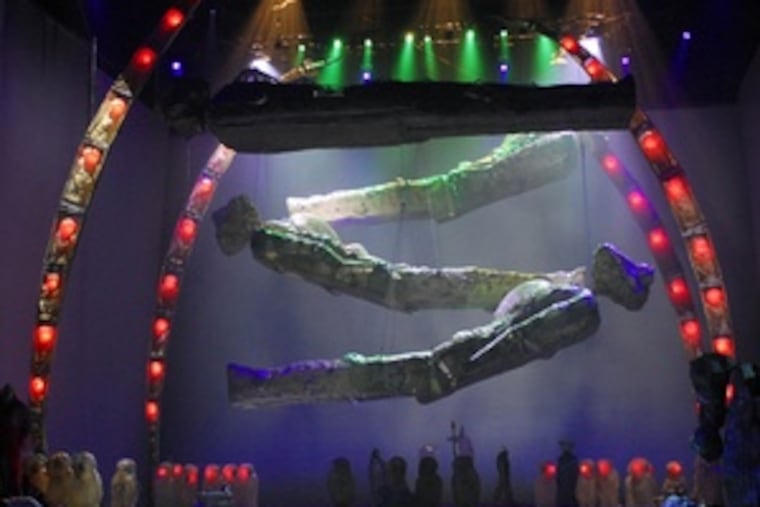
Recurring images from set designer George Tsypin are massive, oblong, rocklike structures suspended over the stage, resembling sarcophagi in Das Rheingold and decomposed heroes (though, curiously, with cow skulls for heads) in Die Walküre. Lighting was abrupt, dramatic, and at times psychedelic. The Rhine gold was a large, glistening globe that suggested an out-of-control lawn ornament. Oddly, the stage blocking was done in a peculiarly antiquated style that didn't flow from one event to another but was sectionalized, almost like a series of dances in classical ballet.
But let's put this in some gratitude-inducing perspective. There was nothing so silly as that Act 3 Die Walküre moment this year at the Canadian Opera Company when filmmaker Atom Egoyan had the warrior maidens tossing body bags around bucket-brigade style. Also, there was nothing on stage so imposing that it distracted you from the cast, which was consistently charismatic and had developed its own passionate Wagner style.
Almost all these singers are unknown here, with the significant exception of the suitably malevolent Nikolai Putilin as Alberich in Das Rheingold. You can't say there were a lot of star voices that you'd want to hear again and again, though Mlada Khudoley (Sieglinde) had a marvelous way of conveying her character's inner transformation with ever richer vocal colors. Alexei Tanovitsky was a youngish, physically vital Wotan, but even his robust bass voice was barely a match for Larissa Diadkova's imposing Fricka.
Kirov visits often launch a major career (Anna Netrebko and Olga Borodina, for example), and this one was Olga Sergeeva, in the punishing role of Brünnhilde. She put so much warriorlike passion into her Act 2 entrance, you feared she'd run out of gas. Instead, the voice kept getting better, full of dramatically telling phrasing, and her stage manner is so accomplished that she may be the most watchable Brünnhilde since Gwyneth Jones.
Another possible discovery is the velvety baritone of Evgeny Nikitin, though such impressions can only be provisional: As the lumbering giant Fasolt, he was encased in a gargantuan costume that appeared to be made out of boulders. Only his head was visible - if barely.
Ever-controversial Valery Gergiev, the Kirov Opera's powerhouse conductor and overall czar, is usually the star of his own shows, and the Ring is no exception. Though I've parted company with him often, Wagner may prove to be Gergiev's primary composer. There wasn't an orchestral moment that wasn't dramatically alive, thanks to a depth of understanding and great range of expression that brought you back to the pre-World War II age of great Wagner conductors.
The Kirov Opera Orchestra - in the past often compromised by low-quality string instruments rendering a dullness of tone - now has plenty of transparency and luster, not to mention what seems to be a telepathic relationship with its conductor. So the good news is, in fact, great news, not just because the strengths are considerable, but because they put operatic values where they primarily belong - in the music.