Growing up with Harry
Generation Potter, 15-to-24-year-olds, have mirrored the young wizard's life.
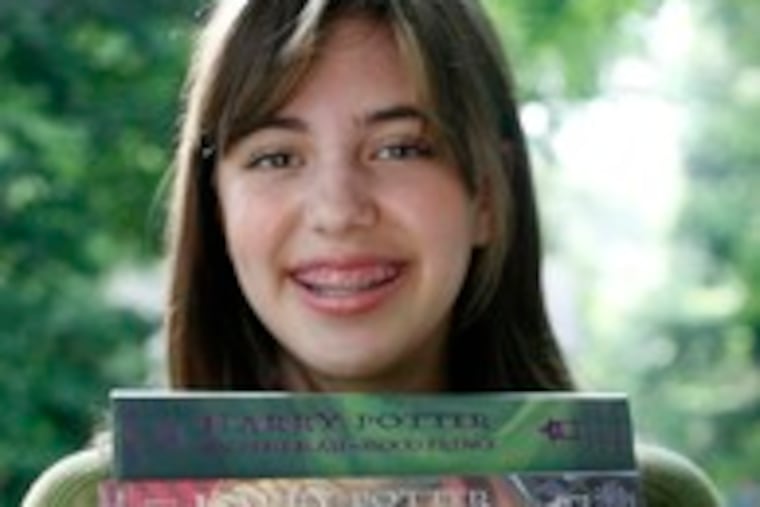
Stephanie Calinan remembers the first time she picked up a copy of Harry Potter.
"I was in sixth or seventh grade, around 10 or 11," recalls the 17-year-old from Blenheim, Camden County. "I was about Harry's age, which made it really interesting because I would be doing the same stuff that Harry would be doing."
Stuff, that is, that's standard fare for 10- and 11-year-olds. Learning about yourself, your friends and the opposite sex, exploring school and sports, having fun - basically, growing up.
"You can relate to the books, especially as a teenager," she says. "The angst, the romance, the studying, and the exams."
It's this sense of connection that makes Calinan part of the Harry Potter generation, the group of kids who ranged from 6 to 15 years old when Harry Potter and the Sorcerer's Stone was released in the United States in 1998. Now anywhere from 15 to 24, they have grown up alongside Harry, hitting puberty, new responsibilities, and adolescent crises right along with him (though they battled bullies, pushy teachers and overbearing parents rather than Lord Voldemort).
"It's all stuff you can relate to," says Alice Conant, 16, of Chestnut Hill. "When the second one, The Chamber of Secrets, came out, I was scared to go to sleep at night because I thought the basilisk was going to be under my bed."
Now Conant and Harry have both moved past that scary snake, and J.K. Rowling's writing has advanced with them. Gradually filling with heavier subjects like wizard wars and impending doom, the novels have become steadily darker and more adult, maturing along with the characters.
"They're told from a child's point of view, but they're adult stories as well," says 15-year-old Emma Johnson, from Southwest Center City. Adds Susanne Collins, 15, of Hatboro, "The same things, like war, are happening in the world right now."
What else is happening in the world right now? Try an explosion of excitement centered on the release of the last installment in the series, proving to anyone deluded enough to doubt it that the generation's fanaticism has not flagged.
A cursory scan of Facebook, which caters primarily to the high school and college set, reveals more than 200 interest groups focused on the seventh book alone (a search on Facebook for "Harry Potter" summons up more than 500 results). Group titles include "I admit: I'm rapidly re-reading the Harry Potter series before book 7" and "My life will be meaningless once I finish Harry Potter book 7."
Fueling the obsession are Harry Potter fan Web sites, such as MuggleNet (www. mugglenet.com) and The Leaky Cauldron (www.the-leaky-cauldron.org).
Manned by members of the HP generation, the sites offer fans up-to-the-minute Potter news in online posts and podcasts. Calinan admits to checking up daily, as does Collins, who often finds herself "wondering what's going to happen next, how [Harry] is going to change, how he is going to get older, and waiting with him to find out."
As the Harry Potter generation ages, its members have also begun looking at the books in a more academic light. Harry Potter programs and conferences abound.
"Enlightening 2007" was held at the University of Pennsylvania last week, and colleges have begun to teach classes on the subject. Next month, "Prophecy 2007: From Hero to Legend," a conference in Toronto, will look at such issues as race, terrorism, and "How queer and psychoanalytic theories can be applied to Remus and Sirius."
Just last winter, Stanford University offered the student-initiated "Harry Potter: The Meaning Behind the Magic," a course for credit taught by a 22-year-old senior, which discussed the themes and patterns in the book.
Steve Flory, 19, who took the class, points out, "It's definitely worthwhile to consider why the books are so popular, why this plot and these characters have struck a chord with the worldwide population." Adds his classmate, Gus Horwith, 18, "We took it seriously, but we weren't trying to read metaphors and symbolism into [Rowling's] work. She's talking about the issues of growing up, but it's not Dostoyevsky."
Great literature or not, however, the release Saturday of Deathly Hallows is getting strong reactions. For some, it marks the tragic end of an era.
"I'm devastated," Johnson says sadly. "I'm going to die. I don't know what I'm going to do."
Others, like Conant, are ready to put the series to rest.
"It's been a few years and I think all this needs to end," she offers. "You can't just follow him forever. It's nice to put an end to it and then it will always be a good book."
Many, though, agree with Calinan in calling the end bittersweet.
"I really appreciate J.K.'s contribution to literature," she says. "It changed the era. How many people do you know who go to midnight releases of a book?"
Collins adds, "It's exciting because I'm going to find out what happens, but it's also sad because it's going to be the end."
She and others believe the series will remain popular, even if the hype quickly dies out. "They'll end up being loved like The Lord of the Rings or The Chronicles of Narnia," Horwith predicts.
Flory agrees that the series will survive the test of time.
"I think the fact that Harry Potter is so appealing to the youth of today means that it's going to continue to be appealing to our kids, the youth of tomorrow."
Coming Friday in Weekend
The Inquirer's Friday entertainment section will feature a Potterpalooza of events related to the midnight sale of the new book, Harry Potter and the Deathly Hallows. Plus, a quiz for the avid wizard fan.EndText
For more Harry Potter news, reviews and even quizzes, go to www.philly.com/harry.EndText