Dishing about Dickens
An international chums-of-Charles fellowship meets in Philadelphia to revel in the latest dirt on its fave author.
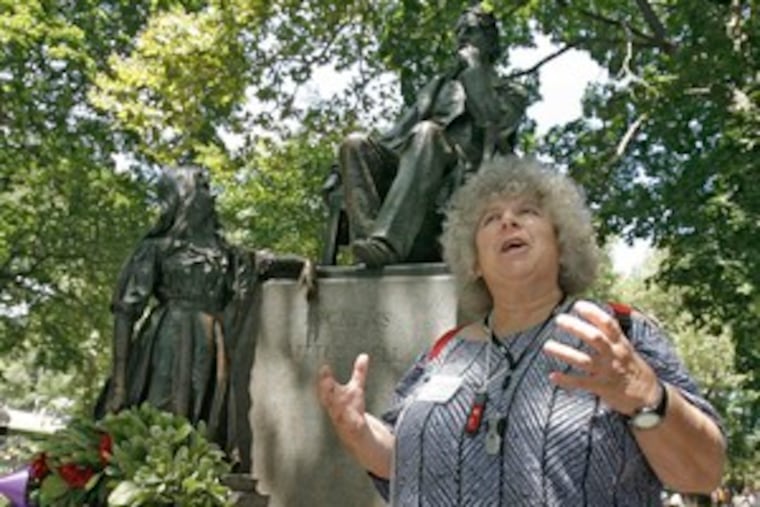
The 101st International Conference of the
» READ MORE: Dickens Fellowship
wraps up here in Philadelphia today, its work complete after the laying of a wreath at the statue of the author posed with his fictional creation, the pathetic Little Nell, in Clark Park.
The wreath-laying ceremony Saturday was a grand occasion ("It was the best of times, it was the worst of times," one might say, if one were to recall the opening lines from A Tale of Two Cities).
Patricia A. Vinci, president of the 100-year-old Philadelphia Branch of the Dickens Fellowship, stood before the assemblage of 141 members who traveled from Japan, Australia, New Zealand and even Boston.
"This," she proclaimed, "is the world's only statue of Charles Dickens."
Say wha? How can that be?
If Philadelphia is crawling with busts and statues of Benjamin Franklin, wouldn't London be littered with Dickens likenesses? Why aren't cheap replicas of Dickens ubiquitous in English gift shops as Liberty Bells are here?
"Wait'll you hear this," says Vinci, who lives in Warminster but has the semblance of a Philly native. She says Dickens, who died in 1870, stipulated in his will that no monument or statue be erected in his honor because he wanted his words, not his image, to live on.
It seems the contents of the will were not known to the Washington Post, which commissioned a statue of Dickens for the World's Columbian Exposition in Chicago in 1893 with the intention of presenting it to the author's surviving relatives after the show.
The Dickens kin (having read Bleak House and being fully familiar with the machinations of Jarndyce v. Jarndyce) firmly rejected the gift. The Fairmount Park Commission obtained it for Philadelphia, but how it landed in Clark Park is anybody's guess.
Of course, scholars don't guess.
But though one might infer otherwise from the name of their organization, members of this Fellowship are not Fellows of the academic ilk. They're more like fellas - folks who are just into Dickens. Dickensians, they like to be called.
"We're enthusiasts," says Vinci. "I don't pay any attention to that scholarly stuff. It's all academic gymnastics."
Indeed. Why quibble over what part of Oliver Twist was allegorical when one can discuss Dickens' Dark Side?
Did he or did he not have sexual relations with that woman, Ms. Ellen Ternan, the 18-year-old beauty he took up with after walking out on his wife and 10 children? Did the two have a child, a son, who died in infancy?
Such are the questions that interest Vinci, a plump sprite of a woman who embodies the best of Albert Einstein and Cinderella's fairy godmother.
Smart, but with a scatterbrained affect and an endearing lisp, Vinci is a devotee of astrology and the concept of the enduring myth as described by writer Joseph Campbell. She spent the better part of 37 years engrossed in Dickens lore, and in 2004 published Frank'ly Dickens (Xlibris press), her thesis that Charles Dickens and Frank Sinatra lived parallel lives.
"They were both superstars of their time!"
Her cup runneth over with tales of Dickens the newspaperman, social activist, and champion of the poor.
"And they're all true," she says. "True as taxes," is the way Dickens put it in David Copperfield.
According to Vinci, Dickens was a poor public speaker until Ternan, who was an actress professionally trained in the proper use of mouth and tongue, became his voice coach. Pre-Ternan, Dickens hesitated to read his work aloud, Vinci says. Post-Ternan, you couldn't shut him up.
And, she says, Dickens' A Christmas Carol influenced the way we celebrate that holiday.
"This is my destiny," Vinci says. "To make Dickens and his work even more celebrated."
She's proud of the Philadelphia Branch, which began in 1907 when local bookseller Charles Sessler placed a note in his shop window calling all interested parties to an organizational gathering.
Now ye shall know them by their scarlet geranium lapel pins (Dickens' favorite flower) and their graying hair (a few younger members are in their 50s; the oldest is 99).
They are a forgiving bunch, not at all offended to learn you've only seen the movie version of Great Expectations.
On their tour of local sites, the Fellowship paid homage to Grip, Dickens' pet raven now stuffed and on display at the Free Library of Philadelphia - and visited Eastern State Penitentiary, which the great man toured on his 1842 visit to Philadelphia and criticized.
Lectures on Dickens as a Legal Historian; Dickens' Philadelphia Connection, and Something of a Sexpot: Phiz' Images of Little Nell rounded out the conference program.
"Reading Dickens tells you nothing about the man," said Flemington, N.J., resident Joseph Rondinelli, who created a slide presentation on Dickens' trips to Philadelphia for the gathering.
And learning less than flattering factoids about Dickens should not diminish one's enjoyment of his novels, Rondinelli says.
British actress Miriam Margolyes, who played Professor Sprout in 2002's Harry Potter and the Chamber of Secrets, spoke at the wreath laying in Clark Park.
"Even if the man was an absolute brute," she said, "he was a dynamo and he is still an industry."
Do You Know Your Dickens?
1. Which of these rock groups took its name from a Dickens character?
a. Jethro Tull
b. Uriah Heep
c. Augie March
2. Which of these lines is not from a Dickens novel?
a. Butterflies are free.
b. The universe makes a rather indifferent parent.
c. Happy families are all alike; every unhappy family is unhappy in its own way.
3. Which of these fictional characters was not created by Dickens?
a. Scrooge
b. Bluebeard
c. Fagin
4. Which of these is the title of a Dickens novel?
a. Little Men
b. Little Dorrit
c. A Little Yellow Dog
5. Many of Dickens' novels were made into films or television movies. Pick the one film in this list that stems from the work of a different author:
a. Timeless
b. Clueless
c. The Stingiest Man in Town
Answers: 1. b, 2. c, 3. b,
4. b, 5. b
EndText
.