Former prodigy's new passage
Pianist Ruth Slenczynska, now 82, has a DVD out, and a following in Japan.
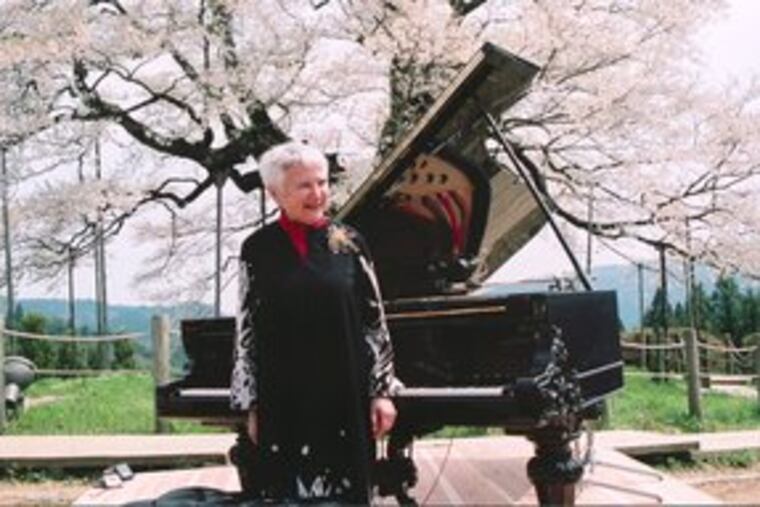
NEW YORK - Once again, pianist Ruth Slenczynska is having a bout with limelight - this time at age 82, as opposed to age 5, when she entered the Curtis Institute of Music the year before making her Berlin debut.
"A musician is always a musician. We pop up somehow or another," she said the other day in her West End Avenue apartment. What she doesn't acknowledge is the odds she has overcome in doing so: Slenczynska has achieved several reincarnations within a single lifetime.
Currently, she's on a new VAI-label DVD titled Tribute to Rachmaninoff, half of it a Camera Three CBS-TV program she made in 1963, the other half a series of recent interviews. In them, she reminisces about her years of study with "Mr. Rachmaninoff," as she calls him, as well as her time at Curtis, when a fellow student nicknamed "the pen pusher" was writing something titled Adagio for Strings. And that was Samuel Barber.
These days, she's often in Japan, where since 2003 she has developed a late-life cult concert following. Along with that comes hobnobbing with Empress Michiko, recording new CDs, and, as a symbol of lively seniorhood, being photographed beneath a 1,200-year-old cherry tree for ads in the Japanese version of TV Guide.
None of that was forseeable as recently as 2000, when she was devastated by the death of her husband of 34 years, or in the decades previous, when she planned to retire at 40, and before that, renounced performing after a child-prodigy period in which she studied with now-legendary artists but suffered some of the worst backstage abuse on record.
Now, she insists, she's only recording, and performing is truly behind her - even as she admits that "little things come up." While one recent CD is titled Last Chopin Recital, she's playing later this year at the Chopin Competition in Warsaw. And then there's the forthcoming concert at a Shinto shrine in Japan.
"It's a pretty place to visit," she says. "I don't expect that any critics will be there."
Nor does she count those concerts two years ago when she celebrated her 80th birthday by playing three concertos in one evening with Japan's NHK Symphony, repeating the program weeks later in Huntsville, Ala. Her rationalizations are as virtuosic as her pianism. NHK "was fun" and Huntsville is so far off the beaten path, "that's not a concert."
She laughs uproariously at her own folly.
But, she says, serious again, "It's hard on your body! It reveals itself in different ways. Some people have tics in their cheeks and eyes. I went to visit [pianist] Claudio Arrau once; he invited a whole bunch of us to show off his Hamburg Steinway. [Rudolf] Serkin was there. [Arthur] Rubinstein. All the people who lived in New York. And guess what the conversation was about? What kind of pills you have to take before a concert."
Stage anxiety never stopped her in the past. A small woman with small hands, she delivers high-octane pianism in expansive, romantic repertoire thanks to fingerings so strategic (plus a four-hour-a-day practice regimen) that even the recent onset of minor hand tremors doesn't get in the way.
"My doctors gave me pills, but I don't want to take pills," she says. "After I make my Brahms record [this fall], and if I like the way it sounds, maybe I'll take those pills."
The keyboard has long been both the source and the reflection of profound changes in her inner life. Though she hasn't had a piano coach since age 14, the years before that were packed with much wisdom from the likes of Josef Hofmann, Georges Enescu, Alfred Cortot, Artur Schnabel and, of course, Sergei Rachmaninoff.
"If I practice every single day, every 10 days or so, without fail, I'll get some kind of helpful insight," she says. "It just comes. And it comes because something has been stored inside of me."
What's amazing is that her storehouse seems to contain little of the bad stuff that came her way. From an early age, the Sacramento-born Slenczynska was made to practice nine hours a day. Her violinist father, Josef, a Polish emigré, was bent on her having a music career from day one; he beat her mercilessly for keyboard mistakes - and even for bad reviews, over which she had no control.
But few musicians had such great teachers. Spending most of her childhood on the East Coast and in Europe, she was at one point simultaneously studying with Cortot and Rachmaninoff in Paris, though neither knew she was working with the other, nor would they have been happy if they'd found out.
"The whole situation was comic," she wrote in her 1957 autobiography Forbidden Childhood (Doubleday & Co.). "Here was Father telling the world that he was my only teacher. Here was Mr. Cortot proudly calling himself my teacher. Here was Mr. Rachmaninoff denying that he was teaching me. My visits were social calls. . . ."
Though audiences were amazed that someone so small could play the big concertos of Liszt and Chopin (in Berlin, the press speculated that she was a midget), her father's orders to go to interpretive extremes destroyed her credibility with critics.
Back in California in 1940, her career seemingly ended, she enrolled at the University of California at Berkeley, where she eventually earned a degree in psychology. That sector of the real world felt pretty alien: "I was 16, felt 50 and looked like 12."
In 1944, she eloped with fellow student George Born, trailed by her father's parting shot: "You can't play two notes again without me."
"As far as he was concerned, I didn't exist," she recalled.
What she discovered, simply, was "I could exist."
By the late 1940s, she was happily ensconced as a piano teacher at the College of Our Lady of Mercy in Burlingame, Calif. When students didn't show up, she passed the time playing through her repertoire. The head of the Carmel Bach Festival overheard her one day and offered her a concert.
"I said that I used to give concerts but didn't think I could anymore," she says. "The Mother Superior said, 'You most certainly can! We'll all pray for you.' "
Her marriage to Born was crumbling, and once again she was touring the world and recording regularly. By the mid-1960s, she'd taken an artist-in-residence position at Southern Illinois University in homey Edwardsville, Ill.
In 1967, she married political science professor James Kerr and her career became a sideline. Still, she continued surfacing in recordings through the late 1990s, usually live recitals showing her in top form, her brilliantly clear sonorities focused with pinpoint accuracy and decisive, etched-in-stone phrasing.
"I loved having my own home," she says of her Illinois idyll. ". . . We had our own group of friends. I thought, 'I'm not going on any big tours anymore. We'll grow old gracefully together. This is the way to live.'
"Then my husband grew weaker and weaker. He had kidney disease. It was terrible. When he went altogether, it didn't even seem like 34 weeks, much less 34 years that we'd been married. . . . It became a different life. I smashed up my car - I'm a terrible driver. I couldn't live there anymore."
She moved to New York, where she'd always had an apartment, though she's now in one that's much roomier. The name on her apartment door, though, is "Kerr" and always will be. Inside her apartment, the decor - the beautiful vases and rugs - reflect visits to Japan. You'd expect memorabilia from her child prodigy years, but her father destroyed most of it. One photo he missed shows child Ruth at the piano during what was to be a brief time at the Curtis Institute, with the legendary Hofmann holding her wrist.
What days those were. Pianist Abbey Simon was the one student closest to her tender age, and he'd take her up to the practice studios where they'd listen outside the door to older classmates, such as Jorge Bolet and Shura Cherkassky. And where was the young Leonard Bernstein? She laughs: "He was after my time!"
After more than seven decades, how has her playing changed?
"I'm more contemplative, much more," she says. "It's been changing over a long period of time, but most recently, I spoke to the Empress Michiko, and she finally had the grandson she wanted so desperately. She's all full of hope and joy. . . .
"I've been playing a lot of Schumann . . . and I play "Traumerei" [a lullabye-like section of Scenes From Childhood] as if I'm holding that precious, wonderful baby in my arms. It changed me. You can hear the difference. So I'm not beyond evolving."
To hear Slenczynska's most recent recording of "Traumerei," and a Rachmaninoff excerpt, go to http://go.philly.com/slenczynska.EndText