Today's status symbol: Hefty bags with hefty prices
Tuesday Gordon is trying to explain the importance of the $2,000 handbag. She's serious. To be fair, the taupe Chlöe handbag is $1,825, but with tax that elevates it to $2,000.
Tuesday Gordon is trying to explain the importance of the $2,000 handbag.
She's serious.
To be fair, the taupe Chlöe handbag is $1,825, but with tax that elevates it to $2,000.
My first car was $2,000.
Remember the car analogy. It's critical. And comes up again and again.
Tuesday is a lethally skilled saleswoman, the manager of Joan Shepp in Center City and a regional style icon. She looks good in everything.
"There's a certain getting used to the idea of the $2,000 handbag," Tuesday says. "Women aren't happy about it. But they're getting used to it."
Yes, apparently they are. Days later, the Chlöe is gone. In a matter of months, the Walnut Street boutique sold 19 in the $2,000 ballpark - a swell ballpark, indeed.
The essential point to keep in mind is that many handbag customers are not rich. They're women who work, not women who lunch.
Such as Tuesday. She has a black, patent-leather, spring-collection Marni Sac, the size of a feed bag, that cost $1,600.
"I feel I can afford this," Tuesday says. "Because I don't have a car, I take this on SEPTA, and everything fits."
See? There's the car analogy.
Joan Shepp, Tuesday's boss, picks up some new handbags, nice totes in mustard and persimmon. They're not by a name designer. Joan fishes for the price tag: $545.
"Inexpensive," she says.
Laugh, but in her world she's right.
Coach has a python satchel for $998 and plenty of styles priced between $600 and $800. Coach has $250 wallets.
For many women, that's a winter coat.
"No matter what age or size you are, a handbag fits. It updates your outfit immediately," Tuesday says.
Unlike shoes, handbags come in one size, or perhaps two. That's good for designers and retailers. Unlike shoes, they don't hurt. Well, at least before handbags became the size of Buicks.
Small bags are no less costly. Knit Wit offers petite Mulberry Smithfield bags that won't carry more than a cell phone, lip gloss and credit card. They're $895 and selling beautifully.
So price isn't dependent on material. One have-to-have bag is a monogrammed piece by the venerable French house of Goyard, sold at Barneys and Bergdorf Goodman. The tote retails for $940.
It's made from cotton, linen and hemp. Barneys' motto is "Taste. Luxury. Humor," the last coming in handy when buying a $940 cotton tote.
In Deluxe: How Luxury Lost Its Luster, Dana Thomas writes that the profit margin for handbags is "between 10 and 12 times the cost to make the item. At Vuitton, it's as much as 13 times. Handbags are the engine that drives the luxury brands today."
Instead of revolting, women are buying more than ever, Thomas reports, purchasing four new handbags a year in 2004, twice as many as two years earlier.
"There is a kind of an obsession with bags," she's told by Miuccia Prada. "It's so easy to make money. The bag is the miracle of the company."
Luxury brands sold $11.7 billion worth of leather goods in 2004, with sales rising 7.5 percent annually between 2001 and 2004, as compared to 1.2 percent for the premier design market overall.
Women are spending money on the literal receptacle of money, a representation of status, rather than saving to increase their actual wealth. Arguably, the status handbag, accelerating in price at record rates and changing faster than clothing, is felling women's actual buying power rather than increasing it.
In the days of our grandmothers, the smaller the bag, the greater the owner's social status. Men carried the cigarettes, the keys, and paid for everything. Carrying a large sack was akin to being a pack mule. It was only with success, and work, that women became bogged down.
If cars are a form of status, handbags are perhaps even more so. We may all have the same T-shirts, but only women fluent in the language of clothes that update seasonally know that YSL, Prada and Miu Miu are strong this season, while Fendi and Dior are not so much, though this may change seconds from now.
Tuesday has customers who buy a $2,000 bag without flinching. It's like a drug. The handbag, in a sense, sets the whole outfit. She tells me about a woman who will choose two favorites, then make her selection based partly on which bag her tiny dog jumps into.
As it turns out, I know this woman. She's impossibly stylish and beautiful, but she's not rich at all. She works. She was born with little and earned every cent.
She went to Paris this year and bought the mother lode of all handbags, the Hermès Birkin, the model updated by Jean Paul Gaultier with shoulder straps. In general, the cachet with the Birkin, and its sister the Hermès Kelly, is that the bag doesn't change in appearance so it never dates. By purchasing one, women possess an item that will never go out of style and, perhaps because of this, costs more than almost any other handbag in the global market, as my friend discovered.
After converting the powerful Euro price-tag back to anemic dollars, she realized the Birkin had set her back $7,000. And, because there's such a paucity of Birkins - there's a black market for them in Russia - she settled for brown.
"So it will go with my more casual clothes, jeans and sweaters," she says.
Precisely when did a $7,000 handbag become casual?
Understandably, this woman decided against having her name in print. It's one thing to own a Birkin, another to confess its cost. She rationalizes the purchase this way. "I don't own a car," she says, as if we haven't heard this before. "So, I think of the handbag as my car."
Consider the bag. You can buy a $1 organic cotton tote at Whole Foods and it will hold your stuff. You can also buy a Miu Miu patent-leather, chevron-quilted satchel for $1,445 as Annette Malandra did. Both will perform the same task equally well.
Annette's Miu Miu, "my black bling," looks like a very shiny sleeping bag. Her affection for it is boundless. The manager of the Saks Fifth Avenue Club, the personal service for the Bala Cynwyd store's heavy hitters, Annette says "as soon as I saw it, I had to have it," and took it right off the mannequin.
"It's all about the handbag," she says.
She treats her handbags like royalty. "They've never touched the ground," she says. There's not a scratch on any of them. Her clothes come and go, but the handbags are forever, like an exquisite art collection: the Annette Malandra Museum of Exceptional Handbags.
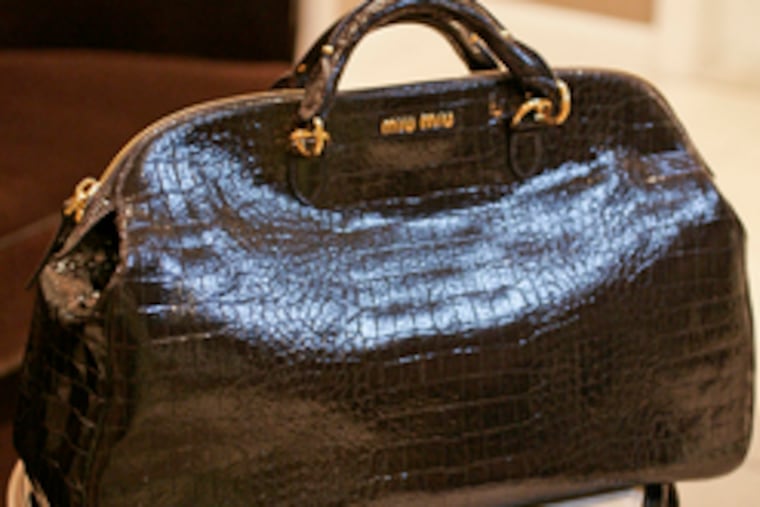
The handbag will soon have a new sister. Right now, Annette's eyeing a putty patent Valentino and a brown, croc-stamped Miu Miu. They're both $1,500.
"It's never over," she says.
And Annette is quite right. In today's obsession of luxury handbags, it never is.