Adam Dorn keeps on moving on
Adam Dorn is a son of jazz and R&B, literally and figuratively. Dorn, 37, is the son of Philadelphia's Joel Dorn, who produced records by Coltrane, Flack and Mingus and owns jazz labels, including Hyena, that hold catalog copyrights to songs from the likes of Rahsaan Roland Kirk.
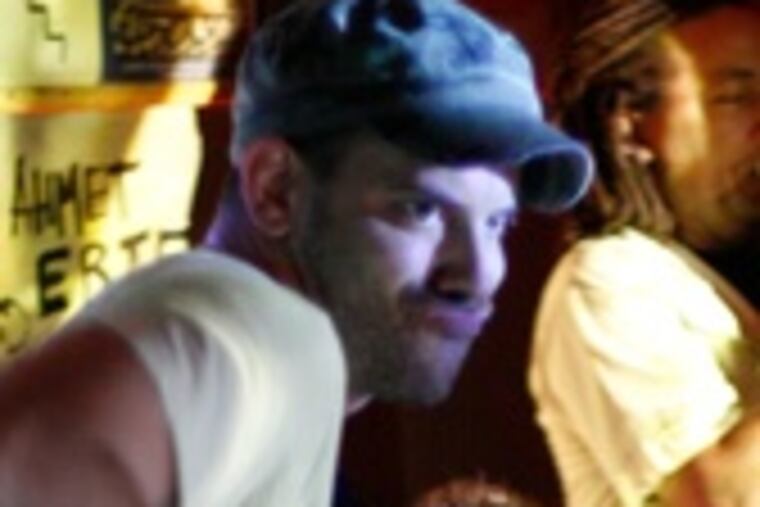
Adam Dorn is a son of jazz and R&B, literally and figuratively.
Dorn, 37, is the son of Philadelphia's Joel Dorn, who produced records by Coltrane, Flack and Mingus and owns jazz labels, including Hyena, that hold catalog copyrights to songs from the likes of Rahsaan Roland Kirk.
Under the name Mocean Worker, Adam Dorn also makes jazz - born of electronic music during its jungle and drum-n-bass heyday - that dances and swings.
He can't help it. It's in his blood.
From Home Movies From the Brain Forest (1998) and Mixed Emotional Features (1999) to Enter the Mowo! (2002), each of Mocean Worker's records has become less reliant on jungle grooves and sampled sounds.
Then came this year's Cinco de Mowo!
Though this self-released CD features nano-samples of funky jazz elders like flutist/saxophonist Kirk and keyboardist Les McCann, the groovy, jiving Cinco truly cooks when live players like trumpeters Herb Alpert ("Changes") and Steven Bernstein ("Shake Your Boogie") do their thing, only to have Mocean/Dorn deconstruct their contributions.
Dorn will perform Thursday night at 9 at the World Cafe Live.
In a phone call from Manhattan, where he's lived since leaving Lower Merion in 1986, Dorn talked about his music:
Question: You made your bones in DnB and jungle. How did you manage to stay clear of its fall while hanging on to its adventurousness?
Answer: I messed around with jungle, but on my first albums, half of the tunes are nowhere near that style of music. I've been headed in the direction I'm writing now since day one. The jazz and R&B has always been there, and the down tempo has always been the basis of my writing. I just started out doing the DnB thing as a launching point. That's where my head was at the time. I jumped ship and made a third album that had nothing to do with the genre. Folks didn't dig it. I made new fans, though, and it was a smart move. You can't do the same thing over and over. I can't imagine a career of writing everything at one tempo.
Q: Critics savaged your album Aural & Hearty, despite St. Bono singing on the record. What did that tell you about the biz
A: Lighten up! Critics didn't savage it. Critics didn't even write about it. [Laughs.] Everyone went silent on me, and it's taken two albums to get back to getting some press. I'm still here so you might as well write about me, as I have no plans on being anything but the annoying cheeky electronic-jazzy bastard that I've become. Can I get an amen?
Q: Did you really miss your Lower Merion senior prom because of Miles Davis?
A: Damn straight! I had already dropped out, but friends of mine were at the senior prom. I was at a mix session working on the album Amandla. I could've been having really awkward sex in the back of a Nissan Sentra. I made a different choice.
Q: I know when you sample, you do it mostly through the catalog that you and your father share in copyright ownership. But you sample less than ever on the new record.
A: We live in a vile, litigious country, and the fact of the matter is from a technical standpoint, I'm sampling. I know that. From a creative standpoint, I'm getting into such micro-level stuff with the sounds I'm using that I'm literally down to, like, single bass notes and single horn notes and single cymbals and creating absolutely different, 100 percent, about-face compositions from those sounds.
I do not get into source material. Truth be told, there is far more live playing on the albums than people realize as well.
Q: So, then, even though there's the sampled snap of Rahsaan Roland Kirk and others on the new CD, you have musicians playing and you're distressing them as one would distress leather?
A: Yeah, exactly. It's mostly guys playing and me treating their performances as samples and cutting and pasting. That's Herb Alpert playing live, too. He cut those parts just for this record. Snap is a good word. This is a snappy record. This record has "snap," fella! I've got to have the snap.
Q: The record and your show have a live dance jazz vibe. How many players does this take and what's your personal preference in doing the do?
A: I'm playing bass, controlling sounds via laptop, triggering things the band couldn't play live. Mostly, the laptop's turned off and we just go for it - six pieces featuring sax, trumpet, bass, drums, piano and percussion along with the computer. Musically? I dig it all. I don't prefer any one vibe because that would be boring. Do a little bit of everything. Try stuff out. It's more exciting that way.
Q: What was great and not great about those initial moments of being on the jungle scene?
A: The great thing was meeting real musicians and creative people who could have found success in any field. I loved hearing how guys like LTJ Bukem incorporated jazz into their groove.
Bad parts? I met the other guys who were caught up in drugs, drink and ridiculous behavior. I don't do it, and it's vile to be around. Drum n bass was fueled by cocaine, right? The average tempo of that stuff is 165 BPM. Being around someone on those drugs when you aren't is as much fun as going to a Shriners convention in Detroit in the dead of winter. The Shriners might be a lot more fun, come to think of it.
Q: Give me your fave Lower Merion High memory.
A: I went in with my father to talk to my guidance counselor about the possibility of me dropping out of high school for professional reasons. I got the single best reaction from a school official ever. He looked me dead in the eye and said: "I've never said this before: Leave school; you're going to be successful. Best of luck."
Listen to excerpts from "Cinco de Mowo!" at http://go.philly.com/mocean EndText