'La Bohème' goes Sick and the City
WASHINGTON - Opera forever struggles to be cool, and will as long as its stars struggle with their weight. But Washington National Opera's season-opening La Bohème, a new production that will be simulcast to educational institutions - including Temple University, Princeton University and Bryn Mawr College, mainly for students but the general public will also be admitted - at 2 p.m. Sunday, is such a fashion slave that it borders on apologizing for the art form. Still, under such outreach circumstances, is that a minus?
WASHINGTON - Opera forever struggles to be cool, and will as long as its stars struggle with their weight. But Washington National Opera's season-opening
La Bohème
, a new production that will be simulcast to educational institutions - including Temple University, Princeton University and Bryn Mawr College, mainly for students but the general public will also be admitted - at 2 p.m. Sunday, is such a fashion slave that it borders on apologizing for the art form. Still, under such outreach circumstances, is that a minus?
Luckily, solidity is found where it matters most: Orchestrally, Puccini's ever-fresh score is in spirited form under Emmanuel Villaume. And though the singers seem to have been cast as much for looks as voice, the singing is good enough, even notable in the case of Vittorio Grigolo, who studied the leading tenor role of Rodolfo with Luciano Pavarotti in the months before his death.
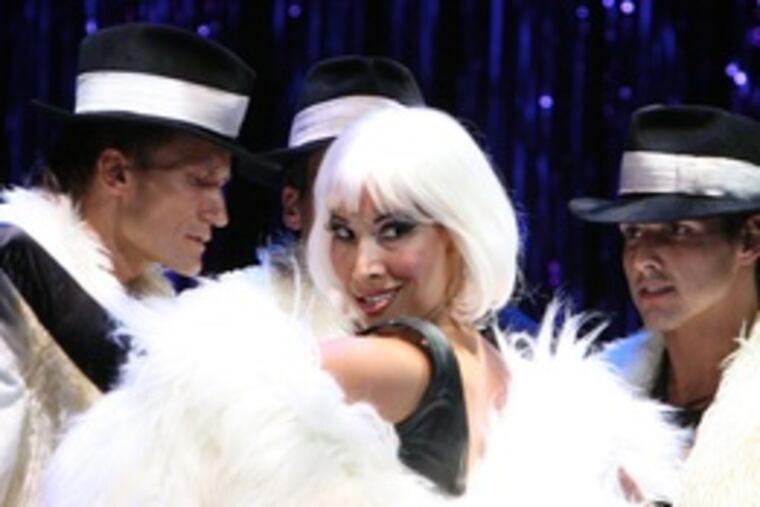
But as much as La Bohème has withstood and benefited from high-concept productions in the past, this one is potentially misleading. The liberties taken in Mariusz Trelinski's production, seen at the Saturday premiere at the Kennedy Center, go beyond the usual updating, though that element is definitely there. The setting is the Manhattan club scene, where tuberculosis (the central disease of La Bohème) is making a comeback. The production is steeped in sex - more than in most renderings of this story of young Parisian artists falling in and out of love while death hovers over its heroine, Mimi. The Act II Christmas Eve scene at Cafe Momus has no children clamoring for toys but partyers impersonating Elvis and Divine.
The problem is surtitles: They often modernize librettos for the sake of clarity; here, the meaning is skewed and rewritten. When a production goes this far to refit a classic, why not just write a new one (as did Jonathan Larson, brilliantly, with Rent)?
In Trelinski's defense, the liberties aren't superficial. This is a serious director whose past Washington productions had great interpretive originality, not to mention spare, geometric set designs, manifested in this Bohème by a huge rectangle of corrugated metal for the Act I artist's loft and, in Act III, the entrance to a nightclub.
Never one to take operatic emotions at face value, Trelinski treats romanticized plot elements as a front for hypocrisy. When Rodolfo burns his manuscript to ward off winter cold, he doesn't warm his hands over the fire. In Act IV when Colline sings about pawning his coat, he's wearing a Prada belt buckle. Everything is a pose. Only with Mimi's death do they experience anything real, and not refracted by a video camera. The problem: Shallow characters aren't very likable.
In Rodolfo's case, that's offset by Grigolo's charisma. From Pavarotti, he seems to have learned a firm, focused projection technique. He also looks like Orlando Bloom. How often does that combination happen? His Mimi, Adriana Damato, looks great but sounds diffuse. Korean baritone Hyung Yun is a promising Marcello. Though Nicole Cabell is enjoying a huge career push after winning the 2005 BBC Cardiff Singer of the World competition, her ultra-theatrical Musetta told you little about her voice.
As an operatic ambassador, this production has more conversion potential than a static video of corpulent singers. But this production is so uncharacteristic of American opera, it's a case of bait and switch. Operatic appreciation is fostered through opera. To love it is to accept its quirks - and chins. Too bad Baz Luhrmann's Broadway Bohème isn't still around. That was an ambassador.
For Information
The Washington National Opera production of La Bohème, at 2 p.m. Sunday at the Kennedy Center in Washington, will be simulcast in this area to Bryn Mawr College, Temple University and Princeton University. For information, go to www.dc-opera.org or call 1-800-876-7372.
EndText